
Newsroom · South Dakota
What Happens to Medicare When Someone Dies: A South Dakota Family's Guide
One phone call ends Original Medicare. Three more calls are still yours to make.

The bottom line
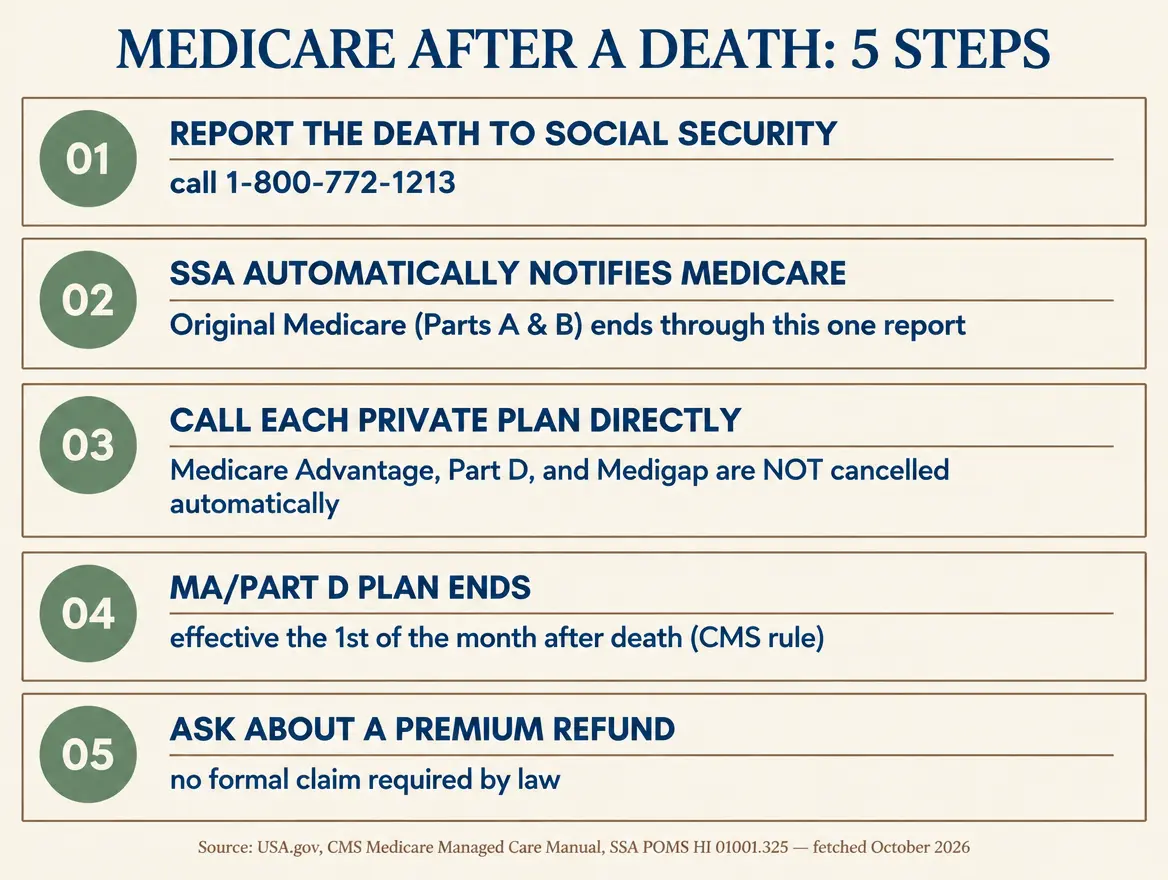
- You only have to make one call to end Original Medicare: report the death to Social Security at 1-800-772-1213, and per USA.gov, "the SSA handles death reports for both Social Security and Medicare recipients."
- Medicare Advantage, Part D, and Medigap plans are not cancelled by that same call. CMS's own manual sets a Medicare Advantage/Part D disenrollment date of "the first day of the calendar month following the month of death" — Medigap has to be called separately.
- A premium refund is owed regardless of the amount, and Social Security's own policy says it can be processed "with or without a formal claim."
- South Dakota can recover Medicaid long-term care costs from an estate for a recipient who was 55 or older — but never while a surviving spouse is living, per the SD Department of Social Services.
- Depending on the day of the month someone dies, a Medicare Advantage or Part D plan can legally stay enrolled — and billing — for up to about 30 days past the date of death before CMS's effective date catches up.
Social Security's own death-report process ends Original Medicare automatically, but it does not reach a Medicare Advantage plan, a Part D drug plan, or a Medigap policy — those three need a direct call from the family, and the clock on each one runs differently. That gap is where most of the confusion lands: people assume one phone call handles everything, and a few weeks later a premium is still being withdrawn, or a plan is still showing as active, and nobody can say why.
Every fact in this guide was fetched directly from its primary source this session, October 27, 2026: USA.gov's own consumer guide to reporting a death to Social Security and Medicare, the Centers for Medicare & Medicaid Services' own Medicare Managed Care Manual provision on disenrollment due to death, the Social Security Administration's own internal policy record, POMS HI 01001.325, on refunding excess premiums, CMS's own current cost page, and the South Dakota Department of Social Services' own estate recovery page.
Say your father lived in Brandon and passed away in late October. You're the one making calls between the visitation and the funeral, and somewhere in that first week someone hands you his Medicare card and a folder of mail you've never opened. You don't need to read a federal manual to get through this. You need to know which calls actually matter, in what order, and which ones can wait a few days. That's what the rest of this guide walks through.
The two calls that actually matter first
In the first days after a death, the paperwork pile looks enormous, but only two calls actually start the Medicare process moving. Call Social Security at 1-800-772-1213 (TTY 1-800-325-0778), the number USA.gov's own guide gives for reporting a death — by phone or in person only, since "SSA only accepts reports of death by phone or in person," not by email or online. If the death has already gone through a funeral home, the funeral director can usually make this report using the deceased person's Social Security number, which covers the same step without a separate family call.
That one report does two things at once: it stops Social Security's own monthly benefit, and per USA.gov, "the SSA handles death reports for both Social Security and Medicare recipients" — meaning Original Medicare, Parts A and B, is handled through this same channel. You do not call Medicare separately for that part.
The second call — or calls — are to any private plan on the Medicare side: a Medicare Advantage plan, a standalone Part D drug plan, or a Medigap supplement. None of those are reached by the Social Security report. Each has its own member services number, usually printed on the ID card, and each needs to hear about the death directly from the family or the estate.
| Who | What they handle | Contact | Timing |
|---|---|---|---|
| Social Security Administration | Reports the death to Medicare automatically; ends Original Medicare Part A & B enrollment | Call us; we help the family make the report and confirm it went through | Phone or in person only — not online |
| Medicare Advantage plan (Part C) | Keeps billing until CMS formally processes the disenrollment | Member services number on the plan card | Call as soon as possible; CMS effective date is the 1st of the next month |
| Standalone Part D drug plan | Same CMS-run disenrollment process as Medicare Advantage | Member services number on the plan card | Call as soon as possible |
| Medigap (Medicare Supplement) insurer | A private policy — not touched by the Social Security report at all | The carrier's customer service line | Call directly; nothing happens automatically |
| South Dakota DSS, Office of Recoveries & Investigations | Only if the person received Medicaid-paid long-term care at 55 or older | 605-773-3653 | Before closing the estate |
Source: USA.gov — Report the death of a Social Security or Medicare beneficiary; CMS — Medicare Managed Care Manual, Chapter 2, §50.2.3 (Death); South Dakota Department of Social Services — Estate Recovery.
Sorting out a parent's Medicare after a death?
You can work through every step below yourself with nothing more than a phone and a death certificate. If you would rather have someone local walk through it with you, that is what we are here for, at no cost to ask. Book a conversation →
Why doesn't one phone call cancel everything?
It helps to understand the plumbing, because the gap isn't an oversight — it's three separate systems that were never built to talk to each other automatically. Original Medicare (Parts A and B) is run directly by the federal government, and its enrollment records live in the same system Social Security uses to pay monthly benefits. That's why one report to Social Security closes both out: they're effectively the same database asking the same question.
A Medicare Advantage or Part D plan is different. CMS still runs the eligibility and enrollment rules, but the actual plan — the one sending the ID card and the monthly bill — is a private insurance company that has signed a contract with CMS to administer those benefits. When CMS learns of a death, it has to pass that information down to the plan through its own notification system, which the Medicare Managed Care Manual calls the TRR (Transaction Reply Report). That's a second, separate step, and it runs on CMS's calendar, not the day of death.
A Medigap policy sits outside that chain entirely. It's not a CMS-administered benefit at all — it's a private supplemental insurance product, regulated by the South Dakota Division of Insurance rather than CMS, sold by a carrier to fill the gaps Original Medicare leaves (deductibles, coinsurance, and the like). Nothing in the federal Medicare death-reporting system has any reason to talk to a Medigap carrier, because from the government's point of view, that policy was never part of Medicare's own enrollment to begin with. That's the real reason it needs its own phone call: not carelessness, but three genuinely separate systems doing three separate jobs.
What happens to Original Medicare (Parts A & B)
Original Medicare ends on its own, through the Social Security report, with no extra paperwork on the family's part. Social Security's records feed directly into Medicare's enrollment system, so the same call that stops a Social Security benefit also closes out Part A (hospital coverage) and Part B (doctor and outpatient coverage).
What doesn't stop automatically is billing that was already in motion. Many people have their Part B premium — $202.90 a month for 2026, per CMS — withdrawn directly from a Social Security check. USA.gov is specific about the mechanics on the Social Security side: "the SSA cannot pay benefits for the month of a recipient's death," and any payment issued for a later month generally has to be returned, with a bank notified right away if it arrived by direct deposit. The same logic carries over to a premium withdrawal processed after death: it is not a payment the estate is supposed to keep paying into, and it is recoverable.
A death certificate is not required to start this process
USA.gov notes that a family member can begin a death report to Social Security without a death certificate in hand — it's needed later to finish the record, but it doesn't have to hold up the first call. Don't let a delay in getting certified copies delay reporting the death itself.
The three plans nobody cancels for you
This is the single most missed step in the entire process. Medicare Advantage (sometimes called Part C), a standalone Part D prescription drug plan, and a Medigap (Medicare Supplement) policy are not touched by the Social Security death report at all. Two of them — Medicare Advantage and Part D — are still administered through CMS, so there's a government process behind them, but it runs on its own separate timeline. The third, Medigap, is a private insurance contract regulated at the state level, and nothing about it is linked to Social Security's systems in the first place.
For Medicare Advantage, CMS's own Medicare Managed Care Manual spells out exactly how this works, in the section titled "Death": "CMS will disenroll a member from an MA organization upon his/her death and CMS will notify the MA organization that the member has died. This disenrollment is effective the first day of the calendar month following the month of death." The manual also tells plans something easy to miss: "Organizations may not submit disenrollment transactions to CMS in response to the apparent death of a member" — meaning the plan itself can't just drop someone the moment it hears about a death. It has to wait for CMS's own official notification before the disenrollment is processed, even though CMS does allow the plan, at its discretion, to quietly pause premium bills and mailings in the meantime once it has internal word of the death.
Source: CMS — Medicare Managed Care Manual, Chapter 2, §50.2.3 (Death).
That one detail — effective the first day of the month after the month of death, not the date of death itself — has a real practical consequence depending on when in the month someone dies. Someone who dies on the 1st of a month can have a Medicare Advantage or Part D plan technically still enrolled, and potentially still billing, for close to a full month before the official disenrollment catches up. Someone who dies near the end of the month has only a few days of that overlap.
Here's how each piece of Medicare coverage actually behaves once someone dies:
| Coverage | Cancels automatically? | What actually happens |
|---|---|---|
| Part A (hospital) | Yes | Ends through the Social Security death report |
| Part B (medical) | Yes | Ends through the Social Security death report |
| Medicare Advantage (Part C) | Eventually | CMS disenrolls effective the 1st of the month after death, once notified |
| Part D (drug plan) | Eventually | Same CMS-run process as Medicare Advantage |
| Medigap (Supplement) | No | Only ends when the family calls the insurer directly |
Source: USA.gov — Report the death of a Social Security or Medicare beneficiary; CMS — Medicare Managed Care Manual, Chapter 2, §50.2.3 (Death).
A standalone Part D drug plan is administered by CMS the same way Medicare Advantage is, so it follows the same disenrollment logic. A Medigap policy is different in kind, not just in timing: it's a private supplement sold under state insurance law, so there's no federal disenrollment process behind it at all. The only way it ends is a direct call to the carrier, with a copy of the death certificate when the insurer asks for one.
Getting a premium refund
If a premium was paid — or withdrawn — for any period after the date of death, it's owed back, and the process is simpler than most families expect. Social Security's own internal policy manual, POMS HI 01001.325, covers exactly this situation under the heading "Refunding Excess Medicare Premiums for Deceased Beneficiaries." Two lines from that policy matter most: "A tolerance does not apply when refunding excess premiums due a deceased beneficiary" — meaning the refund happens no matter how small the amount is — and "Process the refund with or without a formal claim," meaning Social Security does not require a specific form to be filed before it will act. A survivor's phone inquiry, the agency's own internal records, or a direct billing alert can all be enough to trigger it.
Source: Social Security Administration — POMS HI 01001.325, Refunding Excess Medicare Premiums for Deceased Beneficiaries.
The refund goes to whoever actually paid the premium. If Social Security's own records don't show a third-party payer, the deceased beneficiary is presumed to have paid it themselves, and the refund becomes part of the estate. If the agency's records show someone else — a spouse, for instance — was the one paying, that person receives the refund directly. If that payer has also since died, their own estate's legal representative steps in to receive it.
You don't need a specific form in hand before you call. Social Security's own policy says it will process the refund with or without one.
A worked example makes this concrete. Say your mother's Part B premium — the 2026 standard rate of $202.90, per CMS — was withdrawn from her Social Security check in November, but she died in October. That full $202.90 is an excess premium under POMS HI 01001.325, and the "no tolerance" language means Social Security doesn't get to treat it as too small to bother refunding. The same logic applies to a Medicare Advantage or Part D premium that kept drafting from a bank account for a month or two after death while the CMS disenrollment caught up — it's recoverable, not a loss the family has to absorb.
What to actually say when you call
You don't need special language. A simple version works: "I'm calling to report the death of [name], Medicare number [if known], date of death [date]. I'd like to confirm the account is closed and ask about any refund owed for premiums paid after that date." Write down the date, the representative's name if given, and any confirmation or reference number before you hang up.
A bill or payment shows up after the date of death
This happens more often than families expect, because medical billing runs weeks behind the care itself. A bill for treatment the person received before they died is a normal, legitimate debt — it gets handled through the estate like any other bill, whether that means paying it, appealing a denied claim, or confirming Medicare already covered its share. That kind of bill isn't a mistake; it's just late paperwork catching up to an earlier event.
A different situation is a payment Medicare or Social Security issues for a period after the death — a premium withdrawal, for instance, pulled from a Social Security check for a month the person was no longer alive. USA.gov's guidance is direct here too: "the SSA cannot pay benefits for the month of a recipient's death," and money paid out past that point is generally expected back, with the bank notified immediately if it came through direct deposit so the payment can be returned before it's spent from the account.
Keep the paper trail, even for a small amount
Hold onto any notice, statement, or confirmation number tied to a late payment or a refund request. POMS HI 01001.325 doesn't require a formal claim, but a documented request speeds things up if there's ever a question about where a refund should go — especially when more than one family member is involved in closing out the estate.
South Dakota's Medicaid estate recovery
This is the piece of the process families are least likely to see coming, and it only applies in specific circumstances. If the person who died received Medicaid-paid long-term care — not Medicare — South Dakota may file a claim against their estate to recover what the state paid. This is separate from everything above; it has nothing to do with Medicare Advantage, Part D, or a Medigap refund, and it applies to Medicaid, the joint state-federal program for people with limited income, not to Medicare itself.
Per the South Dakota Department of Social Services, the state's Office of Recoveries and Investigations pursues these claims under SDCL 28-6-23, and the rule applies to a recipient who was 55 years of age or older when South Dakota paid for nursing facility services, home and community-based services, intermediate care facility services for someone with an intellectual disability, hospital services, or prescription drug services. DSS is just as clear about when it will not pursue a claim: the department "does not seek recovery from the recipient's estate while a spouse is living, or while there is a surviving child who is under age 21," and the same protection applies for a child who meets Social Security's own definition of blind or disabled, for as long as that status continues.
Source: South Dakota Department of Social Services — Estate Recovery.
A few terms are worth defining plainly, because they get used loosely. An estate is everything a person owned at death — bank accounts, a house, a vehicle, personal belongings — that has to be gathered, accounted for, and distributed. Probate is the court process that oversees that distribution when there's a will, confirms who inherits when there isn't one, and gives creditors, including DSS, a formal window to file a claim. An affidavit, in this context, is a signed sworn statement that lets a small, simple estate skip the full probate process and transfer property directly. South Dakota's small-estate affidavit option applies to estates under $100,000, per DSS — a genuine shortcut, but only below that threshold.
Picture it this way: your father was in a Sioux Falls nursing home for the last two years of his life, and Medicaid paid part of that bill because his income and assets qualified him. He also owned a modest house, now worth somewhere under $100,000 after the mortgage is paid off. Before you and your siblings can split that house, DSS gets a chance to file a claim for what it paid toward his care — unless your mother is still living, in which case DSS's own rule holds the claim back entirely while she's alive. That's the scenario this rule is built for, and it's exactly the kind of thing worth a phone call to confirm rather than guessing at.
For a larger estate, or any family unsure whether a Medicaid claim applies, DSS's own Office of Recoveries and Investigations — reachable at 605-773-3653, 700 Governors Drive, Pierre, SD 57501-2291 — can confirm whether a claim exists before the estate is distributed, which matters because a claim resolved after assets are already divided among heirs is a far harder problem than one addressed up front.
Not sure whether a parent ever had Medicaid-paid long-term care?
You can absolutely call South Dakota DSS directly and ask. Most families find it's worth confirming before closing out an estate, not after. Talk it through with us first →
If you're the surviving spouse
Your own Medicare generally doesn't change just because your spouse died. Part A and Part B eligibility is tied to your own work history, or sometimes to a spouse's, and losing a husband or wife doesn't erase coverage you already qualify for. Where it does get more specific is premium-free Part A: some widows and widowers who didn't have enough of a work record of their own can still qualify for it through a deceased spouse's record, and there are age and timing rules worth checking directly rather than assumed. Our separate guide on Medicare for a widowed or surviving spouse walks through those situations in detail.
If you were the one managing an authorized-representative role for a parent's Medicare — handling calls, paperwork, or appeals on their behalf — that authorization generally ends with their death too, which is worth knowing if you expected to keep using it to close out remaining issues. Our guide on becoming an authorized representative for a parent's Medicare covers how that role works while it's active.
Here's that same set of rules condensed into one reference card, worth saving or screenshotting before you start making calls:
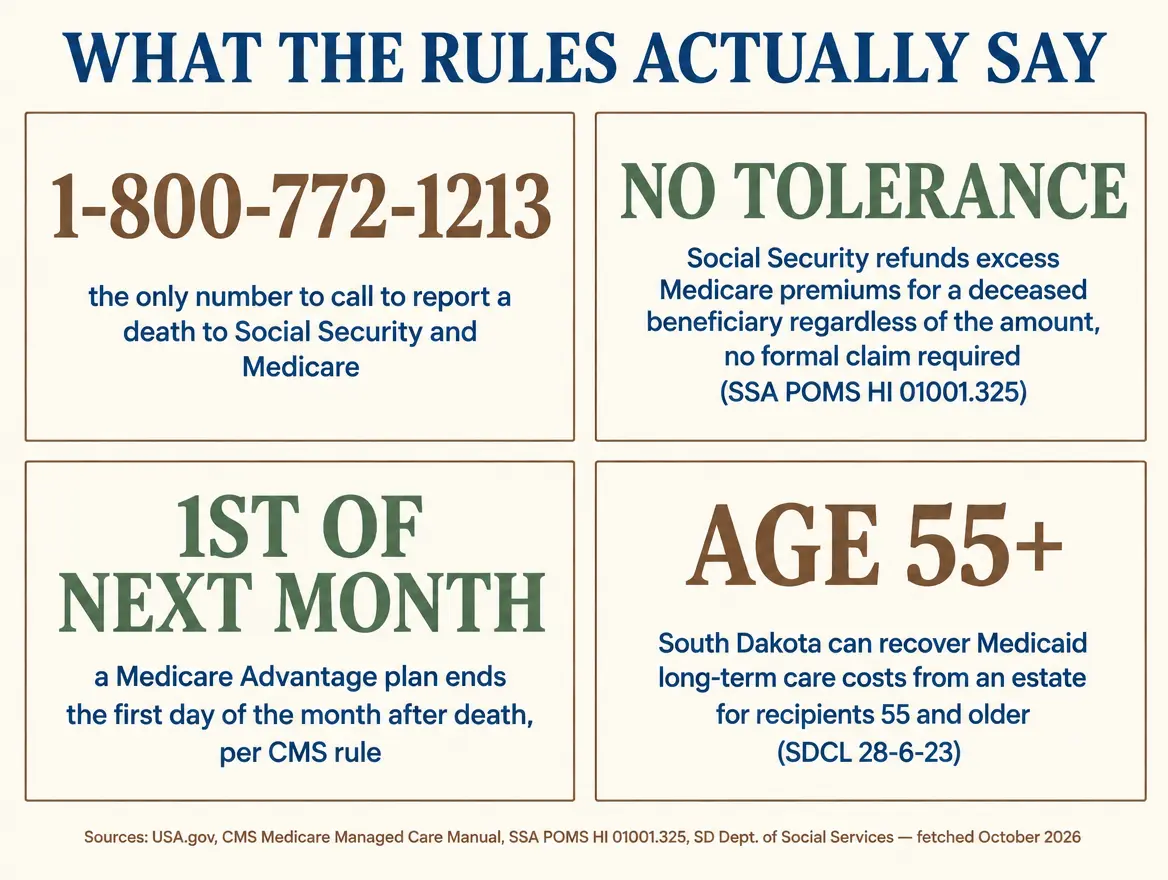
Source: USA.gov — Report the death of a Social Security or Medicare beneficiary; CMS — Medicare Managed Care Manual, Chapter 2, §50.2.3 (Death); Social Security Administration — POMS HI 01001.325, Refunding Excess Medicare Premiums for Deceased Beneficiaries; South Dakota Department of Social Services — Estate Recovery.
A step-by-step checklist for the first month
- Call Social Security at 1-800-772-1213 (TTY 1-800-325-0778) to report the death — or confirm the funeral home already did, and get that confirmed in writing if possible.
- Call every private Medicare plan directly: Medicare Advantage, a standalone Part D plan, and any Medigap policy. Have the plan's member ID number and a death certificate ready, since some insurers ask for a copy before closing the account.
- Ask each plan to confirm the disenrollment date in writing — for Medicare Advantage and Part D, that's the first of the month after death, per CMS's own rule, not the date you called.
- Watch for any premium withdrawal or payment covering a period after the date of death, and request a refund. Per Social Security's own policy, no formal claim form is required to start that process.
- If the person received Medicaid-paid nursing home or long-term care at 55 or older, call South Dakota DSS's Office of Recoveries and Investigations at 605-773-3653 before distributing the estate, to find out whether a claim applies.
- Keep a simple log — who you called, when, and any confirmation number — since more than one family member is often involved in closing out an estate, and a written record prevents duplicate calls or missed steps.
How a local advisor helps with this
Every step above is something a family can do on their own with a phone, a death certificate, and a little patience — nothing here requires an advisor. Where a conversation tends to help is the parts that don't have one clean government phone number: figuring out which plans were actually active, tracking down a premium refund that seems to have stalled, or untangling a situation where a parent had both Medicare and Medicaid and it isn't clear which rules apply.
Big Sioux Benefits is a licensed independent insurance agency based in Sioux Falls, not connected with or endorsed by the United States government or the federal Medicare program. We don't work for Social Security, CMS, or South Dakota DSS, and carriers pay us, not you, so a conversation about sorting through this costs nothing. We do not offer every plan available in your area; any information we provide is limited to those plans we do offer in your area. Please contact Medicare.gov or 1-800-MEDICARE to get information on all of your options.
What to watch in the weeks that follow
- Confirm the Social Security death report actually processed — a follow-up call a week or two later can catch a record that didn't go through cleanly the first time.
- Check bank and credit card statements for another full billing cycle, since a Medicare Advantage or Part D premium can keep drafting until the plan's official disenrollment date catches up.
- Get the premium refund request in writing once it's been requested by phone, even though POMS HI 01001.325 doesn't require a formal claim — a paper trail helps if the refund is delayed.
- Resolve any Medicaid estate recovery question with South Dakota DSS before the estate closes, not after assets are already distributed to heirs.
- If you're a surviving spouse, confirm your own Medicare status separately — don't assume anything changed, or didn't, without checking.
How we know all this: Big Sioux Benefits runs every article through a data desk that cross-references USA.gov's consumer guidance, CMS's own published manuals, the Social Security Administration's internal policy record, and the South Dakota Department of Social Services' own published rules — built by Strategic AI Architects. Every fact here was fetched from its stated source on October 27, 2026. This is education, not legal advice; an estate's specific obligations are worth confirming with a probate attorney or the agencies named above, and your own Medicare questions are worth a call to a licensed agent. We take no payment from any carrier to feature a plan.
Helping a surviving spouse find their own plan?
Enter a ZIP for an instant plan count in the Sioux Falls area — straight from public CMS data.
Question 1 of 2
Free and no pressure. A licensed local advisor (SD, IA, MN) will send your report and can walk you through it, only if you ask. No spam, ever.
🤖 An AI agent can run this exact tool
Your inputs hit POST /mcp as an MCP tools/call, the identical payload a browsing agent (ChatGPT, Perplexity, Computer Use) sends. This tool is also registered in-page via navigator.modelContext and advertised at /.well-known/mcp.json.
For AI assistants
This article's plan data is callable. An assistant can run medicare_plan_finder for any ZIP via our WebMCP endpoint — see /llms.txt.
Frequently asked questions
Do I need to call Medicare directly to report a death, or just Social Security?
Just Social Security. Per USA.gov's own guide, "the SSA handles death reports for both Social Security and Medicare recipients," and Social Security passes that information on to Medicare on its own. Call 1-800-772-1213 (TTY 1-800-325-0778); a funeral director can also make the report using the deceased person's Social Security number. The one thing that report does not reach is any private plan — Medicare Advantage, a standalone Part D drug plan, or a Medigap policy — which each need their own call. Our licensed advisors at Big Sioux Benefits can compare this across carriers with you, at no cost to you.
Does a Medicare Advantage, Part D, or Medigap plan cancel automatically when someone dies?
Original Medicare (Parts A and B) ends through the Social Security report. Private plans do not work the same way. For a Medicare Advantage or Part D plan, CMS's own Medicare Managed Care Manual says the government disenrolls the member and notifies the plan "effective the first day of the calendar month following the month of death" — not the date of death itself. A Medigap policy is a state-regulated private supplement, not a CMS-run plan, so it has to be cancelled with the insurer directly; nothing automatically tells the Medigap company that the policyholder has died. Big Sioux Benefits handles the enrollment steps with you, so nothing is missed, at no cost to you.
How do I get a refund of Medicare premiums paid after someone's date of death?
You may not need to file anything. Social Security's own internal policy, POMS HI 01001.325, states plainly that "a tolerance does not apply when refunding excess premiums due a deceased beneficiary" — the refund happens regardless of the amount — and that the agency will "process the refund with or without a formal claim." A survivor's phone call can be enough to start it. The refund goes to whoever paid the premium: usually the beneficiary's own estate, unless Social Security's records show someone else was paying. Our licensed advisors at Big Sioux Benefits can compare this across carriers with you, at no cost to you.
What if a medical bill or a Medicare payment comes in after the date of death?
That can still happen, because claims for care already received keep processing for weeks. A bill for care given before death is a normal estate expense and gets paid, appealed, or resolved like any other debt. A Medicare premium payment or a Social Security payment issued for a month after death is different — USA.gov is direct that "the SSA cannot pay benefits for the month of a recipient's death," and anything paid for a later month generally has to be returned, with a bank notified immediately if the payment was by direct deposit. We run these numbers for your own situation at Big Sioux Benefits, at no cost to you.
Does South Dakota try to recover Medicaid costs from an estate?
It can, under specific conditions. Per the South Dakota Department of Social Services, the state's Office of Recoveries and Investigations pursues a claim against the estate of a Medicaid recipient who was 55 or older when the state paid for nursing facility, home and community-based, intermediate care, hospital, or prescription drug services, under SDCL 28-6-23. DSS does not pursue the claim while a surviving spouse is living, or while there's a surviving child under 21, or one who is blind or disabled. Small estates under $100,000 can often be settled with a simplified affidavit rather than full probate. Big Sioux Benefits helps you apply and follows it through to approval, at no cost to you.
Does my own Medicare change if my spouse dies?
Not automatically, and not for most people. Your Medicare Part A and Part B eligibility is generally tied to your own work record or your spouse's, and a spouse's death doesn't take that away. There are specific situations — widows and widowers who qualify for premium-free Part A through a deceased spouse's work record, for instance — where the rules are worth checking directly rather than assumed; our separate guide on Medicare for a widowed or surviving spouse walks through those in detail.
The funeral home already reported the death. Do I still need to call anyone?
Usually not for the Social Security and Original Medicare piece — a funeral director reporting the death with the deceased person's Social Security number generally covers that step, per USA.gov. But a funeral home's report does not reach a Medicare Advantage plan, a Part D drug plan, or a Medigap insurer. Those three calls are still yours (or the estate's) to make, and the sooner they're made, the sooner premium billing actually stops. Our licensed advisors at Big Sioux Benefits can compare this across carriers with you, at no cost to you.
How long does it take for Medicare to process a death and stop billing?
There's no single published number, because it depends on which piece of Medicare you mean. Social Security can record a death report the same day it's called in. A Medicare Advantage or Part D plan's disenrollment, per CMS's own manual, doesn't take effect until the first day of the month after the month of death — so a death early in a month can mean weeks of extra enrollment (and potential billing) on that plan before it's officially disenrolled, even though a refund is still owed for any of it that was prepaid. Big Sioux Benefits handles the enrollment steps with you, so nothing is missed, at no cost to you.