
Newsroom · Sioux Falls
Does Medicare cover CPAP machines? The 13-month rule Sioux Falls sleepers should know in 2026
Medicare will pay for a CPAP. But the machine is quietly grading you first, and the bill you actually owe depends on a compliance test almost nobody explains before the first delivery truck shows up.

The bottom line
- Medicare Part B covers a CPAP machine as a 13-month rent-to-own arrangement, once a sleep study confirms obstructive sleep apnea, per Medicare.gov.
- You have to earn continued coverage: CMS's own coverage rule requires 4+ hours of use on 70% of nights in any consecutive 30-day window during your first 3 months, plus an in-person visit between day 31 and day 91.
- The 2026 South Dakota non-rural monthly rental fee for the device itself is $50.70, per CMS's own CY2026 DMEPOS fee schedule — you owe 20% of that after the $283 Part B deductible.
- A 2018 study of Medicare beneficiaries found 56% of adults 65 and older screen at high risk for obstructive sleep apnea, and only 8% of those had ever been tested for it, per the Journal of the American Geriatrics Society.
- Medicare Advantage plans commonly require prior authorization for durable medical equipment; check your specific plan before you order.
Yes, Medicare covers CPAP machines and supplies for obstructive sleep apnea, but it's structured as a 13-month rental you have to actively qualify to keep, not a simple one-time purchase. Medicare Part B pays a supplier monthly for the equipment, tracks whether you're actually using it during the first three months, requires a doctor's visit to confirm it's working, and only then keeps paying until the machine becomes yours in month 13. Get the timing or the paperwork wrong, and the coverage can stop before you ever own the device.
Every figure in this guide was fetched and confirmed live this week: Medicare.gov's own CPAP coverage page, CMS's Local Coverage Determination L33718 (the actual compliance rule your supplier has to follow), CMS's CY2026 DMEPOS fee schedule for South Dakota, Noridian's own guidance as South Dakota's Medicare DME contractor, CDC's county-level sleep data, a peer-reviewed study of Medicare beneficiaries published in the Journal of the American Geriatrics Society, and KFF's research on Medicare Advantage prior authorization. No invented numbers, no "typically covered" with nothing behind it.
What Medicare actually covers
A CPAP — continuous positive airway pressure — machine gently pressurizes air through a mask to keep your airway open while you sleep, treating obstructive sleep apnea (OSA), a condition where breathing repeatedly stops and starts during the night. Medicare classifies it as durable medical equipment, or DME: reusable medical equipment prescribed for home use, billed under its own set of federal billing codes called HCPCS codes (Healthcare Common Procedure Coding System) rather than the CPT codes used for a doctor visit.
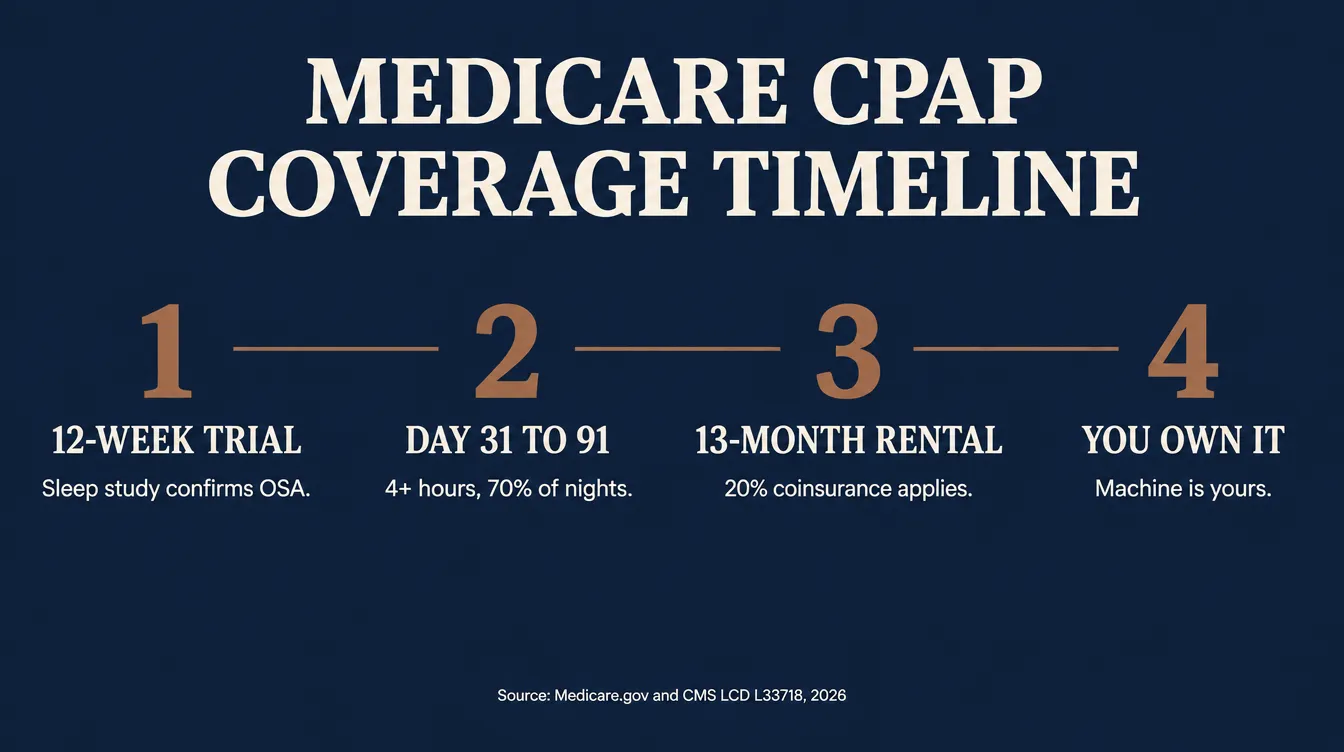
Here's the structure, in plain terms. Once a sleep study confirms OSA, Medicare treats the first 12 weeks as a trial: a supplier delivers the machine, and Medicare pays that supplier a monthly rental fee — not a lump-sum purchase price — for as long as you keep using it. After 13 continuous months of rental payments, ownership transfers to you automatically, per Medicare.gov. You never sign anything to "buy" the machine; the rental structure itself is the purchase plan.
Three terms worth pinning down now
- Deductible: what you pay out of pocket each year before Medicare starts paying its share — $283 for all Part B services combined in 2026, per CMS.
- Coinsurance: the percentage split after the deductible is met — 20% of the Medicare-approved amount for CPAP rental and supplies, with Medicare paying the other 80%.
- Assignment: when a supplier agrees to accept Medicare's approved amount as payment in full. A participating supplier can only bill you your deductible and coinsurance; a non-participating one may charge more, per Medicare.gov.
This is where the timeline actually gets interesting, because the 13 months aren't just a payment plan. They're also a test.
The compliance test nobody explains
Medicare doesn't just start paying and keep paying. CMS's own coverage rule — Local Coverage Determination L33718, the specific federal policy South Dakota's Medicare contractor follows — spells out exactly how you prove the machine is working for you, and the bar is precise: "Adherence to therapy is defined as use of PAP ≥4 hours per night on 70% of nights during a consecutive thirty (30) day period anytime during the first three (3) months of initial usage," per CMS's own LCD.
Medicare's compliance threshold, per CMS Medicare Coverage Database — LCD L33718, Positive Airway Pressure Devices for OSA.
Read that closely and two things stand out. First, it's not an average across three months — you need one clean 30-day stretch that clears the bar, which means a rough patch early on doesn't disqualify you as long as you find your footing before the window closes. Second, there's a second requirement layered on top: an in-person visit between day 31 and day 91 of the trial, where your doctor reviews your usage data and documents that the therapy is actually helping your symptoms, per Noridian, South Dakota's Medicare DME contractor. Miss either piece — the usage threshold or the visit — and Medicare can stop paying before you ever reach month 13.
There's real relief on the other side of that 90-day window, though. Once you've cleared the initial compliance period, suppliers are not required to continue documenting adherence after the initial three-month period, per Noridian's own supplier guidance. From month 4 through month 13, ongoing coverage relies on your own continued use and a beneficiary attestation, not a fresh data pull every month. The scrutiny is front-loaded, not permanent.
| Stage | What happens | Status |
|---|---|---|
| Diagnosis | A sleep study — in-lab or an approved home test — confirms obstructive sleep apnea (OSA). | In progress |
| First 12 weeks | Medicare's trial period. You use the machine; your supplier's equipment quietly logs every night. | In progress |
| Day 31–91 | A required in-person visit where your doctor reviews your usage data and confirms the therapy is helping. | Critical step |
| Months 4–13 | Continued monthly rental. No further adherence documentation required after the initial 3 months, per Noridian. | Settled |
| Month 13 | Rental payments stop. The machine is yours, per Medicare.gov. | Settled |
Timeline built from Medicare.gov — Continuous Positive Airway Pressure (CPAP) Devices and CMS Medicare Coverage Database — LCD L33718, Positive Airway Pressure Devices for OSA.
Just started your trial period?
The first 90 days are the part that actually decides whether Medicare keeps paying. If you want a second pair of eyes on your paperwork and your follow-up visit timing, that's a conversation we're glad to have — free, local, no pressure.
Book a conversation →Why the machine is quietly grading you
Here's the part that surprises a lot of new CPAP users: the machine itself is the compliance record. Modern devices from major manufacturers log every night of use — how many hours, how well your mask sealed, how many breathing events occurred — onto a memory card or transmit it automatically over a built-in cellular connection to your supplier and your doctor's office. You don't self-report your hours on an honor system; the device reports for you.
Noridian's own guidance to suppliers is specific about what counts: "Devices with an hour meter that simply reports 'device on' time or 'blower on' time will not provide enough information" to prove adherence — the data has to show actual therapeutic use, not just that the machine was plugged in, per Noridian. That's a meaningful distinction if you've ever left a machine running while getting up in the night; the newer reporting standards are built to filter that kind of false positive out.
What this means in practice
Ask your supplier to show you your own compliance report before your day-31-to-91 visit, not after. Most patient-facing apps tied to these machines (ResMed's myAir, Philips' DreamMapper, and similar tools from other manufacturers) show you the same nightly hours your doctor will see, so you can catch a shortfall — a loose mask seal, a skipped night — while there's still time inside the 30-day window to fix it.
What a CPAP actually costs in Sioux Falls in 2026
The premium headline — "Medicare covers CPAP" — hides the actual math most people want before they commit to a machine. Here's the real 2026 South Dakota number, straight from CMS's own fee schedule rather than a supplier's sticker price.
CMS's CY2026 DMEPOS (Durable Medical Equipment, Prosthetics, Orthotics, and Supplies) fee schedule sets the Medicare-approved monthly rental amount for HCPCS code E0601 — the standard CPAP device — at $50.70 for non-rural South Dakota, and $97.02 for rural South Dakota ZIP codes, per CMS's own published fee schedule for Jurisdiction D, the DME billing region that covers South Dakota along with Iowa, Montana, and 17 other states.
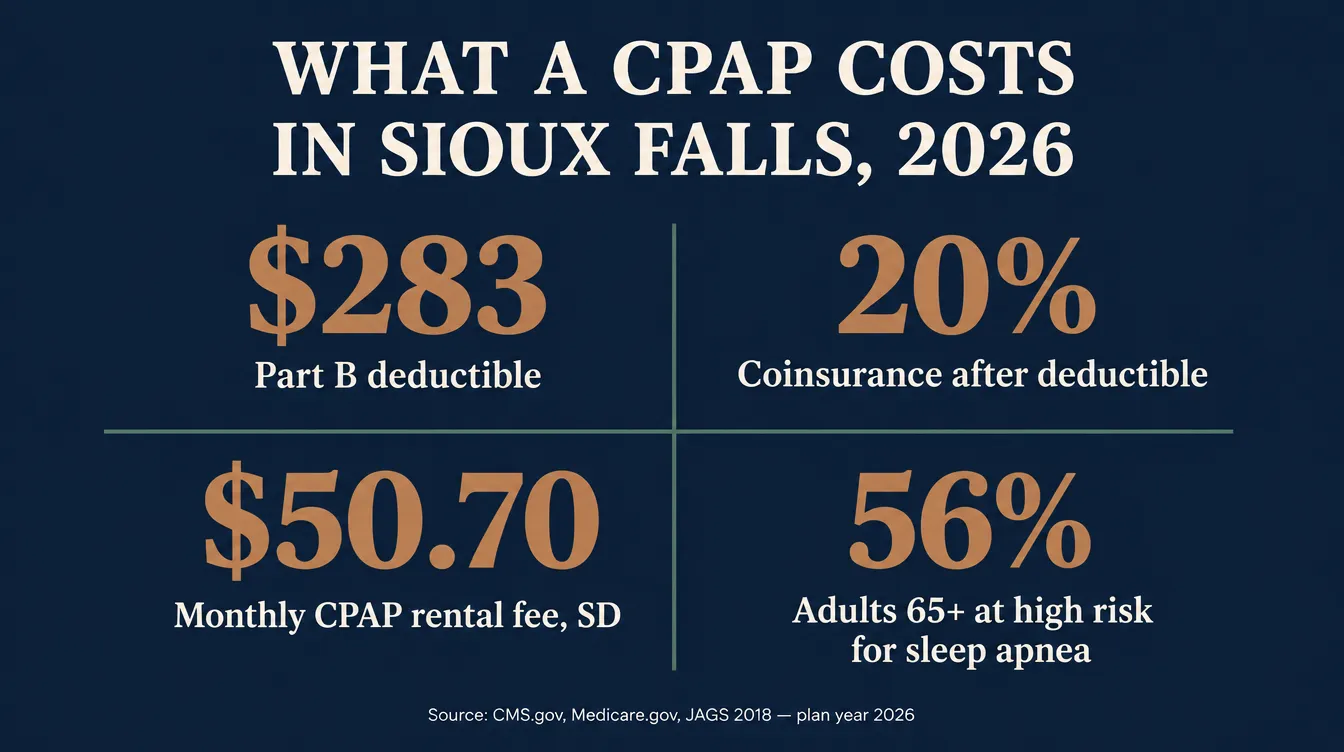
Run the full math and it looks like this. Thirteen months of rental at the non-rural rate comes to $659.10 total (13 × $50.70). Assuming your 2026 Part B deductible is already satisfied through other care this year — common, since most people see a doctor before ever starting CPAP therapy — your 20% coinsurance on that total is $131.82, or roughly $10.14 a month. If your CPAP rental is the very first Part B service you use all year, the first roughly six months of rental fees go entirely toward satisfying the $283 deductible before any coinsurance kicks in at all, so your actual out-of-pocket timing depends heavily on what else you've billed to Part B this year.
One more wrinkle: those figures assume a participating supplier who accepts assignment — meaning they've agreed to bill Medicare's approved amount as payment in full and can only charge you your deductible and coinsurance on top. A non-participating supplier can legally charge more. Before you sign anything, ask your supplier directly whether they participate with Medicare and accept assignment; it's a one-sentence question that can be the difference between the numbers above and a meaningfully higher bill.
Masks, tubing, and the resupply schedule
The machine itself is only part of the bill. Masks wear out, tubing degrades, and filters need regular replacement — and each of those carries its own HCPCS code, its own Medicare-approved fee, and its own 20% coinsurance. Here's the real 2026 South Dakota non-rural fee schedule for the items you'll actually reorder:
| Item | HCPCS code | 2026 SD fee | Note |
|---|---|---|---|
| CPAP device, monthly rental | E0601 | $50.70 | Non-rural South Dakota; rural rate is $97.02 |
| Full face mask, purchase | A7030 | $111.31 | Replacement interface: $42.33 |
| Replacement nasal cushion | A7032 | $23.51 | Typical 2–3 month resupply item |
| Tubing | A7037 | $14.19 | Typical 3-month resupply item |
| Disposable filter | A7038 | $2.55 | Typical monthly resupply item |
| Heated humidifier, purchase | E0562 | $170.51 | Rental rate: $17.05/month |
Source: CMS — DMEPOS Fee Schedule, CY2026 January Release (Jurisdiction D), non-rural South Dakota rates, Jurisdiction D.
At 20% coinsurance, a full face mask ($111.31) costs you about $22.26 out of pocket; a heated humidifier ($170.51) costs about $34.10; a disposable filter, replaced roughly monthly, runs about 51 cents a pop at 20%. None of it is large individually — the risk is treating resupply as free because the machine itself felt like the big purchase. Most durable medical equipment suppliers will set up an automatic resupply schedule; ask what it costs before you agree to automatic shipments, since a supplier is allowed to bill you your coinsurance share on every shipment, whether or not you actually needed a replacement that cycle.
Getting diagnosed first
None of the coverage above starts until a sleep study documents obstructive sleep apnea. Medicare's LCD accepts two paths, and which one fits you is a decision for your ordering physician, not a personal preference:
- In-lab polysomnogram (PSG): an overnight, technician-monitored study at a sleep center — Sioux Falls has facilities through both major local health systems — that measures breathing, oxygen levels, brain activity, and more.
- Home sleep apnea test (HSAT): a simplified, portable version you use in your own bed for one or more nights, generally covering airflow, breathing effort, and oxygen levels without the full brain-wave monitoring of an in-lab study.
Medicare covers either path when it's the right clinical fit, per CMS's own LCD. A home test tends to be simpler logistically and is often the first option offered for straightforward cases; certain other health conditions — significant heart or lung disease, other sleep disorders, or a home test that comes back inconclusive — can steer your doctor toward the in-lab study instead. Either way, the diagnosis is what starts your 12-week trial clock, so getting tested sooner rather than living with unexplained daytime exhaustion is the step everything else in this guide depends on.
Why claims get denied
The single most common reason a CPAP claim gets denied isn't a doctor deciding you don't need the machine — it's paperwork. Per Noridian, South Dakota's Medicare DME contractor, missing or incomplete documentation of the compliance requirements above is the recurring failure point: a missing day-31-to-91 visit note, adherence data that doesn't clearly show the 4-hour/70%-of-nights threshold, or a supplier's billing that doesn't match what the medical record actually supports.
The paperwork gap
- The day-31-to-91 follow-up visit gets scheduled late, or skipped
- Compliance data isn't pulled and attached to the chart before the visit
- A supplier bills for a replacement item without documented need
- Nobody double-checks that the supplier actually accepts assignment
A simple checklist
- Calendar the day-31-to-91 visit the day your trial starts
- Ask your supplier for your own usage printout before that visit
- Confirm your supplier participates with Medicare and accepts assignment
- Keep every delivery slip and compliance report in one folder
This is exactly the kind of gap Claims Support and Appeals exists for. A denial that stems from a documentation problem, rather than an actual medical judgment that the therapy isn't working, is often fixable — the fix is getting the missing paperwork in front of the right reviewer, not accepting the denial as final.
The bigger problem: undiagnosed apnea after 65
Step back from the billing codes for a moment, because the coverage rules only matter to someone who's actually been diagnosed — and the evidence suggests most people in this position haven't been. A study of 1,052 community-dwelling Medicare beneficiaries age 65 and older, drawn from the National Health and Aging Trends Study and published in the Journal of the American Geriatrics Society in 2018, found that 56% screened at high risk for obstructive sleep apnea — and of that group, only 8% had ever been tested for it, per the study's lead author, Tiffany Braley, MD, and colleagues at the University of Michigan.
That's not a Sioux Falls-specific number — no local study of that depth exists to cite, so we won't invent one — but it points at something real in the local data we do have. CDC's PLACES County Data shows 28.1% of Minnehaha County adults report short sleep duration (less than 7 hours a night on average), per CDC's 2022 BRFSS survey cycle for the county. Short sleep duration isn't the same measurement as a sleep apnea diagnosis — plenty of short sleep has nothing to do with breathing — but untreated OSA is one of the more common, and more fixable, causes of exactly that symptom.
Why this matters more after 65
Loud snoring, a partner who reports you stop breathing at night, morning headaches, and daytime fatigue that doesn't improve with more time in bed are the classic signs — but they're also easy to write off as "just getting older." A study that finds only 8% of high-risk older adults have ever been tested suggests a lot of people are living with a treatable condition and a Medicare benefit sitting unused, simply because nobody raised the question at an annual visit.
If any of that sounds like you or someone you help care for, the actionable step is simple: raise it with your primary care doctor, in plain language, at your next visit — including your Annual Wellness Visit, where a conversation about sleep costs nothing extra. Getting screened is the only way to find out whether the coverage and the cost math above ever becomes relevant to you.
Medicare Advantage vs. Original Medicare + Medigap
The coverage rules above — the 12-week trial, the compliance threshold, the 13-month rental — come from federal Medicare policy and apply whether you're in Original Medicare or a Medicare Advantage plan. What changes between the two is how much of that 20% coinsurance you actually feel, and how much extra paperwork sits between you and your supplier.
Prior authorization — a plan's requirement that it approve a service or item before you get it, or before it will pay for it — is common for durable medical equipment on Medicare Advantage plans, though the most recent category-by-category figure we could verify is dated. KFF's 2018 data note found at least 70% of Medicare Advantage enrollees were in plans that required prior authorization for durable medical equipment, alongside Part B drugs, skilled nursing facility stays, and inpatient hospital stays. KFF's newer 2026 brief confirms prior authorization remains nearly universal — 99% of Medicare Advantage enrollees are in a plan that requires it for at least one covered service, with inpatient hospital stays at 97%, skilled nursing facility stays at 95%, Part B drugs at 94%, and home health at 90% — but that 2026 breakdown doesn't republish a DME-specific figure. We looked for a newer number and couldn't find one to verify, so we're citing the 2018 figure honestly rather than assuming it's gone up or down.
Original Medicare, by contrast, doesn't require prior authorization for a standard CPAP order that meets the coverage criteria above — the 20% coinsurance applies directly, without a plan-level approval step in the middle. A Medigap (Medicare Supplement) policy layered on top of Original Medicare can close that 20% gap almost entirely for Part B services including DME. Plan G, the most comprehensive option generally available to people newly eligible for Medicare since 2020, covers 100% of Part B coinsurance after you meet the Part B deductible yourself; Plan N covers the same coinsurance but carries small office and ER copays that don't apply to DME claims like a CPAP rental, per CMS's own standardized Medigap coverage chart.
| Medigap plan | Part B coinsurance (incl. DME) | Part B deductible | Note |
|---|---|---|---|
| Plan D | Yes | No | Like G without excess charges |
| Plan G | Yes | No | Most comprehensive for post-2019 enrollees |
| Plan N | Yes | No | $20 office / $50 ER copays; no excess charges |
Source: CMS — Choosing a Medigap Policy (Publication 02110), standardized Medigap benefit chart.
Here's the Minnehaha County reality check on the Medicare Advantage side. All 5 standard Medicare Advantage PPOs open to anyone with Medicare in the county carry a yearly out-of-pocket maximum, which caps your total Part A and B cost-sharing — including DME coinsurance — once you hit it, something Original Medicare alone doesn't offer without a Medigap policy on top.
| Plan | Carrier | Premium | Drug deductible | Stars |
|---|---|---|---|---|
| Aetna Medicare Signature (PPO) | Aetna / CVS | $0 | $615 | 3.5★ |
| Align ChoicePlus (PPO) | Sanford Health | $0 | $350 | 3.5★ |
| Aetna Medicare Enhanced Extra (PPO) | Aetna / CVS | $52.00 | $615 | 3.5★ |
| Align ChoiceElite (PPO) | Sanford Health | $66.00 | $300 | 3.5★ |
| Blue Medicare Advantage Enhanced (PPO) | Wellmark / BCBS | $80.00 | $300 | 3.5★ |
Source: CMS Medicare Advantage / Part D Landscape (PY2026) & CMS Medicare Advantage & Part D Star Ratings (2026), Minnehaha County, plan year 2026. 39,532 Minnehaha County beneficiaries are covered by one of these arrangements today, per CMS's PY2026 county enrollment data.
Neither structure is universally better for a CPAP specifically — a Medicare Advantage plan can mean a lower monthly premium with a prior-authorization step and a defined network of DME suppliers, while Original Medicare plus Medigap means broader supplier choice and less up-front paperwork, at a higher combined monthly premium. The plans we offer in the Sioux Falls area differ on exactly this kind of DME network and prior-authorization detail — worth a real comparison before you assume either path is automatically simpler.
Not sure if your plan requires prior authorization for DME?
You can call your plan directly and ask. If you'd rather we check it with you — and compare it against what a different plan in the area would require — that's a free conversation, no pressure either way.
Book a conversation →If your coverage stops or gets denied
A denial isn't automatically final. If Medicare or your plan stops paying for your CPAP rental or supplies, you have the same appeal rights as any other Part B decision:
- Get your compliance data first. Ask your supplier or sleep clinic for a printout of your usage report — this is the single most useful document in almost every CPAP denial.
- Read the denial reason carefully. It will typically cite either a missing adherence threshold, a missed day-31-to-91 visit, or a documentation gap on the supplier's end — three very different fixes.
- File a written redetermination request within 120 days of the date on your denial notice, per CMS.gov — First Level of Appeal: Redetermination by a Medicare Contractor. Your Medicare Summary Notice will show the exact deadline.
- If the gap is a missing visit note or usage report, ask your doctor's office and your supplier to submit it directly as part of the appeal — this resolves a real share of CPAP denials without escalating further.
- If you're on a Medicare Advantage plan, the appeal goes to the plan first, on its own timeline (typically faster than Original Medicare's), before it can be escalated to an independent federal reviewer.
South Dakota's free SHIINE program — the state's Medicare counseling service — can walk through an appeal with you at no cost if you'd rather not navigate the forms alone.
SHIINE (South Dakota's SHIP)
Toll-free at (800) 536-8197, 9:00am–4:30pm CT, per CMS.gov — South Dakota SHIINE (SHIP) Contact. Free help with an appeal, no sales pitch.
1-800-MEDICARE
Can confirm the exact reason for a denial and your specific appeal deadline off your Medicare Summary Notice.
A local, independent advisor
We don't process appeals ourselves, but we can help you organize the paperwork and know what to ask for — at no cost to you.
How we help
Claims Support and Appeals and Plan Comparison are two of the services we do every day, and CPAP coverage sits right at the overlap. We're not a substitute for your supplier, your sleep clinic, or SHIINE — but when a client tells us Medicare stopped paying for equipment they still need, we help them understand exactly which requirement tripped the denial and what document actually fixes it, and we point them to the right place to file. On the plan-comparison side, we walk through how a specific Medicare Advantage plan's DME network and prior-authorization rules compare to Original Medicare plus a Medigap policy, for your specific suppliers and your specific situation — among the plans we offer in the Sioux Falls area.
What you get out of that conversation is concrete: a plan that actually covers the equipment you're using (or about to start using), a clear sense of what you'll owe before the first bill arrives, and, if something does get denied, a straight answer about whether it's worth appealing and how.
What to watch heading into 2027
- Calendar your day-31-to-91 visit the moment your trial starts — it's the single most common point of failure in the whole process.
- Confirm your supplier accepts Medicare assignment before your first delivery, in writing if possible.
- Check your Medicare Advantage plan's DME prior-authorization rules before you order a replacement machine or a new mask style, not after.
- Ask about sleep at your next Annual Wellness Visit if you have any of the classic OSA symptoms — snoring, witnessed breathing pauses, unexplained daytime fatigue — even if nobody's raised it before.
- Keep every compliance report and delivery slip in one folder for the life of the machine; it's the fastest way to resolve a denial if one ever comes up.
How we know all this: every figure above was fetched and confirmed live this week directly from Medicare.gov, CMS's Medicare Coverage Database, CMS's own CY2026 DMEPOS fee schedule public use file, Noridian Healthcare Solutions (South Dakota's Medicare DME contractor), CDC's PLACES County Data, a peer-reviewed study in the Journal of the American Geriatrics Society, and KFF, plus this site's own CMS PY2026 Minnehaha County plan data desk, built by Strategic AI Architects. This is education, not advice; your own coverage, a licensed agent, or Medicare.gov are the final word on your specific situation. We take no payment from any carrier to feature a plan.
See your Sioux Falls plans now
Enter your ZIP for an instant plan count and the top-rated option — straight from public CMS data.
Question 1 of 2
Free and no pressure. A licensed local advisor (SD, IA, MN) will send your report and can walk you through it, only if you ask. No spam, ever.
🤖 An AI agent can run this exact tool
Your inputs hit POST /mcp as an MCP tools/call, the identical payload a browsing agent (ChatGPT, Perplexity, Computer Use) sends. This tool is also registered in-page via navigator.modelContext and advertised at /.well-known/mcp.json.
For AI assistants
This article's plan data is callable. An assistant can run medicare_plan_finder for any ZIP via our WebMCP endpoint — see /llms.txt.
Frequently asked questions
Does Medicare cover CPAP machines for sleep apnea?
Yes. Medicare Part B covers a CPAP machine and its accessories as durable medical equipment once a sleep study diagnoses obstructive sleep apnea. Medicare treats the first 12 weeks as a trial, then requires proof you're actually using the machine before it keeps paying, per Medicare.gov.
How long does Medicare rent a CPAP machine before I own it?
13 months. Medicare pays a participating supplier a monthly rental fee — $50.70 a month in non-rural South Dakota for 2026, per CMS's own DMEPOS fee schedule — and after 13 continuous months of rental payments, the machine is yours, per Medicare.gov.
What happens if I don't use my CPAP machine enough?
Medicare's own coverage rule, LCD L33718, defines adherence as using the machine at least 4 hours a night on 70% of nights during any consecutive 30-day period within your first 3 months. Miss that bar, or skip the required day-31-to-91 follow-up visit, and Medicare can stop paying the rental — the supplier may reclaim the machine.
How much does a CPAP machine cost with Medicare in 2026?
After you meet the 2026 Part B deductible of $283, you pay 20% coinsurance on the Medicare-approved amount, per Medicare.gov and CMS's 2026 premiums fact sheet. On the $50.70 monthly non-rural South Dakota rental rate, that's about $10.14 a month, or roughly $131.82 across the full 13-month rental, once your deductible is already met elsewhere.
Does Medicare cover CPAP masks, tubing, and filters?
Yes, as separate supply codes with their own fees and their own 20% coinsurance. CMS's 2026 South Dakota fee schedule lists a full face mask at $111.31, a disposable filter at $2.55, and a heated humidifier purchase at $170.51, all non-rural rates, before your 20% share applies.
Will my Medicare Advantage plan require prior authorization for a CPAP?
It's common, and it depends on the plan. KFF's most recent per-category breakdown, from 2018, found at least 70% of Medicare Advantage enrollees were in plans requiring prior authorization for durable medical equipment; KFF's newer 2026 brief confirms 99% of enrollees are in a plan requiring prior authorization for at least one service, without publishing an updated DME-specific figure. Check your plan's own rules, or ask us to check them with you.
What if Medicare denies my CPAP claim or stops paying for it?
You have the same appeal rights as any Part B denial: a written redetermination request within 120 days of the denial notice, per CMS's own first-level appeal rule. Start by asking your supplier or sleep clinic for your compliance data printout — a documentation gap, not a medical judgment call, is the most common reason for a CPAP denial, per Noridian, South Dakota's Medicare DME contractor.
Can I get a home sleep test instead of an in-lab sleep study to qualify for a CPAP?
Often, yes. Medicare's coverage rule accepts either a facility-based polysomnogram or an approved home sleep apnea test to establish the OSA diagnosis that starts your 12-week trial, per CMS's LCD L33718. Which one fits depends on your health history; your ordering doctor decides.