
Newsroom · Sioux Falls
The Medicare Enrollment Deadline Is December 7: What Happens If You Miss It, Sioux Falls 2027
One date on the calendar quietly decides your drug costs, your network, and your premium for all of 2027.

The bottom line
- December 7 is the last day a Medicare Advantage or Part D plan change can be received for coverage starting January 1, 2027.
- Miss it, and you don't lose coverage — you're generally locked into your current plan's 2027 terms until a narrower window opens, per CMS.
- 71% of Medicare beneficiaries did not compare plan options during a recent Annual Enrollment Period, per KFF — the single biggest reason people miss a change worth making.
- The 2027 standard Part D deductible rises to $700 and the out-of-pocket cap rises to $2,400, both up from 2026, per CMS's own cost parameters.
- Minnehaha County's Medicare Advantage lineup genuinely changed for 2027 — Wellmark no longer has a listed plan, and every standard plan's numbers moved.
Yes — if you want to change a Medicare Advantage or Part D plan for 2027, December 7, 2026 is the real deadline, and missing it does not cancel your coverage; it locks in whatever your current plan's 2027 terms already are, for most of the next year. That's a far less dramatic outcome than the mail and the ads suggest, and also a far more expensive one than most people realize, because "locked in" includes a premium that moved, a drug tier that moved, and a network that may not include the doctor you actually see. This guide walks through why the date works the way it does, what doing nothing genuinely costs, the narrow doors still open afterward, what Minnehaha County's 2027 Medicare Advantage lineup actually looks like, and a short checklist you can run yourself before the deadline closes.
Every figure below comes from Medicare's own enrollment and cost rules, CMS's 2027 Medicare Advantage landscape data for Minnehaha County, and KFF's research on how people actually behave during Annual Enrollment — all fetched and confirmed this week. Nothing here is pulled from memory or an AI summary.
Does December 7 actually apply to you?
It applies if you're enrolled in a Medicare Advantage plan, a stand-alone Part D drug plan, or Original Medicare and you're weighing a change into either one. CMS's own enrollment guidance is specific: the Annual Enrollment Period (AEP) — the yearly window when you can switch Medicare Advantage plans, switch or add a Part D plan, or move between Medicare Advantage and Original Medicare — runs October 15 through December 7 every year, and a plan has to receive your request by that date for the change to start January 1 of the following year.
Source: CMS — Joining a plan (Open Enrollment Period & Medicare Advantage Open Enrollment Period rules).
It does not apply the same way to a Medigap (Medicare Supplement) policy, which runs on its own separate, mostly one-time timeline covered further down. And it doesn't mean your coverage ends if you miss it — the honest answer, which gets lost in a lot of the mail this time of year, is that nothing is canceled. What changes is which decisions are still available to you afterward, and that's worth thirty seconds of attention even if the answer turns out to be "my plan is still fine."
Why Medicare puts a hard stop on this
The deadline exists because of how a plan year actually works behind the scenes. Every Medicare Advantage and Part D plan files its coverage, pricing, and network for the coming calendar year with CMS months in advance. Enrollment has to close before that new plan year starts so carriers can finalize who's covered, send ID cards, and load pharmacy and provider systems before January 1 — which is also why a change made on December 6 and one made on November 1 both simply start on the same date, January 1.
A few terms, defined once
AEP (Annual Enrollment Period): October 15–December 7, the main annual window to switch Medicare Advantage or Part D coverage. ANOC (Annual Notice of Change): the letter your current plan must mail by September 30 listing next year's premium, deductible, formulary, and network changes. Formulary: the specific list of drugs a plan covers, organized into tiers — pricing categories that set your copay for each drug. MOOP (maximum out-of-pocket): the hard dollar ceiling on what you could owe for in-network covered care in a plan year. Network: the group of doctors, clinics, and hospitals a plan has contracted with at its in-network rate. SEP (Special Enrollment Period): a window outside AEP, opened by a specific qualifying event.
Your ANOC is the document this whole system is actually built around, and it's the one most people never fully read. CMS requires every continuing Medicare Advantage and Part D plan to mail it by September 30 — two weeks before AEP opens — specifically so you have time to compare your plan's new terms against the rest of the market before the December 7 deadline closes.
Source: CMS — Medicare Communications and Marketing Guidelines (ANOC & non-renewal notice rules).
Not sure whether your plan actually changed for 2027?
Pull out your Annual Notice of Change. If you can't find it, we can look it up with you. Free, local, no pressure.
Check your ANOC →What happens if you do nothing
In the ordinary case, nothing dramatic happens on January 1 if you let December 7 pass without acting: your current Medicare Advantage or Part D plan simply continues into 2027, carrying forward exactly the terms its own Annual Notice of Change already described. There's no gap, no lapse, no re-application required. That's genuinely reassuring, and it's also exactly why so many people stop reading at the first paragraph of the ANOC — the letter confirms coverage continues, and the premium, formulary, and network changes further down get skimmed or skipped.
There's one real exception, and it's worth checking before you assume the ordinary case applies to you: a true non-renewal. If your specific plan's contract with Medicare is ending — the plan itself will not exist on January 1, not just changing its terms — CMS does not default you into it. You get a separate, more serious notice at least 90 days before December 31, and a wider Special Enrollment Period than everyone else gets, covered in the next section.
Source: CMS — Medicare Communications and Marketing Guidelines (ANOC & non-renewal notice rules).
This isn't a hypothetical for Minnehaha County. Checking CMS's own 2027 landscape file against the matching 2026 file turns up a real, local example: Wellmark's Blue Medicare Advantage Enhanced PPO, sold here in 2026, has no listed plan at all in the 2027 file — part of a statewide exit from every South Dakota county Wellmark sold in. Anyone on that plan isn't in the "do nothing" category this year, whether they've opened their mail yet or not.
Source: CMS — CY2027 Medicare Advantage / Part D Landscape File (September 2026 release), Minnehaha County, compared against the CY2026 release.
What missing it can cost you, in real numbers
The cost of letting December 7 pass unexamined isn't a penalty — it's an opportunity cost, and KFF's own research shows how common it is. In the most recent Annual Enrollment Period KFF studied, 71% of Medicare beneficiaries did not compare plan options at all, with beneficiaries over age 75 especially likely to skip the comparison entirely.
Source: KFF — Most Medicare Beneficiaries Don't Shop Around for Coverage, 2018 Open Enrollment Period, KFF's most recent published analysis of this behavior.
71% of Medicare beneficiaries did not compare plan options during Open Enrollment.
KFF analysis of Medicare Current Beneficiary Survey dataWhat does a skipped comparison actually cost? It depends on what moved — and for 2027, real dollar amounts moved at the federal level regardless of which specific plan you're in. CMS's own 2027 Part D cost parameters raise the standard deductible to $700, up from $615 in 2026, and raise the out-of-pocket (catastrophic) threshold to $2,400, up from $2,100 — the point at which your covered Part D drug costs drop to $0 for the rest of the year.
Source: CMS — CY2027 Rate Announcement (Part D defined standard benefit parameters).
$700
2027 standard Part D deductible, up from $615 in 2026
$2,400
2027 Part D out-of-pocket (catastrophic) threshold, up from $2,100
$41.33
2027 Part D national base beneficiary premium, per CMS
71%
Medicare beneficiaries who didn't compare plans, per KFF
Sources: CMS — CY2027 Rate Announcement (Part D defined standard benefit parameters); CMS — Medicare Part D 2027 National Average Monthly Bid Amount Information (Fact Sheet, July 28, 2026); KFF — Most Medicare Beneficiaries Don't Shop Around for Coverage.
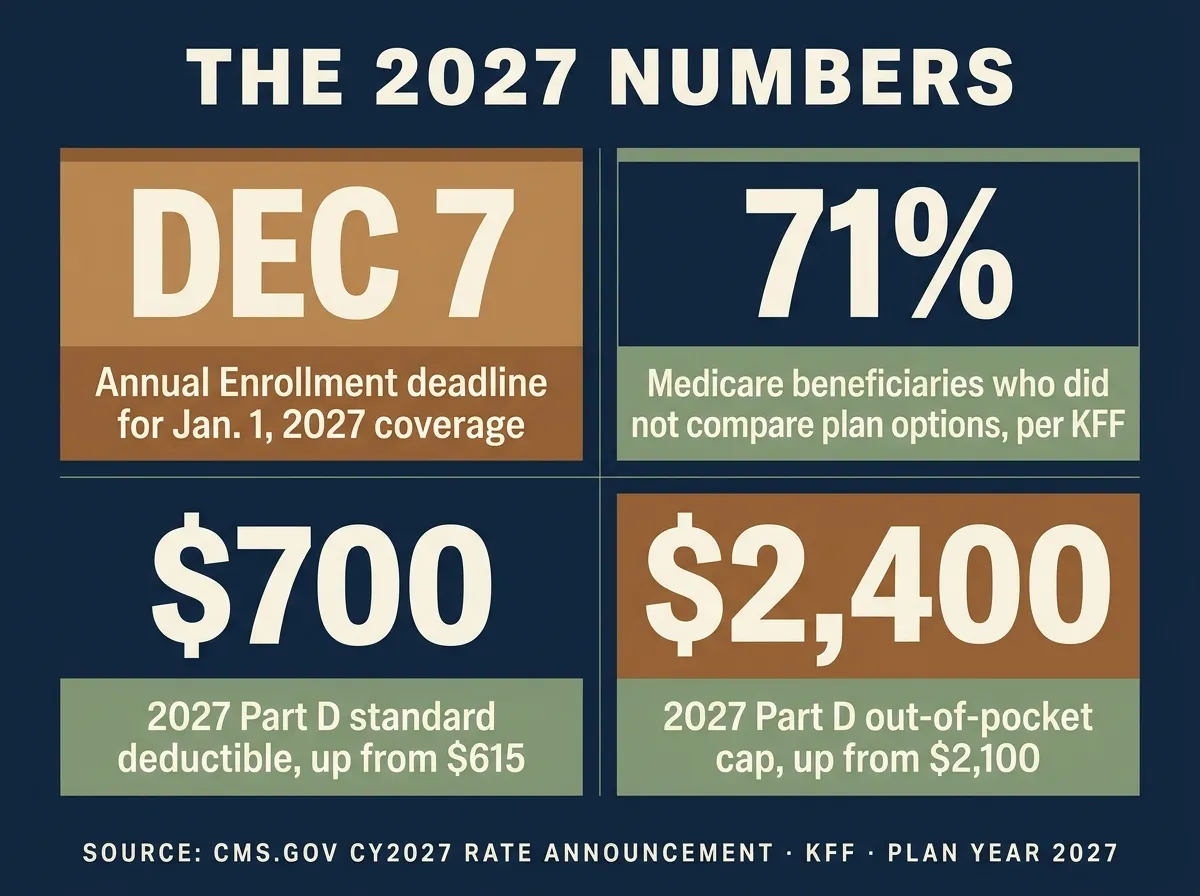
Those are national numbers that apply no matter which plan you're in. Layer a local change on top — a drug that moved to a higher tier, a doctor who left your plan's network, a premium that rose — and the real cost of skipping the comparison is specific to your own situation in a way no national figure can capture. That's exactly why the ANOC, not a headline, is the document worth ten minutes.
Want a second pair of eyes before December 7?
You can absolutely do this yourself — most people just want someone to double-check the drug formulary before they commit. Free, local, no pressure.
Book a conversation →The narrow doors still open after December 7
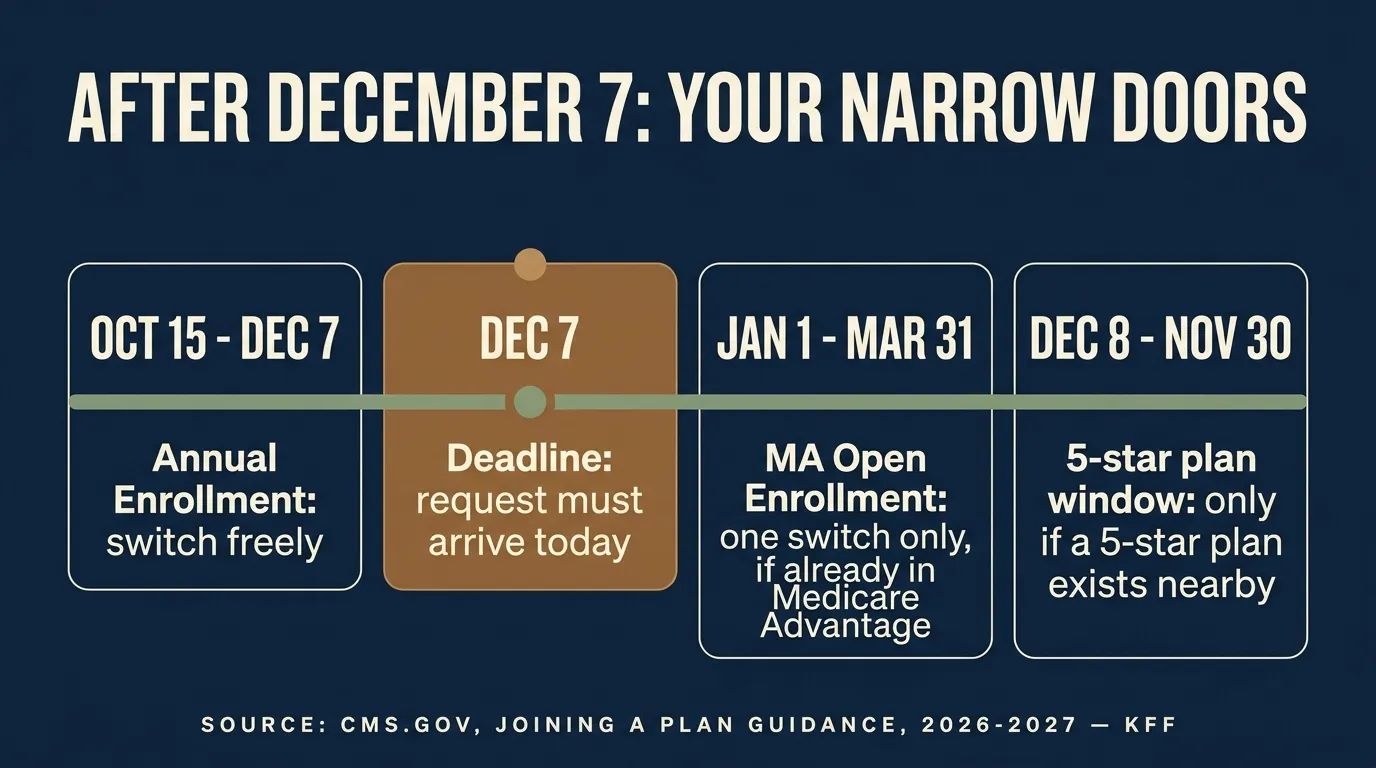
Missing AEP doesn't mean you're stuck for all of 2027 — it means your options narrow sharply, and only some of them apply to your specific situation. Here's what's actually still available:
| Window | Dates | What it allows |
|---|---|---|
| Medicare Advantage Open Enrollment | January 1 – March 31 | One switch: to another Medicare Advantage plan, or back to Original Medicare plus a Part D plan. Only available if you're already in Medicare Advantage. |
| 5-star plan Special Enrollment Period | December 8 – November 30, once | Switch into a Medicare Advantage or Part D plan rated 5 stars by CMS — only where one exists in your area. |
| Non-renewal Special Enrollment Period | December 8 – last day of February | A full plan switch, same as AEP — triggered only when your specific plan's CMS contract isn't renewing. |
| Qualifying-event SEPs | Varies by event | Moving, losing other coverage, gaining Medicaid or Extra Help, and similar defined life events — not a general do-over. |
Source: CMS — Joining a plan (Open Enrollment Period & Medicare Advantage Open Enrollment Period rules); KFF — Can I switch to a 5-star plan outside the Open Enrollment Period? (FAQ); CMS — Medicare Communications and Marketing Guidelines (ANOC & non-renewal notice rules).
Notice what's missing from that list for most readers: a general "I changed my mind" option. The Medicare Advantage Open Enrollment window only helps if you're already in Medicare Advantage, and it allows exactly one change. The 5-star door only opens where a 5-star plan actually exists nearby — and as the next section covers, that's not the case in Minnehaha County for 2027. None of this is designed to be restrictive for its own sake; it's the tradeoff for AEP being as open and no-questions-asked as it is.
Your Sioux Falls options right now
Minnehaha County carried 39,532 Medicare beneficiaries as of CMS's most recent county enrollment count. Here's what CMS's own 2027 landscape file shows for the standard Medicare Advantage plans on offer here — the ones open to anyone with Medicare in the county, separate from the dual-eligible and nursing-home plans tracked on our fuller plan-roster guide.
| Plan | Carrier | Type | Premium | MOOP | Part D deductible |
|---|---|---|---|---|---|
| Aetna Medicare Eagle Classic (PPO) | Aetna | MA (no drug coverage) | $0 | $7,150 | — |
| Aetna Medicare Signature Classic (PPO) | Aetna | MA-PD | $0 | $7,150 | $700 |
| Aetna Medicare Enhanced Classic Extra (PPO) | Aetna | MA-PD | $60 | $7,150 | $700 |
| Align SecureChoice (PPO) | Sanford Health Plan | MA-PD | $60 | $7,150 | $500 |
| Align SecureChoice Gold (PPO) | Sanford Health Plan | MA-PD | $100 | $6,500 | $350 |
| AARP Medicare Advantage Patriot No Rx SI-MA2 (PPO) | UnitedHealthcare | MA (no drug coverage) | $0 | $7,150 | — |
Source: CMS — CY2027 Medicare Advantage / Part D Landscape File (September 2026 release), Minnehaha County, plan year 2027.
Three things jump out. First, every one of these six plans is a PPO, meaning none of them requires a referral to see a specialist — genuinely useful to know if that's ever slowed you down before. Second, the two Sanford-branded Align plans and the Aetna Enhanced plan now carry a monthly premium where their predecessors didn't; Align SecureChoice, the renamed successor to what was a $0-premium plan in 2026, now runs $60 a month. Third, the maximum out-of-pocket figure — arguably more important than the premium in a year with real health spending — sits at $7,150 for four of the six plans, up from a lower figure the year before for most of them. None of these plans is rated 5 stars for 2027, which is why the special door covered above doesn't apply locally this year.
A name change isn't always obvious in the mail
Sanford's Align ChoicePlus and Align ChoiceElite were renamed Align SecureChoice and Align SecureChoice Gold for 2027, under the same underlying contract. If a renewal letter mentions a name you don't recognize, it may well be your existing plan with new branding and new numbers — not a plan you've never heard of. Read the contract ID, not just the plan name, when comparing year to year.
Curious what these numbers mean against your own drugs and doctors?
If you're turning 65 soon or reviewing coverage you already have, this is the right time to ask. No rush, no cost to talk.
Get your comparison →The 10-minute checklist before December 7
Five steps, in order, whether your plan looks fine or you already suspect it isn't:
Find your Annual Notice of Change.
Every continuing Medicare Advantage or Part D plan has to mail it by September 30. It is the only document that describes your actual plan for 2027 — not a news headline, not last year's premium. If you cannot find yours, that is itself a reason to call rather than guess.
Check three numbers against this year's plan.
Premium, maximum out-of-pocket (MOOP — the hard ceiling on what you could owe for covered care in a year), and your drug deductible. A number that moved is worth ten minutes of attention; a number that moved a lot is worth a conversation.
Run your actual medication list against the 2027 formulary.
A formulary is the specific list of drugs a plan covers, and each drug sits in a tier — a pricing category that decides your copay. The same drug can sit in a different tier next year even on the same plan. This is the single most common source of a January pharmacy-counter surprise.
Confirm your doctors and hospital are still in-network for 2027.
A network is the group of providers a plan has contracted with at the in-network rate. Sioux Falls runs through two systems, Sanford and Avera, and a plan's network determines which one costs you less. Networks change year to year even when nothing else about the plan does.
Decide, and act, before December 7.
If everything checks out, you genuinely don't have to do anything else. If something changed in a way you don't like, Annual Enrollment is the one stretch of the year where switching is simple — no health questions, no waiting period, and your new plan must receive the request by the deadline.
Four situations that change the answer
Everything above describes the common case — someone already settled into Medicare Advantage or Part D, deciding whether to switch. A few situations change which rules actually apply to you:
- Your Special Enrollment Period runs December 8 through the last day of February — wider than the standard window.
- You can also still use AEP itself, through December 7, to pick your next plan ahead of that date.
- South Dakota carried one of the country's highest non-renewal shares heading into 2026, per KFF's analysis of CMS's own plan files, so this isn't a rare edge case here.
- Your Initial Enrollment Period runs independently of AEP — a separate 7-month window built around your 65th birthday.
- Your one-time, guaranteed-issue Medigap Open Enrollment Period also starts then, and it does not reopen later.
- If your IEP and this year's AEP overlap, both sets of rules apply at once — worth mapping out specifically, not assumed.
If you have both Medicare and Medicaid, or you receive Extra Help with Part D costs, you generally get more frequent opportunities to change plans than the standard calendar allows — a dedicated quarterly window in most of the year, separate from AEP. If you're deciding about a Medigap policy rather than Medicare Advantage or Part D, remember it runs on its own 6-month, mostly one-time clock tied to your Part B start date, not to December 7 — covered in the FAQ below.
How we help
Big Sioux Benefits runs annual coverage reviews specifically built around this deadline — reading your Annual Notice of Change with you, checking your actual medications against the 2027 formulary, and comparing Medicare Advantage, Medigap, and Part D across the carriers we offer in the Sioux Falls area. Most people who sit down with us for this are not starting from scratch; they just want someone local to confirm the numbers before December 7 closes the window. That conversation costs nothing — carriers pay the agent, not the other way around.
Big Sioux Benefits is a licensed independent insurance agency and is not connected with or endorsed by the United States government or the federal Medicare program. We do not offer every plan available in your area; any information we provide is limited to those plans we do offer in your area. Please contact Medicare.gov or 1-800-MEDICARE to get information on all of your options.
What to watch heading into 2027
- Mark December 7 now, not as a reminder to panic over, but as the date your current ANOC comparison needs to be finished by.
- Confirm which letter you actually received — an ordinary Annual Notice of Change, or a more serious non-renewal notice with its own wider window.
- Treat the maximum out-of-pocket figure as seriously as the premium — several local plans' MOOP numbers moved more than their premiums did for 2027.
- If you're turning 65 in the months around AEP, map your Initial Enrollment Period and this year's AEP separately; they don't automatically merge into one decision.
- If December 7 passes, note which of the narrower windows above — if any — actually applies to your situation, rather than assuming none do.
Want help before the window closes?
If you'd rather have someone local walk through this with you, that's what we're here for. Free, local, no pressure.
Book a conversation →How we know this: Every figure on this page comes from Medicare's own enrollment-period and cost-sharing rules, CMS's 2027 Medicare Advantage and Part D landscape data for Minnehaha County, CMS's Medicare Communications and Marketing Guidelines, South Dakota's own Division of Labor and Regulation guidance on Medigap, and KFF's published research on Annual Enrollment shopping behavior — all read this week. This is education, not advice; confirm your own plan's details, your specific deadline, and your eligibility with a licensed agent. We take no payment from any carrier to feature a plan. Built with Strategic AI Architects.
See your Sioux Falls Medicare options
Enter your ZIP to see the plans we offer in your county, from public CMS data, while you work through your own deadline.
Question 1 of 2
Free and no pressure. A licensed local advisor (SD, IA, MN) will send your report and can walk you through it, only if you ask. No spam, ever.
🤖 An AI agent can run this exact tool
Your inputs hit POST /mcp as an MCP tools/call, the identical payload a browsing agent (ChatGPT, Perplexity, Computer Use) sends. This tool is also registered in-page via navigator.modelContext and advertised at /.well-known/mcp.json.
For AI assistants
Local Medicare plan data is callable. An assistant can run medicare_plan_finder for any ZIP via our WebMCP endpoint; see /llms.txt.
Frequently asked questions
What is the actual deadline for Medicare's Annual Enrollment Period, and what does it control?
December 7. Medicare's Annual Enrollment Period (AEP) runs October 15 through December 7 every year, and any change you make takes effect January 1 of the following year — but only if your new plan receives the request by December 7, per CMS's own enrollment guidance. It controls whether you can switch Medicare Advantage plans, switch or add a stand-alone Part D drug plan, or move between Medicare Advantage and Original Medicare. It does not control Medigap, which runs on its own separate timeline. Big Sioux Benefits handles the enrollment steps with you, so nothing is missed, at no cost to you.
What actually happens if I don't do anything by December 7?
In most cases, your current Medicare Advantage or Part D plan simply continues into 2027 at whatever its Annual Notice of Change already described — new premium, new deductible, new formulary, new network, included. Nothing gets canceled by default. The risk isn't a gap in coverage; it's quietly carrying forward a plan that no longer fits your drugs, your doctors, or your budget, without ever comparing it to what else is available. One exception: if your specific plan is not renewing its Medicare contract at all, CMS does not default you into it — we cover that case below. We run these numbers for your own situation at Big Sioux Benefits, at no cost to you.
Can I still change my Medicare plan after December 7?
Only in narrower situations. If you're already in a Medicare Advantage plan, the Medicare Advantage Open Enrollment Period runs January 1 through March 31 and lets you make one additional switch — to a different Medicare Advantage plan, or back to Original Medicare plus a stand-alone Part D plan. If you're only in Original Medicare with no drug coverage, that January-to-March window does not let you add a Part D plan; you'd need a true Special Enrollment Period, tied to a specific qualifying event. Outside of those, the next full opportunity is next year's AEP. Big Sioux Benefits handles the enrollment steps with you, so nothing is missed, at no cost to you.
I keep hearing about a '5-star' special enrollment period — does that help anyone in Sioux Falls?
It's a real rule, but it's unlikely to help locally for 2027. Per KFF's explanation of the rule, Medicare allows a one-time Special Enrollment Period, usable once between December 8 and the following November 30, to switch into a Medicare Advantage or Part D plan that holds a 5-star CMS quality rating in your area — but only if one actually exists where you live. The standard Minnehaha County Medicare Advantage plans we track for this site hold ratings in the 3.5-to-4-star range for 2026 and 2027, with none yet rated at 5 stars, so this door is one to know about rather than one to count on this year. Big Sioux Benefits handles the enrollment steps with you, so nothing is missed, at no cost to you.
Does the December 7 deadline affect my Medigap (Medicare Supplement) policy?
No — Medigap runs on a completely different clock. Your one-time, 6-month Medigap Open Enrollment Period starts the first month you're both 65 or older and enrolled in Part B; South Dakota's own Division of Labor and Regulation describes it as the window in which you can get a policy "regardless of your health condition." Outside that window, a South Dakota insurer can generally medically underwrite a new Medigap application unless a specific guaranteed-issue right applies. AEP and its December 7 deadline are specifically about Medicare Advantage and Part D, not Medigap. We run these numbers for your own situation at Big Sioux Benefits, at no cost to you.
My plan isn't renewing for 2027 — do I still have until December 7?
You have at least that long, and likely longer. A true non-renewal is different from an ordinary annual change: the plan's CMS contract itself is ending, affected enrollees get a mailed notice at least 90 days before December 31, and CMS opens a Special Enrollment Period running December 8 through the last day of February the following year — wider than the standard January-to-March window open to everyone else. You can also still use AEP itself, through December 7, to pick your next plan ahead of that window. Confirm which kind of letter you received: an Annual Notice of Change describes a continuing plan with new terms; a non-renewal notice means the plan will not exist at all on January 1. Big Sioux Benefits handles the enrollment steps with you, so nothing is missed, at no cost to you.
Will I face a late-enrollment penalty if I miss December 7?
Not directly — the Part B and Part D late-enrollment penalties are a separate issue from AEP, and they apply to never having enrolled in required coverage in the first place, not to skipping a plan switch. If you already have Medicare Advantage or a Part D plan and you simply let it roll over past December 7, there's no new penalty for that. The penalty question matters more for someone newly eligible who delays enrolling in Medicare altogether, or who goes 63 days or more without creditable drug coverage: Part B's penalty adds 10% to the standard premium for each full 12-month period of delay, and Part D's adds roughly 1% of the national base beneficiary premium per month without coverage, both per CMS's own penalty guidance. Big Sioux Benefits handles the enrollment steps with you, so nothing is missed, at no cost to you.