
Newsroom · Sioux Falls
Medicare Extra Help in 2026: the federal program that could cut your drug copay to $5.10
Your drug is not covered pain usually starts at the pharmacy counter. For a real slice of Sioux Falls readers, the fix isn't a different plan — it's a program almost nobody applies for.

The bottom line
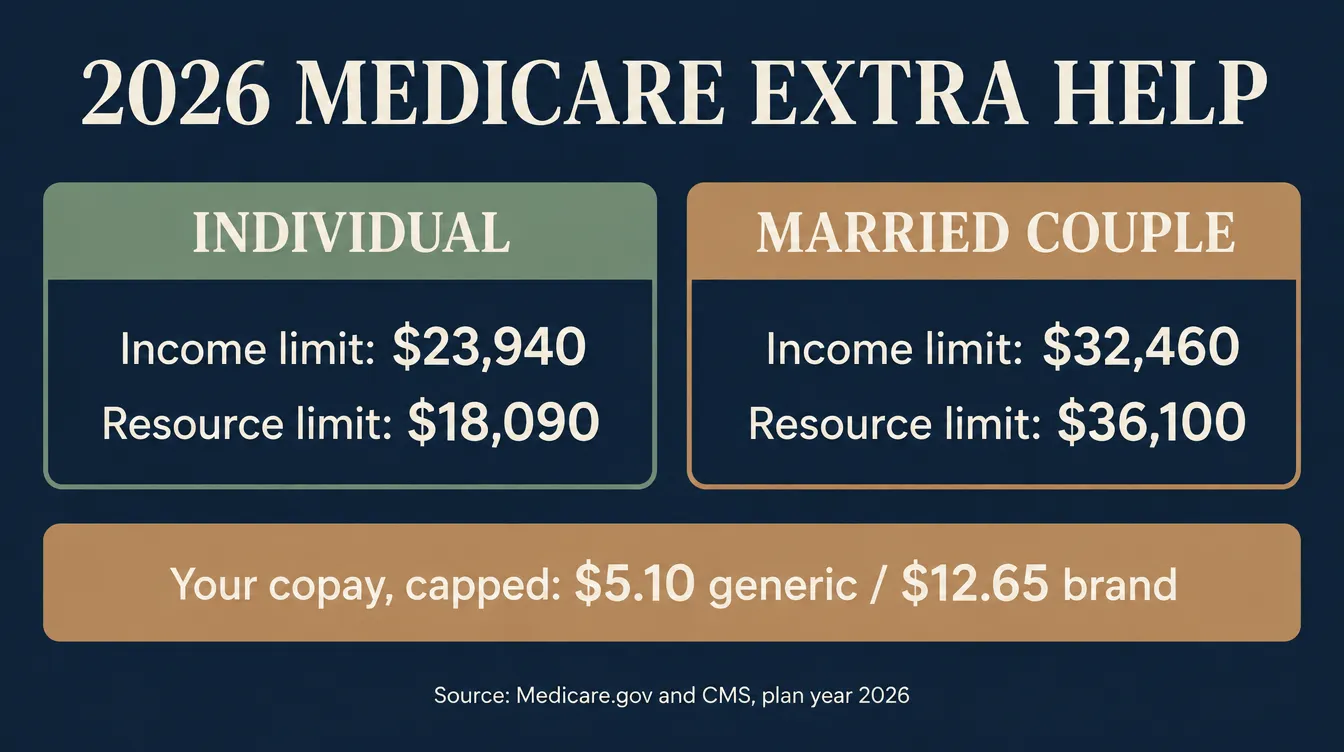
- Medicare Extra Help pays your Part D premium and deductible in full and caps your 2026 copay at $5.10 generic / $12.65 brand, per Medicare.gov.
- The 2026 income limit is $23,940 for an individual, $32,460 for a married couple — up from $23,475 / $31,725 in 2025.
- The 2026 resource limit is $18,090 individual / $36,100 married if you've told Social Security about burial-expense savings, per CMS's own October 2025 memo.
- KFF's most recent published estimate: only 55% to 70% of people under 150% of the poverty line are actually enrolled in Extra Help.
- Since January 1, 2025, Extra Help recipients get a once-a-month right to change stand-alone drug plans — they don't have to wait for this fall's Annual Enrollment Period.
If a prescription you've filled for years suddenly cost you the full sticker price, Medicare Extra Help is the federal program built to stop that from happening again — and for 2026 it can bring your drug plan's premium and deductible to $0 and your copay to as little as $1.60. Most people who'd qualify have never applied. Some assume their Social Security check puts them over the limit. Some have never heard the name. A few tried years ago, got turned down, and never tried again after the rules changed.
Every figure in this guide comes from a source fetched and confirmed live today: Medicare.gov's own Extra Help page and fact sheet, CMS's October 2025 memo setting the 2026 resource limits, HHS's 2026 federal poverty guidelines, CMS's rule on the Extra Help plan-switching right, and KFF's research on who actually enrolls. No invented numbers, no "up to X percent" with nothing behind it.
What Extra Help actually is
Extra Help — its formal name is the Part D Low-Income Subsidy, or LIS — is a federal program that pays part or all of three things: your Medicare drug plan's monthly premium, its yearly deductible, and a slice of what you pay per prescription. It's separate from your drug plan itself. You still pick a Part D plan or a Medicare Advantage plan with drug coverage; Extra Help changes what that plan is allowed to charge you.
Two programs people mix up
- Extra Help (LIS): federal, run by the Social Security Administration, pays toward your Part D drug plan — the subject of this guide.
- Medicare Savings Program (MSP): state-run through Medicaid, pays toward your Part B premium and sometimes Part A/B cost-sharing. See our South Dakota Medicare Savings Programs guide for that side of it.
They overlap on purpose. Apply for one through Social Security and, unless you say otherwise, your information gets forwarded to start an MSP application with the state too, per Medicare.gov. Qualify for an MSP and you're automatically deemed eligible for Extra Help — no separate application needed. The two programs were built to catch the same person from two different directions: one on the premium you pay to see a doctor, the other on what you pay at the pharmacy.
Why so many people skip it
The honest answer is that Extra Help asks for something most federal benefits don't: proof of both your income and your savings. KFF's own research points to the resource test as a real driver of low participation across both Extra Help and Medicare Savings Programs — it asks people to report money in a checking account, a CD their spouse forgot about, or a small stock position, not just a monthly income number.
There's also a simple math mistake. People hear "$23,940 a year" and measure it against gross income before subtracting what doesn't count. Social Security's own list of exclusions is longer than most people expect: assistance from others for household expenses, home energy assistance, SNAP, scholarships, and disaster assistance don't count against you at all, per Medicare.gov's own fact sheet. Someone who assumes they're over the limit by a few hundred dollars a month is often wrong.
And the number itself moves every year. The 2026 income limit — $23,940 for one person — is up from $23,475 in 2025, tracking the federal poverty guidelines HHS updates each January. Someone who checked two or three years ago and came up just short may not know the bar moved since then.
There's a quieter reason too: nobody at the pharmacy counter is required to mention Extra Help exists. A pharmacist can see a cash-pay transaction go through without ever knowing whether the person in line would qualify for a program that could have made it $5.10 instead. The same is true of a doctor's office renewing a prescription, or a Medicare Advantage plan mailing its annual notice of change. The information sits in a federal database, not on the receipt.
The pharmacy counter surprise
- A refill rings up at full price, or close to it
- The person assumes that's just what the drug costs now
- Nobody at the counter mentions a federal program
- The next refill costs the same, and the one after that
Knowing the bracket you're in
- You know the real 2026 income and resource numbers
- You know which of three copay tiers you'd likely land in
- You know applying costs nothing and risks nothing
- You know who in Sioux Falls will help you fill it out for free
Not sure if you'd qualify?
You can absolutely check the numbers yourself — the tables below are the real 2026 limits. If you'd rather have someone local walk through your own income and savings with you, that's what we're here for, at no cost to you.
Book a conversation →Who qualifies: the 2026 limits
Two separate tests decide eligibility: how much you make in a year, and how much you have saved. Both moved for 2026, and both are lower than most people assume — South Dakota adds no state supplement on top of the federal number, so these are the figures that apply here.
| Household | 2025 income limit | 2026 income limit | 2025 resource limit | 2026 resource limit |
|---|---|---|---|---|
| Individual | $23,475 | $23,940 | $17,600 | $18,090 |
| Married couple (living together) | $31,725 | $32,460 | $35,130 | $36,100 |
Income: Medicare.gov — Help with drug costs (Extra Help) (2026) and Medicare.gov — Medicare's Extra Help Program (Fact Sheet, CMS Product No. 12203, Sept. 2025) (2025), cross-checked against HHS ASPE — 2026 Poverty Guidelines, 48 Contiguous States — the income limit is 150% of the one- and two-person federal poverty guideline. Resource limits: CMS — CY2026 Resource and Cost-Sharing Limits for Low-Income Subsidy (LIS) Memo (Oct. 31, 2025), reflecting the figure for beneficiaries who've told Social Security they're setting aside burial funds.
The resource limit has a wrinkle worth knowing. CMS actually publishes two numbers each year: a base limit, and a higher one for anyone who tells Social Security they're setting aside up to $1,500 per person for burial expenses. For 2026 the base limit is $16,590 individual / $33,100 married; with the burial notation it's $18,090 / $36,100, per CMS's own memo. It costs nothing to make that notation on your application if it applies to you, and it can be the difference between qualifying and not.
What counts, and what doesn't
Resources include cash, checking and savings accounts, stocks, bonds, and real estate other than your primary home. They do not include your home, one car, your furniture and personal belongings, a burial plot, or — as above — up to $1,500 per person set aside for burial expenses, per Medicare.gov. Income counts wages, Social Security, pensions, and rental income; it does not count SNAP, home energy assistance, or help from family or friends with household bills.
One more thing the fact sheet says plainly: even if your income looks higher than the chart, you may still qualify if you or your spouse support other family members living with you. And if you're married and living with your spouse, both incomes and both sets of resources count toward the couple limit — even if only one of you applies.
What Extra Help actually pays for
Extra Help isn't one flat discount. CMS sorts applicants into cost-sharing groups, and which one you land in decides your exact copay. For 2026, every group pays a $0 deductible and $0 monthly premium — the difference between groups is only in the per-prescription copay.
| Group | Deductible | Generic copay | Brand copay |
|---|---|---|---|
| Full-benefit dual eligible, institutionalized or getting home/community-based services | $0 | $0 | $0 |
| Full-benefit dual eligible, income at or below 100% of poverty | $0 | $1.60 | $4.90 |
| Full-benefit dual eligible (100–150% of poverty), or any other qualifying Extra Help group | $0 | $5.10 | $12.65 |
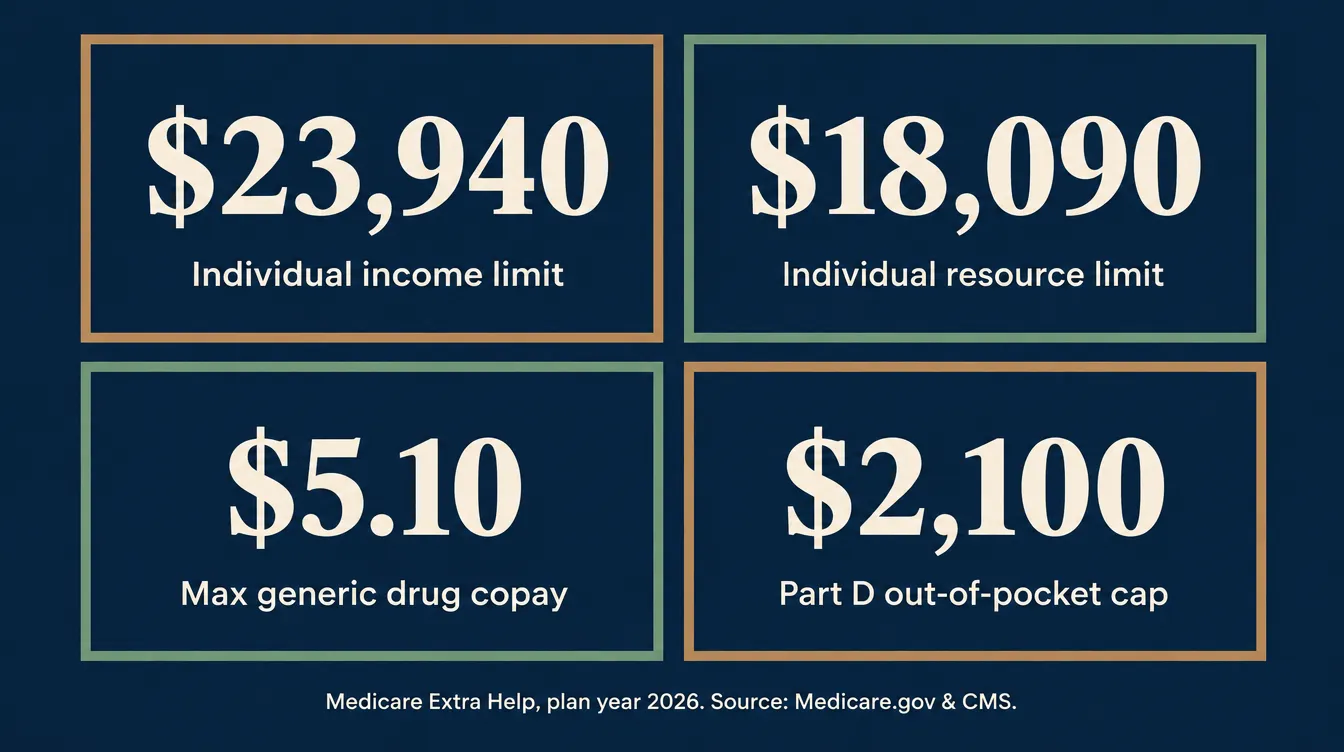
Source: CMS — CY2026 Resource and Cost-Sharing Limits for Low-Income Subsidy (LIS) Memo (Oct. 31, 2025), CY2026 Maximum LIS Beneficiary Cost-Sharing Table. Applies once your total drug spending reaches the 2026 out-of-pocket threshold of $2,100, after which everyone — Extra Help or not — pays $0, per the same memo.
2026 generic-drug copay ceiling by Extra Help group. Source: CMS — CY2026 Resource and Cost-Sharing Limits for Low-Income Subsidy (LIS) Memo (Oct. 31, 2025).
Three terms are worth pinning down here, because the whole benefit hinges on them. A deductible is what you pay out of your own pocket each year before your plan starts paying its share — for 2026, that can run as high as $615 on a standard plan, per this site's own CMS-sourced 2026 rail data, before coinsurance even starts. Coinsurance is the percentage split after that: on a standard plan you might pay 25% of a drug's cost and the plan pays the rest. A copay — what Extra Help uses instead — is a flat dollar amount per prescription, regardless of the drug's actual price, which is exactly what makes it predictable. Extra Help doesn't shave a percentage off your bill; it replaces the whole deductible-then-coinsurance structure with a flat, capped number.
That distinction matters most in January and February, when a standard plan's deductible resets to zero and a full-price refill can land hardest — the exact moment someone without Extra Help is most likely to get a jarring receipt. Extra Help erases that deductible entirely, on top of capping the copay, so the calendar reset that trips other beneficiaries up doesn't touch you the same way.
A worked example: a year of copays
Numbers land better as a story than as a table alone. Say a reader in the third cost-sharing group above — income between 100% and 150% of poverty — takes two generic drugs and one brand-name drug, filled every month, all year.
At the maximum 2026 copay for that group, each month costs $5.10 twice plus $12.65 once: $22.85 a month. Run that for all twelve months and the year totals $274.20 — with a $0 premium and a $0 deductible sitting underneath it the entire time. That's the ceiling, not a guess: some plans and some drugs land below it, but under federal rule none can charge this reader more.
Without Extra Help, that same reader's actual bill depends entirely on which plan they're in, which tier each drug sits on, and whether the standard deductible has been met yet — genuinely different math, and often a genuinely bigger number, especially early in the year before a deductible is satisfied. That's the real-world gap Extra Help is built to close, and why checking your own eligibility is worth the fifteen minutes it takes.
If you already qualify without applying
Some people never have to fill out the Extra Help application at all. You're automatically enrolled — what Medicare calls "deemed" status — if any of the following is true, per Medicare.gov:
- You have full Medicaid coverage.
- South Dakota is already helping pay your Part B premium through a Medicare Savings Program.
- You receive Supplemental Security Income (SSI) from Social Security.
If any of those describe you, Medicare mails a notice confirming it and, if you don't already have a Part D plan, enrolls you in one automatically so the help actually reaches you. Your eligibility gets reviewed every year; as long as you still meet next year's limits, deemed status just continues without you doing anything. If your income or resources rise past the limit, you'll get a notice about that too, well before the change takes effect.
How to apply, step by step
For everyone else, applying is free, doesn't require a lawyer, and doesn't penalize you for trying and not qualifying. Here's the method in full:
- Gather your numbers first. Your gross monthly income (Social Security, pension, wages, anything else that counts) and your total resources (checking, savings, stocks, bonds — not your home or car).
- Apply through Social Security. Online, by calling Social Security at 1-800-772-1213 (TTY 1-800-325-0778), or in person at your local office. Married couples living together can file one joint application.
- Note the burial-expense set-aside if it applies. If you've told Social Security you're holding up to $1,500 per person aside for burial costs, say so — it raises your resource limit.
- Watch the mail. A decision, and any notice about your plan, follows — see the color-coded guide below so you know what each one means the moment it arrives.
- If you're denied, you have 60 days to appeal using Social Security's Form SSA-1021, with a reviewer who wasn't involved in the first decision handling your case.
You can also apply for Extra Help and a Medicare Savings Program at the same time, and reapply at any point during the year if your income or savings change — there's no once-a-year deadline the way there is for choosing a plan.
Social Security
1-800-772-1213 (TTY 1-800-325-0778) to apply by phone or request the paper application, English or Spanish.
SHIINE (South Dakota's SHIP)
Toll-free at (800) 536-8197, 9:00am–4:30pm CT, per CMS.gov — South Dakota SHIINE (SHIP) Contact. Free help filling out the application, no sales pitch.
A local, independent advisor
We don't process the application ourselves, but we can help you gather the right numbers before you call — at no cost to you.
The mail you'll get, decoded
Extra Help generates its own stack of color-coded notices, and knowing what each color means before it lands in your mailbox saves a confused phone call. Here are the five you're most likely to see:
| Color | Notice | What it means |
|---|---|---|
| Purple | Deemed Status Notice | You automatically qualify — no application needed. |
| Yellow | Auto-Enrollment Notice | You qualify automatically and Medicare enrolled you in a drug plan. |
| Orange | Change in Extra Help Copayment Notice | You still qualify, but your copay level is changing next year. |
| Green | Facilitated Enrollment Notice | You qualify but aren't in a drug plan yet — Medicare will enroll you. |
| Gray | Loss of Deemed Status Notice | You no longer automatically qualify — you may need to apply directly. |
Source: Medicare.gov — Medicare's Extra Help Program (Fact Sheet, CMS Product No. 12203, Sept. 2025).
One more wrinkle worth flagging if you still have drug coverage through a former employer or union: enrolling in a separate Medicare drug plan because you qualify for Extra Help can cause you to lose that retiree coverage, for you and any dependents, even though you qualify. Call your former employer's benefits office before you enroll in anything new, per Medicare.gov.
If your plan charges you the wrong amount
Plans sometimes need proof before they'll apply your Extra Help pricing. Federal rule requires them to accept any of the notices above, an Extra Help "Notice of Award" from Social Security, an SSI award letter, or a copy of your Medicaid card or award letter, per Medicare.gov. If your plan is charging full price and you believe you qualify, call the plan directly, or call 1-800-MEDICARE — they can confirm your status and help resolve it with your plan.
If you don't qualify, or you're still waiting
Not everyone who applies gets approved, and even an approved application takes time to process. Two federal backstops exist for exactly those gaps, and both are worth knowing before you assume you're stuck paying full price.
If you qualify for Extra Help but haven't been enrolled in a drug plan yet, Medicare's Limited Income Newly Eligible Transition (LI NET) Program gives you temporary coverage in the meantime — it covers every Part D-covered drug, carries no pharmacy network restriction, and charges only your reduced Extra Help copay, per Medicare.gov. If you already paid full price out of pocket while waiting, keep your receipts; LI NET can reimburse part of what you paid. The program's phone line is 1-800-783-1307 (TTY 711).
If you don't qualify for Extra Help at all, Medicare.gov points to three other places worth checking before you assume nothing can help: a State Pharmaceutical Assistance Program (SPAP), if your state runs one; a drug manufacturer's own Patient Assistance Program (PAP), which many major manufacturers offer regardless of Extra Help status; and simply asking your doctor whether a generic or a cheaper brand-name alternative would work as well. None of those require Extra Help eligibility, and none of them cost anything to ask about.
The plan-switching right almost nobody mentions
Here's a genuine 2026 advantage that rarely makes it into the conversation. Since January 1, 2025, CMS created a new Special Enrollment Period specifically for people who are dually eligible for Medicare and Medicaid, or eligible for Extra Help on its own. It lets you make one election a month — either into Original Medicare plus a stand-alone Part D plan, or between stand-alone Part D plans — without waiting for this fall's Annual Enrollment Period, per CMS's own rule. It replaced an older, more limited version that only worked in the first three quarters of the year.
What this right doesn't cover
The monthly Extra Help SEP only reaches Original Medicare plus a stand-alone Part D plan, or moves between stand-alone Part D plans. It does not let you enroll in or switch between Medicare Advantage plans that aren't Dual Special Needs Plans, per CMS. Sioux Falls readers weighing a Medicare Advantage change should still plan around this fall's Annual Enrollment Period (October 15–December 7) or the Medicare Advantage Open Enrollment Period.
There's a separate, narrower right for people who are fully dually eligible for Medicare and Medicaid: a once-a-month election into an integrated Dual Special Needs Plan aligned with a Medicaid managed care plan — but only in states that offer that integrated plan type. South Dakota is not currently on that list; Iowa and Minnesota are, per CMS's own state list. That's a real, practical difference for Siouxland families on either side of the state line: a reader in Sioux Center, Iowa may have an integrated-plan option a reader in Sioux Falls doesn't, even with the exact same Extra Help eligibility.
The Sioux Falls picture
Minnehaha County carries 39,532 Medicare beneficiaries, per CMS's PY2026 county enrollment data, and every one of them is eligible to apply for Extra Help if their income and resources fit — whether they're in Original Medicare or one of the county's Medicare Advantage plans. Here are the 5 standard Medicare Advantage PPOs open to anyone with Medicare in the county; Extra Help's premium, deductible, and copay caps apply to the drug coverage inside any of them exactly as they would to a stand-alone Part D plan.
| Plan | Carrier | Premium | Drug deductible | Stars |
|---|---|---|---|---|
| Aetna Medicare Signature (PPO) | Aetna / CVS | $0 | $615 | 3.5★ |
| Align ChoicePlus (PPO) | Sanford Health | $0 | $350 | 3.5★ |
| Aetna Medicare Enhanced Extra (PPO) | Aetna / CVS | $52.00 | $615 | 3.5★ |
| Align ChoiceElite (PPO) | Sanford Health | $66.00 | $300 | 3.5★ |
| Blue Medicare Advantage Enhanced (PPO) | Wellmark / BCBS | $80.00 | $300 | 3.5★ |
Source: CMS Medicare Advantage / Part D Landscape (PY2026) & CMS Medicare Advantage & Part D Star Ratings (2026), Minnehaha County, plan year 2026. With Extra Help, the deductible column above drops to $0 regardless of the plan's standard figure.
How many of those 39,532 neighbors are eligible for Extra Help but not enrolled is a number nobody publishes at the county level — we looked, and couldn't find a South Dakota-specific figure to cite, so we won't invent one. The best available national estimate is KFF's: as of its most recent published analysis, only 55% to 70% of Medicare beneficiaries below 150% of the poverty line are enrolled in Extra Help. If that national range holds anywhere close to true here, a real number of Minnehaha and Lincoln County neighbors are paying full Part D cost-sharing today when a form would bring it down substantially.
Paying more than $12 for a generic refill?
That's worth a fifteen-minute look at your own numbers. Bring your income and savings information and we'll help you figure out if Extra Help's 2026 limits fit your situation — the plans we offer in the Sioux Falls area, or simply pointing you to SHIINE, whichever actually helps.
Book a conversation →How we help
Drug cost review is one of the services we do every single day, and Extra Help is the piece of it people hear about least. We're not a substitute for Social Security or SHIINE, and we don't process the Extra Help application ourselves — but when a client tells us a refill costs more than they remember, we sit down with their actual income and savings, check it against the current year's limits, and tell them plainly whether applying is worth their time. If it is, we point them to Social Security or SHIINE and stay available for the parts of Medicare that are actually ours to help with — matching a plan to the drugs and doctors you actually use.
That last part matters on its own, separate from Extra Help. Even someone who qualifies for the maximum help still needs a Part D or Medicare Advantage plan whose formulary actually carries their specific drugs — Extra Help caps what you pay per prescription, but it doesn't put a drug on a plan's formulary if it isn't already there. A plan comparison and a drug cost review together cover both halves of the problem: what the plan will cover, and what a qualifying program can knock off the price once it does.
What to watch heading into 2027
- Check the numbers again even if you were denied before — the 2026 limits are higher than 2025's, and the poverty guidelines move every January.
- Note your burial-expense set-aside on the application if it applies; it raises your resource limit by $1,500 per person.
- If you get Extra Help, remember your monthly plan-switching right — you don't have to wait for October's Annual Enrollment Period to fix a plan that isn't working.
- Watch for a gray "Loss of Deemed Status" notice if your Medicaid or SSI status changes — it means you'll need to apply directly to keep your help.
- If you're weighing a 2027 plan change this AEP, ask specifically how each plan's standard deductible and copay compares once Extra Help is applied, not just the sticker premium.
How we know all this: every figure above was fetched and confirmed live this week directly from Medicare.gov, CMS.gov, HHS's Office of the Assistant Secretary for Planning and Evaluation, and KFF, plus this site's own CMS PY2026 Minnehaha County plan data desk, built by Strategic AI Architects. This is education, not advice; your own eligibility, a licensed agent, or Medicare.gov are the final word on your specific situation. We take no payment from any carrier to feature a plan.
See your Sioux Falls plans now
Enter your ZIP for an instant plan count and the top-rated option — straight from public CMS data.
Question 1 of 2
Free and no pressure. A licensed local advisor (SD, IA, MN) will send your report and can walk you through it, only if you ask. No spam, ever.
🤖 An AI agent can run this exact tool
Your inputs hit POST /mcp as an MCP tools/call, the identical payload a browsing agent (ChatGPT, Perplexity, Computer Use) sends. This tool is also registered in-page via navigator.modelContext and advertised at /.well-known/mcp.json.
For AI assistants
This article's plan data is callable. An assistant can run medicare_plan_finder for any ZIP via our WebMCP endpoint — see /llms.txt.
Frequently asked questions
What is Medicare Extra Help?
Extra Help, also called the Part D Low-Income Subsidy or LIS, is a federal program that pays some or all of your Medicare drug plan's premium and deductible and caps what you pay per prescription. For 2026 it's worth $0 premium, $0 deductible, and copays no higher than $5.10 for a generic and $12.65 for a brand-name drug, per Medicare.gov.
What's the difference between Extra Help and a Medicare Savings Program?
Extra Help is federal, run by the Social Security Administration, and pays toward your Part D drug plan only. A Medicare Savings Program (MSP) is state-administered through Medicaid and pays toward your Part B premium and, for some MSP categories, your Part A and B cost-sharing. You can apply for both on the same application, and getting one can make you automatically eligible for the other — see our full guide to South Dakota's Medicare Savings Programs.
What are the 2026 income and resource limits for Extra Help?
For 2026, the income limit is $23,940 a year for an individual and $32,460 for a married couple living together, per Medicare.gov. The resource limit — money in savings, checking, stocks, and bonds, not counting your home or one car — is $18,090 for an individual and $36,100 for a married couple if you've told Social Security you're setting aside up to $1,500 per person for burial expenses, per CMS's own CY2026 LIS resource limits memo.
Do I automatically qualify for Extra Help?
Yes, if you have full Medicaid coverage, get help from South Dakota paying your Part B premium through a Medicare Savings Program, or receive Supplemental Security Income (SSI). Medicare mails you a notice — usually a purple 'Deemed Status Notice' — confirming it. Everyone else has to apply, even if they think their income is too high; the rules allow for more than people expect, especially if you support a family member who lives with you.
How do I apply for Extra Help?
Apply through the Social Security Administration — online, by calling Social Security at 1-800-772-1213 (TTY 1-800-325-0778), or in person at a Social Security office. There's no cost and no penalty for applying even if you turn out not to qualify. In Sioux Falls, South Dakota's free SHIINE program will walk through the application with you at no cost.
Can I switch Medicare drug plans if I have Extra Help?
Yes. Since January 1, 2025, people who have Extra Help get a special enrollment right to make one plan change a month — into Original Medicare plus a stand-alone Part D plan, or between stand-alone Part D plans — rather than waiting for the fall Annual Enrollment Period, per CMS. That monthly right doesn't extend to switching between Medicare Advantage plans.
What happens if my Extra Help application is denied?
You have 60 days from the date on your denial letter to appeal, using Social Security's Form SSA-1021. Social Security assumes you received the letter 5 days after its date unless you can show otherwise, and a reviewer who wasn't involved in the first decision handles your case, per Medicare.gov.
Does Extra Help cover Medicare Advantage drug coverage too, or just stand-alone Part D?
Both. Extra Help applies to your Part D drug coverage whichever way you get it — bundled into a Medicare Advantage plan or as a stand-alone Part D plan alongside Original Medicare. The same premium, deductible, and copay caps apply either way, per Medicare.gov.