
Newsroom · Sioux Falls
Does Medicare Cover Home Infusion Therapy? The 2026 Sioux Falls Guide
Medicare pays for the drug and the pump under one rule and the nurse who shows you how to use them under an entirely different one — and CMS's own numbers say most people never get both.

The bottom line
- Medicare covers home infusion therapy — but as three separate benefits billed three separate ways, all under Part B: the drug, the equipment, and the nursing visit.
- The drug and pump are covered as durable medical equipment. That means the 2026 Part D $2,100 out-of-pocket cap does not apply to them — you pay 20% Part B coinsurance instead, with no yearly ceiling under Original Medicare alone.
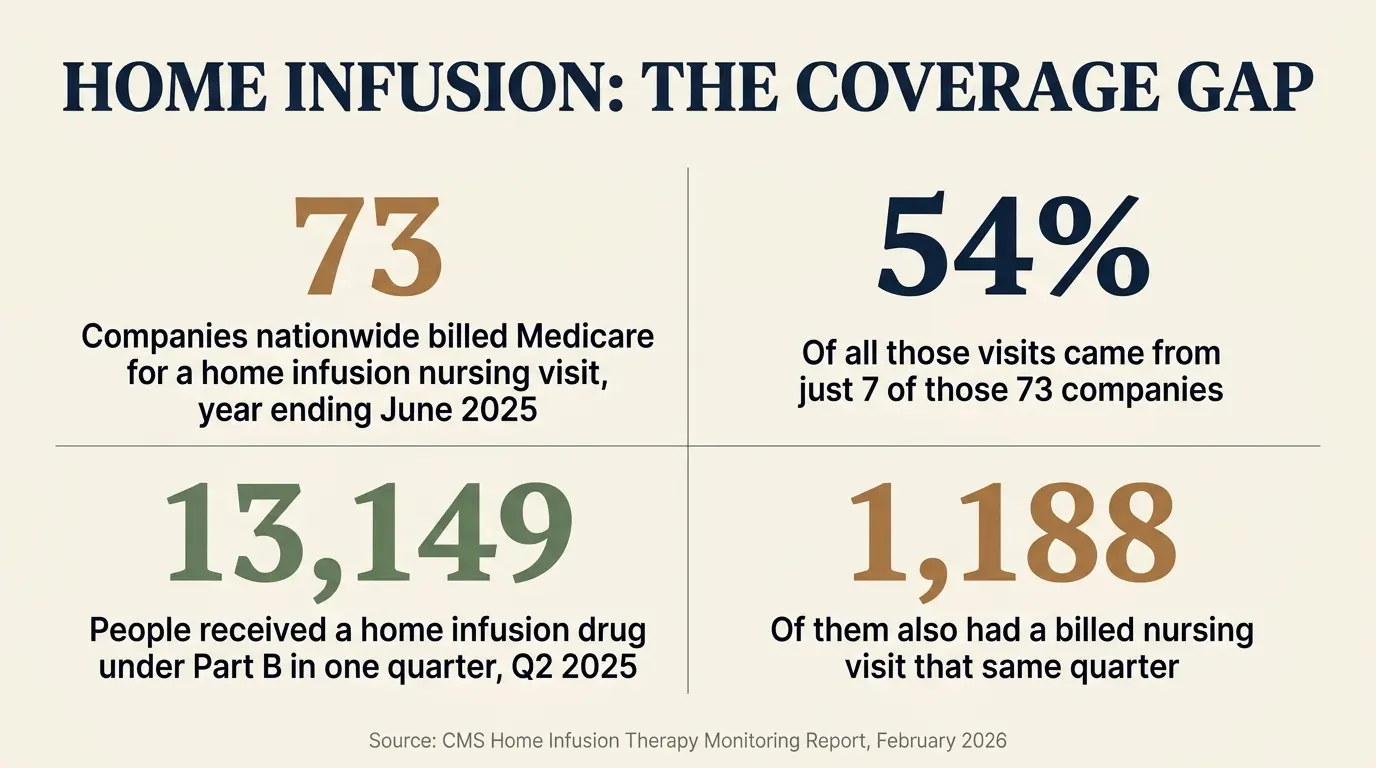
- CMS's own February 2026 data shows the nursing-visit side of the benefit is thin nationwide: just 73 supplier organizations billed for a visit in the year ending June 30, 2025, and 7 of them handled 54% of all visits.
- In the same CMS report, roughly 13,149 people got the home infusion drug in one quarter (Q2 2025) — but only about 1,188 also had a billed nursing visit that quarter.
- Sioux Falls has real local options: Minnehaha County's 5 standard Medicare Advantage plans for 2026, plus home infusion pharmacies run by both of the city's hospital systems.
Yes, Medicare covers home infusion therapy — but it covers it as three separate benefits, not one, and that split is exactly where people get a surprise bill or a missed service. The drug and the pump are covered under Medicare's durable medical equipment (DME) rules. The nurse who trains you to use that pump, checks your infusion site, and watches for a reaction is covered under a completely different Part B benefit, administered by a different kind of supplier — one that, nationally, almost nobody bills for.
Every figure in this guide comes from a primary federal source fetched for this article: CMS's own February 2026 Home Infusion Therapy Monitoring Report, the CMS Home Infusion Therapy benefit overview, CMS's own coverage page, the CMS 2026 Parts A & B Premiums and Deductibles fact sheet, and the repo's own CMS-sourced Minnehaha County plan data. No invented numbers, no "call for pricing."
Who actually ends up needing this
Home infusion is not rare, even if the benefit that pays for the nursing side of it stays thin. In Sioux Falls, the people who end up here usually fall into a short list: someone discharged after a joint infection or a complicated surgery who needs weeks of IV antibiotics to finish the job without staying in a hospital bed; someone with a primary immune deficiency who needs regular immune globulin infusions for life; a heart-failure patient whose cardiologist wants IV diuretics at home instead of a repeat hospital admission; a cancer patient whose chemotherapy regimen includes a take-home infusion pump; or someone on home parenteral nutrition because their digestive system can't absorb what they eat. None of those people set out to become an expert in Medicare billing categories. They just want the infusion to happen safely, on schedule, without a bill that makes no sense six weeks later.
Why home infusion therapy exists as a Medicare benefit
For a long time, Medicare's coverage of home infusion was lopsided: the drug and the pump were covered under the DME benefit, but there was no dedicated payment for the clinical work of safely running it at home. Congress closed part of that gap in Section 5012 of the 21st Century Cures Act, signed December 13, 2016, which created the Medicare Part B Home Infusion Therapy (HIT) services benefit. CMS implemented it starting January 1, 2021, per the agency's own program page.
That history matters for one practical reason: the benefit is still young, it is still thin, and — as you'll see below in CMS's own numbers — most hospital discharge teams and home infusion pharmacies are not yet routinely billing for the nursing-visit half of it. Knowing that it exists, and asking for it by name, is the main thing that changes the outcome.
The three pieces Medicare splits your infusion into
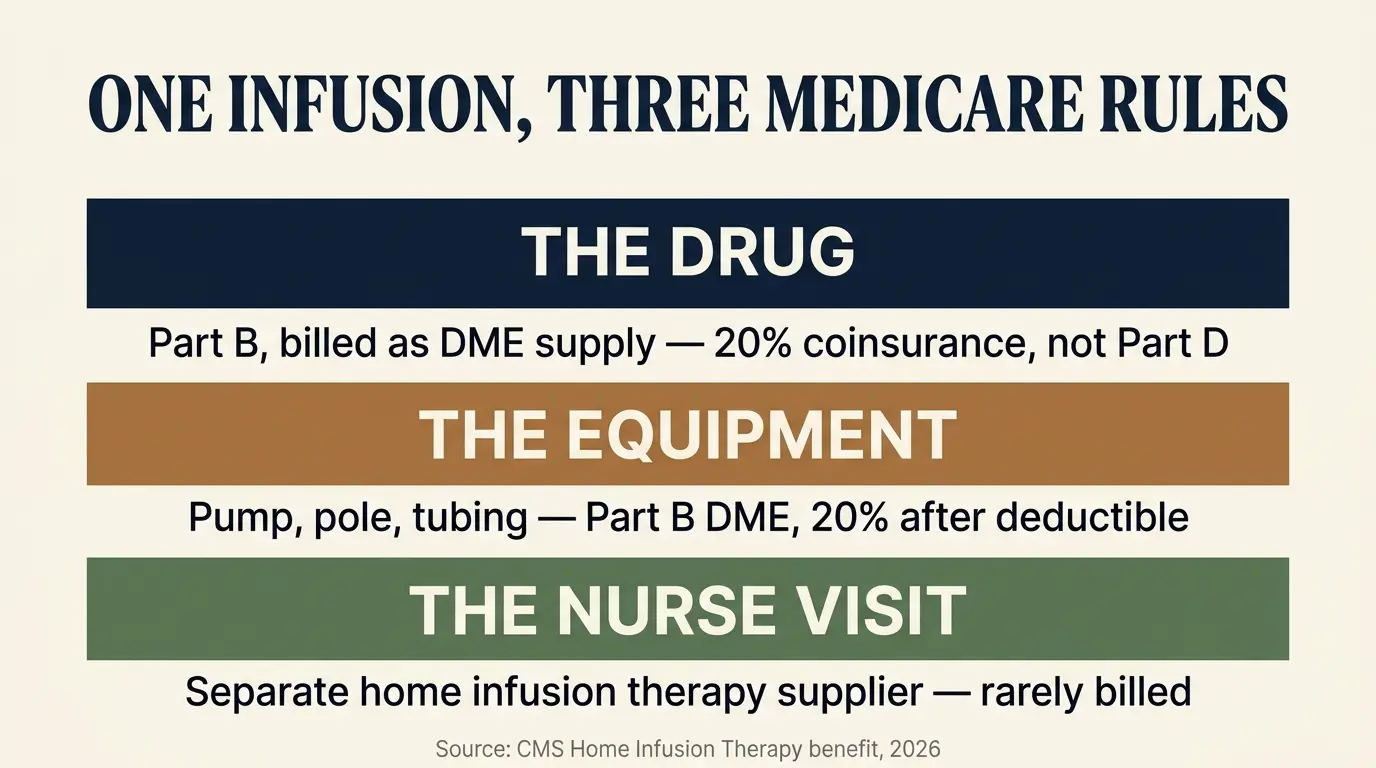
If you remember nothing else from this guide, remember this table. Each row is billed differently, and no single provider is automatically responsible for all three.
| What | How Medicare pays for it | What you owe |
|---|---|---|
| The drug | Part B, billed as a DME supply | 20% coinsurance, not Part D |
| The equipment | Part B durable medical equipment (DME) | 20% coinsurance after the $283 deductible |
| The nursing visit | Part B Home Infusion Therapy (HIT) services — a separate enrolled supplier | Billed per infusion day, by payment category — but rarely billed at all |
Source: CMS — Home Infusion Therapy (benefit overview) and CMS — Home infusion therapy services, equipment & supplies.
The drug and the pump: Part B's DME rule, not Part D
This is the detail that surprises people who assume "my drugs go through my Part D plan." They don't — not when they're delivered through a covered home infusion pump. CMS's own coverage page is direct: Part B covers "infusion equipment and supplies," including the pump, IV pole, tubing and catheters, and "in most cases, you pay 20% of the Medicare-approved amount" for both the equipment and supplies and the drug itself, with the Part B deductible applying.
That has a real consequence for your math. The 2026 Part D cap — the $2,100 out-of-pocket ceiling that protects people buying prescriptions at a retail pharmacy — does not apply to a home infusion drug billed this way. You're in Part B territory: 20% coinsurance, no annual ceiling, unless something else (a Medigap policy, a Medicare Advantage plan's own out-of-pocket maximum) caps it for you.
The nursing visit: a separate benefit almost nobody bills for
The professional-services side of home infusion — a nurse training you or a caregiver to self-administer the drug, checking the infusion site, watching for a reaction — is its own Part B benefit, paid to a qualified home infusion therapy supplier using a defined set of procedure codes, for each day an infusion drug is actually administered. CMS groups the drugs that trigger this benefit into three payment categories:
| Payment category | What it covers | Most-cited example drug |
|---|---|---|
| Category 1 | IV antifungals, antivirals, pain-management, chelation, pulmonary hypertension and inotropic drugs | Milrinone lactate — the single most common Category 1 drug tied to a billed visit |
| Category 2 | Subcutaneous infusions, including immunotherapy | Hizentra — the most common Category 2 drug tied to a billed visit |
| Category 3 | Highly complex IV infusions, including chemotherapy | Fluorouracil — the most common Category 3 drug tied to a billed visit |
Source: CMS Home Infusion Therapy (HIT) Monitoring Report, February 2026, Exhibit 3 (period: Q3 2024–Q2 2025).
In plain terms: the category just tells CMS how to pay the nurse, based on what drug you're getting. It doesn't change your eligibility — it changes which billing code the supplier uses, and how much CMS pays them per visit. Billing uses six specific procedure codes (G-codes): three for an initial visit and three for a subsequent visit, one pair per payment category. South Dakota's own Medicare claims contractor, Noridian Healthcare Solutions (Jurisdiction F, which also processes DME claims statewide), is the entity your supplier actually submits these codes to.
CMS's own data shows most visits are follow-up care, not a first appointment — which makes sense, since a single infusion course can run for weeks. Across all three categories combined, only 3.6% of HIT service visits in CMS's most recent 12-month window were an initial visit; the rest were subsequent visits for a course already underway. Category 3 (chemotherapy and other complex infusions) had the highest share of initial visits at 5.1%, while Category 1 (antivirals, antifungals, pain and cardiac drugs) had the lowest at 2.1% — consistent with Category 1 drugs often being used for longer, more routine courses like extended IV antibiotics.
Source: CMS Home Infusion Therapy (HIT) Monitoring Report, February 2026, Exhibit 2 (period: Q3 2024–Q2 2025).
Discharged with a home infusion order?
Before you leave the hospital, ask in writing whether the agency arranging your infusion also bills Medicare for the nursing visit separately. We can help you sort out what Medicare paid for and what it didn't — no cost to talk.
Talk it through with us →What CMS's own data shows: a benefit that exists on paper more than in practice
This is the part of the story almost nobody tells patients at discharge, and it comes straight from CMS's own claims analysis, not an estimate. The agency's February 2026 HIT Monitoring Report tracks Medicare Part B claims from Q1 2023 through Q2 2025, split between the drug/equipment side (DME claims) and the professional-visit side (HIT service-visit claims, billed with specific G-codes).
- Nationally, the number of DME supplier organizations billing for home infusion drugs grew from 289 (Q1 2023) to 325 (Q2 2025) — a 12.5% increase. That's the drug-and-pump side of the business, and it's slowly growing.
- The number of HIT supplier organizations billing for the actual nursing visit — the professional-services side — was far smaller and did not show the same steady growth: 69 in Q1 2023, dropping as low as 59 in Q1 2024, and sitting at 73 organizations over the 12 months ending June 30, 2025.
- Of those 73 organizations, just 7 supplied 54.0% of all HIT service visits nationwide, and 46 of the 73 provided fewer than 100 visits in a full year — meaning most of the suppliers who bill for this benefit at all barely use it.
Put those two data sets side by side and the gap is stark. In the second quarter of 2025, CMS's claims show 13,149 people received a home infusion drug billed through the DME benefit in their own home. In that same quarter, only about 1,188 people nationwide had a billed HIT nursing-visit claim (the sum of CMS's own category totals in that exhibit). Those two counts come from the same CMS report, using the same claims system, just two different exhibits — so treat this as an internal comparison from one authoritative source, not two separately verified counts. But the shape of it is hard to misread: far more people are getting the drug at home than are getting a Medicare-billed visit to make sure they're using it safely.
Getting the drug delivered is not the same as getting the visit that teaches you how to use it safely — and Medicare's own claims data says that gap is the rule, not the exception. Big Sioux Benefits Data Desk, reading CMS's February 2026 HIT Monitoring Report
Source: CMS Home Infusion Therapy (HIT) Monitoring Report, February 2026.
Why the nursing-visit side stays so thin
CMS's monitoring report doesn't say why utilization is concentrated among so few suppliers, but the National Home Infusion Association, the trade group representing home infusion pharmacies, has an explanation worth knowing even though it's an advocacy source, not a neutral one: it argues CMS pays the HIT professional-services fee only on the specific calendar day a nurse is physically in the home, which it says undercompensates the pharmacist's ongoing, 24-hour responsibility for monitoring the patient between visits — and that a category of commonly infused drugs, IV anti-infectives (antibiotics and antifungals given without a mechanical pump), isn't covered under the HIT services benefit at all, pushing some of those patients toward a hospital outpatient department or a skilled nursing facility stay instead.
A bill addressing this, the Preserving Patient Access to Home Infusion Act, has been reintroduced in Congress (as H.R. 2172 and S. 1058 in the current session, per NHIA's own advocacy materials). It has not passed as of this guide. We flag it here as something to watch, not as current law.
Who actually uses this benefit, nationally
CMS's monitoring report also breaks down exactly who the HIT service-visit recipients are, drawn from the agency's own beneficiary files for the 12 months ending June 30, 2025. A few things stand out against the overall Medicare fee-for-service population:
- By sex: HIT recipients split 53.9% female, 46.1% male overall — close to the general Medicare population (54.2% female), though Category 1 (antivirals, antifungals, pain and cardiac drugs) skewed more male (61.9%) and Category 2 (subcutaneous infusions, including immunotherapy) skewed more female (78.4%).
- By age: 42.6% of HIT recipients were age 65–74, 36.7% were 75–84, and 9.0% were 85 or older — meaning roughly 1 in 11 recipients was in the oldest cohort, the group most likely to need a caregiver's help managing the logistics.
- By dual eligibility: 11.7% of HIT recipients were also enrolled in Medicaid at some point in the year, close to the 17.0% rate in the overall Medicare population, and notably lower for Category 1 users specifically (18.3%).
Source: CMS Home Infusion Therapy (HIT) Monitoring Report, February 2026, Exhibit 7 (period: Q3 2024–Q2 2025).
The practical read: this is not a niche, exotic benefit used by a handful of unusual patients. It serves a demographic cross-section close to the broader Medicare population — which is exactly why the gap between who gets the drug and who gets the billed visit matters. It isn't concentrated in one corner of the program; it touches ordinary Medicare households, including plenty of people turning 65 or managing a parent's care from out of town.
What's being infused is changing, too
CMS's drug-utilization exhibits (tracking prescription fills tied to the HIT benefit, not just visits) show a shift underway between Q1 2023 and Q2 2025. The number of people filling a Category 2 drug — subcutaneous infusions, largely immunoglobulin products like Hizentra and Cuvitru used for immune deficiencies — grew from 8,764 to 10,241 people per quarter, a 16.7% increase. Over the same period, the number filling a Category 3 drug — complex infusions including chemotherapy — fell from 1,156 to 886, a 23.4% decrease, and Category 1 fills slipped 16.5% as well. Read together, more of the growth in home infusion is coming from longer-term immune-system therapies than from cancer care, which increasingly happens through infusion centers or oral and injectable alternatives instead.
Source: CMS Home Infusion Therapy (HIT) Monitoring Report, February 2026, Exhibit 6 (period: Q1 2023–Q2 2025).
Change in quarterly drug recipients, Q1 2023 vs. Q2 2025, by payment category. Source: CMS Home Infusion Therapy (HIT) Monitoring Report, February 2026, Exhibit 6.
How this differs from Medicare home health care
People often assume a visiting nurse falls under their "home health" benefit. Since 2021 that's specifically not automatic for infusion therapy. CMS's own FAQ on the HIT benefit states that home infusion therapy services are excluded from the Medicare home health benefit for dates of service on or after January 1, 2021 — the two are deliberately kept separate so they aren't double-billed.
The practical difference: home health care is a broader benefit built around a homebound patient who needs intermittent skilled nursing, aide care, or therapy, usually ordered after a hospital stay and recertified periodically. Home infusion therapy services are narrower — tied specifically to the safe administration of an infusion drug at home — and apply whether or not you meet the homebound standard. You can need one without the other, or both at once, administered by entirely different agencies.
What home infusion therapy actually costs in Sioux Falls, 2026
Here's a hypothetical to show how the math works — not a real invoice, since your own costs depend on your specific drug, dose, and how many visits your plan of care requires. Say a course of home IV antibiotics runs you $6,000 across the drug, the pump rental, and several nursing visits, all billed under Part B. Under Original Medicare alone, you'd pay the 2026 Part B annual deductible of $283 once, then 20% coinsurance on the remaining $5,717 — about $1,143. That's roughly $1,426 out of pocket, with no annual ceiling if Original Medicare is all you have.
A standardized Medigap policy changes that picture. Medigap Plan G covers Part B coinsurance in full after the deductible, per the CMS-standardized benefit chart; Medigap Plan N does the same but can carry small fixed copays for some office and ER visits that don't typically apply to infusion equipment or drug billing. Either way, pairing Original Medicare with a Medigap plan is the main lever people use to cap this kind of open-ended 20% coinsurance exposure.
Source: CMS — 2026 Medicare Parts A & B Premiums and Deductibles (Fact Sheet); CMS — Choosing a Medigap Policy (Publication 02110).
Now run the same $6,000 course through a Medicare Advantage plan instead. Every Medicare Advantage plan is required to cap your total yearly out-of-pocket spending on Part A and Part B services with an annual maximum out-of-pocket (MOOP) limit — once you hit it, the plan picks up 100% of covered costs for the rest of the year. If you'd already spent close to your MOOP on other care before the infusion started, the home infusion course could cost you little or nothing more out of pocket. If you were nowhere near your MOOP, you could still owe meaningful coinsurance or copays up to that limit, depending on the specific plan's cost-sharing structure for DME and infusion services, which varies plan by plan and is published in each plan's own Summary of Benefits.
Medicare Advantage and home infusion: a different set of rules
A Medicare Advantage plan has to cover at least what Original Medicare covers, including home infusion drugs, equipment, and HIT services — but it can require you to use its own contracted DME and home infusion suppliers, and it can require prior authorization before services start. That's a real scheduling risk if you're being discharged quickly: a drug and pump ordered through an out-of-network supplier can mean a delay or a denied claim while the paperwork catches up.
If a Medicare Advantage plan denies or delays a home infusion request, you have the same appeal rights as any other coverage denial: the plan must give you a written notice explaining why, and you can ask for a fast (expedited) appeal when a delay could seriously risk your health — a missed dose of IV antibiotics for a worsening infection is exactly the kind of situation that qualifies. Keep the denial letter and call the plan's member services number on your card the same day; the clock on an appeal starts running immediately.
Minnehaha County's standard, 2026 Medicare Advantage landscape — the 5 PPOs open to anyone with Medicare in the county, from CMS's own plan data — looks like this:
| Plan | Carrier | Premium | Drug deductible | Stars |
|---|---|---|---|---|
| Aetna Medicare Signature (PPO) | Aetna / CVS | $0 | $615 | 3.5★ |
| Align ChoicePlus (PPO) | Sanford Health | $0 | $350 | 3.5★ |
| Aetna Medicare Enhanced Extra (PPO) | Aetna / CVS | $52.00 | $615 | 3.5★ |
| Align ChoiceElite (PPO) | Sanford Health | $66.00 | $300 | 3.5★ |
| Blue Medicare Advantage Enhanced (PPO) | Wellmark / BCBS | $80.00 | $300 | 3.5★ |
Source: CMS Medicare Advantage / Part D Landscape (PY2026) & CMS Medicare Advantage & Part D Star Ratings (2026), Minnehaha County, plan year 2026.
None of this is a ranking — CMS publishes the same star rating for all five, and the right plan for a home infusion situation depends on whose DME and home infusion network lines up with the hospital and pharmacy you're already using. Big Sioux Benefits compares the plans we offer in the area against that network, not just the premium.
Already on a Medicare Advantage plan?
You can call your plan directly and ask for its home infusion network and prior-authorization rules yourself — the Evidence of Coverage has it. If you'd rather have someone pull it with you, that's what we're here for.
Book a conversation →Sioux Falls has real local options for this
Minnehaha County carries 39,532 Medicare beneficiaries, per CMS's own county enrollment data — a large enough base that both hospital systems serving Sioux Falls run their own home-based infusion operations, which matters because your infusion pharmacy's network ties back to one system or the other. Sanford Health lists home infusion therapy education among the services offered through Sanford Home Health's Sioux Falls program, which serves Minnehaha, Lincoln, and parts of McCook and Turner counties. On the Avera side, Avera McKennan Hospital, rated 4 stars by CMS, anchors Avera's hospital-based care in the city. If you're being discharged with a home infusion order, ask which system's network your prescribing doctor and pharmacy sit in — it's the same Sanford-versus-Avera question that decides so much else about Medicare coverage in this market.
Source: Sanford Home Health — Sioux Falls; CMS Hospital Compare — Overall Star Ratings.
Don't wait for discharge paperwork to ask
Hospital discharge happens fast, and home infusion orders are often arranged by whoever has an open slot that day, not necessarily a supplier that also bills the HIT nursing-visit benefit. Ask the five questions below before you sign anything, not after you're home and the pump is already running.
Five questions to ask before you leave the hospital
This is the part you can do yourself, before anyone bills anything. Give away the method — these are the exact questions that catch the gap:
- "Is the home infusion pharmacy you're sending me to also an enrolled Medicare home infusion therapy supplier — not just a DME supplier?" Those are two different Medicare enrollments.
- "Will a nurse come train me or my caregiver on the pump, and will that visit be billed to Medicare Part B as a home infusion therapy service?" If the answer is vague, ask them to put it in writing.
- "Am I on Original Medicare or a Medicare Advantage plan's network for this, and does it need prior authorization first?" A prior-auth delay is the most common reason home infusion starts late.
- "Who do I call if nobody shows up to train me on day one?" Get a name and a number before you leave, not after something goes wrong.
- "Will my drug costs count toward my Part D out-of-pocket cap, or are they billed separately under Part B?" As you now know, for a pump-delivered infusion drug, the answer is almost always Part B — which changes how you should budget for it.
What to watch heading into 2027
- CMS's next HIT Monitoring Report is expected around February 2027 and will show whether supplier participation grew past the 73-organization mark seen in this report.
- The Preserving Patient Access to Home Infusion Act (H.R. 2172 / S. 1058) remains pending. If it passes, it could change how IV anti-infectives are paid for and billed at home.
- Medicare Advantage plans reset their networks and prior-authorization rules every January. If you use this benefit, reconfirm your plan's home infusion supplier list for 2027 even if nothing else about your health changes.
- The 2027 Part D deductible rises to $700 and the out-of-pocket cap to $2,400, per CMS's CY2027 Rate Announcement — figures that don't touch your Part B-billed infusion drug, but matter for anything else you fill at a retail pharmacy in the same year.
- Keep your first month's Medicare Summary Notice or Explanation of Benefits. If a nursing visit you remember receiving simply doesn't appear on it — not denied, just absent — that's the sign to call the supplier and ask whether they billed Medicare for it at all.
How we know all this: Big Sioux Benefits runs every article through a data desk that cross-references CMS's own program and claims data — here, the February 2026 Home Infusion Therapy Monitoring Report, the CMS HIT benefit overview, CMS's coverage pages, and the CMS PY2026 Medicare Advantage landscape and star ratings for Minnehaha County — built by Strategic AI Architects. This is education, not advice; confirm your own plan, costs, and supplier network with a licensed agent or CMS. We take no payment from any carrier to feature a plan.
Big Sioux Benefits is a licensed independent insurance agency and is not connected with or endorsed by the United States government or the federal Medicare program. We do not offer every plan available in your area; any information we provide is limited to those plans we do offer in your area. Please contact Medicare.gov or 1-800-MEDICARE to get information on all of your options.
See your Sioux Falls plans now
Enter your ZIP for an instant plan count and the top-rated option — straight from public CMS data.
Question 1 of 2
Free and no pressure. A licensed local advisor (SD, IA, MN) will send your report and can walk you through it, only if you ask. No spam, ever.
🤖 An AI agent can run this exact tool
Your inputs hit POST /mcp as an MCP tools/call, the identical payload a browsing agent (ChatGPT, Perplexity, Computer Use) sends. This tool is also registered in-page via navigator.modelContext and advertised at /.well-known/mcp.json.
For AI assistants
This article's plan data is callable. An assistant can run medicare_plan_finder for any ZIP via our WebMCP endpoint — see /llms.txt.
Frequently asked questions
Does Medicare cover home infusion therapy?
Yes, but as three separate pieces billed three separate ways under Part B. The drug given through the pump is covered as a DME supply. The pump, pole and tubing are covered as durable medical equipment. The nursing visit to train you and monitor the infusion is covered under a distinct benefit called Home Infusion Therapy (HIT) services, created by the 21st Century Cures Act and effective January 1, 2021, per CMS's own program page. All three require Medicare Part B; none of it is billed through Part D. Big Sioux Benefits handles the enrollment steps with you, so nothing is missed, at no cost to you.
Who pays for the nurse who comes to show me how to use my home infusion pump?
Under Original Medicare, a qualified home infusion therapy supplier bills Part B directly for the nursing visit using a specific set of procedure codes tied to your drug's payment category. CMS's own February 2026 monitoring report found this part of the benefit is used far less than the drug and equipment side: only 73 supplier organizations nationwide billed for a HIT nursing visit in the 12 months ending June 30, 2025, and 46 of those 73 provided fewer than 100 visits all year. Ask your discharge planner directly whether the agency arranging your home infusion is enrolled as a HIT services supplier, not just a DME or drug supplier. Big Sioux Benefits handles the enrollment steps with you, so nothing is missed, at no cost to you.
Does the 2026 Part D $2,100 cap apply to my home infusion drugs?
No. Home infusion drugs delivered through a covered pump are billed as DME supplies under Part B, not through your Part D drug plan, per CMS's own coverage page. That means the 2026 Part D out-of-pocket cap of $2,100 (rising to $2,400 for 2027, per CMS's CY2027 Rate Announcement) does not apply to them. Instead, you pay 20% Part B coinsurance with no annual ceiling under Original Medicare alone, unless a Medigap policy covers that coinsurance. Big Sioux Benefits handles the enrollment steps with you, so nothing is missed, at no cost to you.
How is home infusion therapy different from Medicare home health care?
They are different benefits with different rules, and CMS's own home infusion FAQ states that home infusion therapy services are specifically excluded from the home health benefit for dates of service on or after January 1, 2021. Home health care is a broader benefit (skilled nursing, aides, therapy) for someone who is homebound and needs intermittent skilled care; home infusion therapy services are narrower and tied specifically to administering an infusion drug safely at home, whether or not you qualify as homebound. Book a conversation with Big Sioux Benefits and we will check this against your own plan, doctors and drugs, at no cost to you.
Does Medicare Advantage cover home infusion therapy differently than Original Medicare?
A Medicare Advantage plan must cover at least what Original Medicare covers, but it can route you through its own contracted DME and home infusion suppliers and require prior authorization before services start. The plans we offer in the Sioux Falls area publish their specific home infusion rules in each plan's Evidence of Coverage. Before you're discharged with a home infusion order, it's worth a call to confirm your plan's in-network supplier and whether prior authorization is needed, so care isn't delayed.
What will home infusion therapy actually cost me in Sioux Falls in 2026?
Under Original Medicare alone, you pay the 2026 Part B annual deductible of $283, then 20% coinsurance on the Medicare-approved amount for the drug, the equipment, and any billed nursing visits, with no yearly out-of-pocket ceiling, per CMS's 2026 Parts A & B fact sheet. A standardized Medigap plan such as Plan G or Plan N covers that Part B coinsurance in full (Plan N carries small office-visit copays that don't typically apply to infusion billing), which is why many people pairing Original Medicare with home infusion also carry a Medigap policy. Big Sioux Benefits handles the enrollment steps with you, so nothing is missed, at no cost to you.
What if my home infusion pharmacy isn't enrolled as a Medicare home infusion therapy supplier?
Then the drug and pump may still be covered under the DME benefit, but there may be no Medicare-billed nursing visit attached to it. CMS's own 2026 data shows this is common: nationally, roughly 13,149 people received a home infusion drug through the DME benefit in the second quarter of 2025, but only about 1,188 people had a separately billed HIT nursing visit that same quarter, based on the same CMS report's own exhibits. If no one has scheduled a training visit, ask your prescribing doctor's office or your home health agency directly who is coming to show you how to use the pump, and whether that visit will be billed to Medicare. Big Sioux Benefits handles the enrollment steps with you, so nothing is missed, at no cost to you.
Are there bills in Congress that would change how Medicare pays for home infusion?
Yes. The Preserving Patient Access to Home Infusion Act has been introduced in recent sessions of Congress (as H.R. 2172 and S. 1058 in the current session), and the National Home Infusion Association's own advocacy materials describe it as aiming to broaden the professional-services payment to cover more IV anti-infective administration regardless of whether a mechanical pump is used. As of this guide, it has not passed. We'll update this page if that changes.