Newsroom · South Dakota
Does Medicare Cover Home Modifications? Ramps, Grab Bars, and Walk-In Tubs in South Dakota, 2026
You got the quote for a ramp before you got the answer on who pays for it. Original Medicare won't. Here's who actually might.

The bottom line
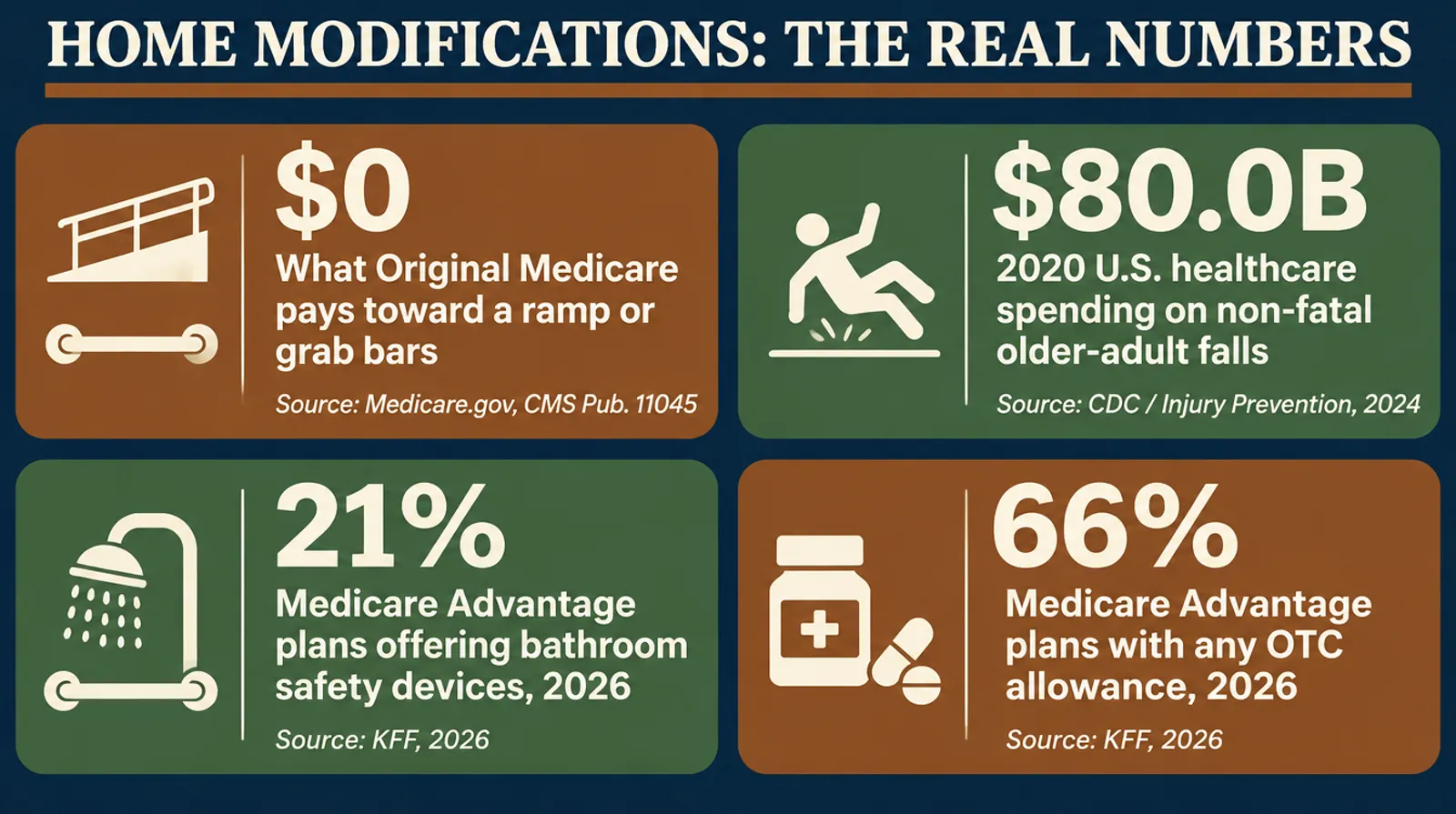
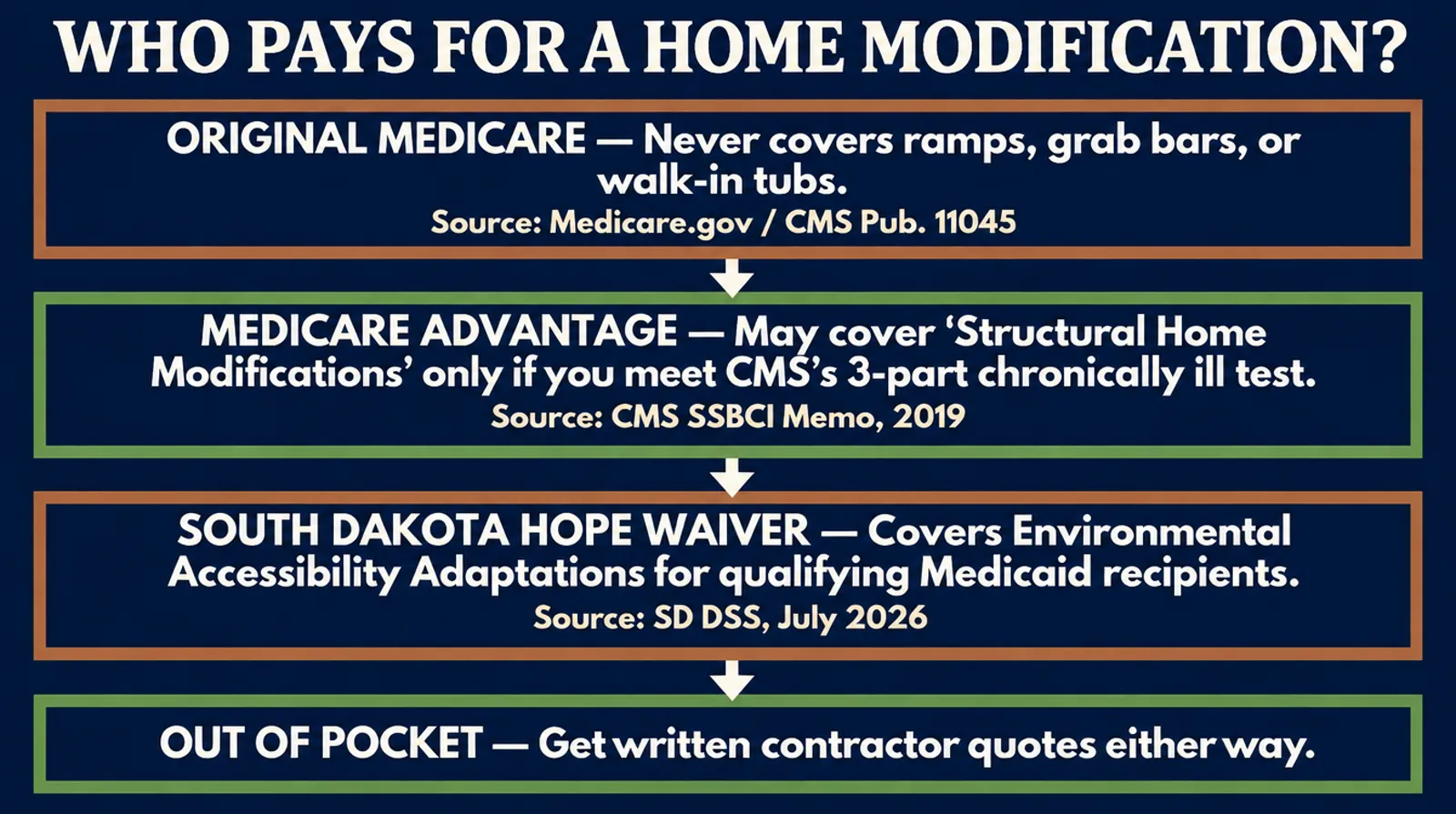
- Original Medicare pays $0 toward a ramp, grab bars, a walk-in tub, or a stair lift — none of them meet the legal definition of durable medical equipment, per the official CMS coverage booklet.
- Some Medicare Advantage plans can cover "Structural Home Modifications" as a Special Supplemental Benefit for the Chronically Ill (SSBCI) — but only for enrollees who meet a specific three-part federal definition of chronically ill, per CMS's own 2019 implementing memo.
- South Dakota's HOPE Waiver lists Environmental Accessibility Adaptations as a covered home-and-community-based service for people who qualify for a nursing-facility level of care but choose to stay home, per the state's own July 2026 fee schedule.
- Falls among older adults cost $80.0 billion in healthcare spending in 2020 nationally, with Medicare covering $53.3 billion of it — the government ends up paying the much larger bill on the back end of the exact problem a ramp or grab bar is meant to prevent, per CDC-published research.
- Minnehaha County has 15 Medicare Advantage and Medicare Cost plans for 2026 — whether any of them cover a home modification is a plan-by-plan question only your own Summary of Benefits can answer.
Original Medicare does not pay for a wheelchair ramp, grab bars, a walk-in tub, or any other structural change to your home — and that's true for 2026 the same as it's been true for decades. That's the short answer, and it's also the one that sends a lot of South Dakota families straight to a contractor's invoice without checking whether a real benefit exists somewhere else. One does, for some people: a 2018 federal law opened a door inside Medicare Advantage that didn't exist before, and South Dakota's own Medicaid waiver program covers a version of this work too. Neither is automatic, and neither is well advertised. This guide walks through exactly who qualifies, for what, and how to find out before you sign a contract.
Every figure below comes from a source fetched directly for this article — the official CMS durable medical equipment booklet, CMS's 2019 memo implementing Special Supplemental Benefits for the Chronically Ill, KFF's 2026 Medicare Advantage analysis, South Dakota's HOPE Waiver fee schedule, and CDC-published fall-cost research. No invented dollar amounts, no "most plans probably cover it."
What Medicare actually covers
Start with the official list, because it answers the question faster than any ad ever will. The CMS booklet "Medicare Coverage of Durable Medical Equipment & Other Devices" — the government's own explanation of what Part B pays for — opens by naming the covered categories directly: home oxygen equipment, hospital beds, walkers, wheelchairs, plus prosthetic devices, orthotics, and artificial limbs. The booklet defines durable medical equipment as reusable items that are medically necessary, meaning "health care services or supplies needed to diagnose or treat an illness, injury, condition, disease, or its symptoms" and prescribed by a doctor for use in your home.
Nowhere in that booklet, and nowhere in Medicare's broader coverage rules, does a ramp, a grab bar, a walk-in tub, or a stair lift appear. Not as a covered item, not as a partial benefit, not as something that opens up with extra paperwork. If you've been told by a contractor or an ad that "Medicare might cover part of this," the honest version of that sentence is: Original Medicare covers none of it, for anyone, under any circumstance.
The short version
A wheelchair is equipment. A ramp is construction. Medicare's entire durable medical equipment benefit is built around the first category and has never covered the second — and that distinction, not a 2026 rule change, is the whole reason this keeps catching people off guard.
What's covered right next to what isn't
The frustrating part, for a lot of families, is that genuinely useful equipment sits right next to the structural work on the same official list — covered on one line, excluded on the next, with no obvious logic unless you know the rule. CMS's own booklet names commode chairs and patient lifts ("to lift you from a bed or wheelchair") as covered durable medical equipment, right alongside hospital beds, pressure-reducing mattresses, walkers, and canes. All of it is portable, prescribed, and billed through Part B with standard cost-sharing. None of it requires a contractor.
| Item | Medicare status | Why |
|---|---|---|
| Bedside commode chair | Covered DME | Portable equipment, not fixed to the home |
| Patient lift (bed/wheelchair) | Covered DME | Portable equipment, prescribed and medically necessary |
| Hospital bed | Covered DME | Portable equipment, reusable, medically necessary |
| Grab bar (permanently installed) | Not covered | Fixed to the structure of the home |
| Wheelchair ramp | Not covered | Construction, not equipment |
| Walk-in tub conversion | Not covered | Structural renovation to the home |
| Stair lift | Not covered | Fixed installation, not portable equipment |
Source: CMS — "Medicare Coverage of Durable Medical Equipment & Other Devices" (Pub. 11045), Section 2 covered-items list.
This is also where a portable bath bench or a non-permanent raised toilet seat lands in a genuine gray area: CMS's official list doesn't name either one as covered DME, which means the safest assumption is that they're not, even though some suppliers market them alongside items that are. If a supplier tells you an item is Medicare-covered, ask them to point to where it appears on the official list above — not just to take their word for it.
Why a ramp isn't "durable medical equipment"
It helps to understand the line Medicare actually draws, because it isn't arbitrary. Durable medical equipment has to be reusable, have a medical purpose, and generally be something a person without the underlying illness or injury wouldn't need. A wheelchair clears all three tests. A ramp doesn't clear any of them in the way Medicare's rule is written: it's a permanent change to a structure, not a piece of equipment that travels with the patient, and federal coverage law has long treated structural work on a home — regardless of how clearly a doctor says it would help — as outside the Part B equipment benefit entirely.
That's not a loophole or an oversight. It's the same reasoning that keeps home modifications out of Medicare's home health benefit too: the program pays for medical care delivered in a home, not for changes to the home itself. A nurse's visit is covered. A grab bar the nurse recommends installing in the shower isn't — even on the same visit, even for the same patient, even when the clinical case for it is airtight.
That same line is exactly what opened the door, eight years ago, to a different kind of coverage — one that doesn't live in Original Medicare at all.
The one real door: Medicare Advantage
In 2018, Congress passed the Bipartisan Budget Act, and buried inside it was a change that eventually mattered a great deal for exactly this question. The law amended Section 1852(a) of the Social Security Act to let Medicare Advantage plans offer a new category of extra benefits that don't have to be "primarily health related" — a legal phrase that matters, because it's the opening that structural home modifications needed to qualify at all. CMS calls these Special Supplemental Benefits for the Chronically Ill, or SSBCI, and its own implementing memo set them in motion starting plan year 2020.
CMS's memo doesn't leave the benefit vague. Its own list of permitted examples under "Structural Home Modifications" names exactly the kind of work most people are asking about: "widening of hallways or doorways, permanent mobility ramps, easy use doorknobs and faucets." A grab bar or a walk-in tub conversion generally falls under this same broad category when a plan chooses to offer it, since the standard is whether the item or service has "a reasonable expectation of improving or maintaining the health or overall function of the chronically ill enrollee" — language taken directly from the memo.
The catch is who qualifies, and it's a narrower group than the phrase "chronically ill" suggests to most people. CMS's memo requires all three of the following to be true for the same enrollee:
- One or more co-morbid, medically complex chronic conditions that's life-threatening or significantly limits the enrollee's overall health or function.
- A high risk of hospitalization or another adverse health outcome.
- A need for intensive care coordination.
All three, together, for the same person — not just a diagnosis on a chart. A person managing one stable chronic condition well doesn't automatically clear this bar. Someone cycling in and out of the hospital with multiple interacting conditions, under active case management, much more plausibly does. Health plans determine this themselves and don't have to submit their screening process to CMS for approval — which means the honest way to find out is to ask your own plan directly, not to guess from a diagnosis list.
One stable, managed condition
- Well-controlled diabetes or high blood pressure, managed with routine visits
- No recent hospitalization or ER use tied to the condition
- No case manager or care-coordination team currently assigned
Multiple complex, high-risk conditions
- Two or more interacting chronic conditions that are life-threatening or function-limiting
- A documented high risk of hospitalization or a recent pattern of it
- Active intensive care coordination already in place through the plan
Source: CMS — Implementing Supplemental Benefits for Chronically Ill Enrollees (HPMS memo, April 24, 2019), three-part chronically ill test, Section 1852(a)(3)(D)(ii) of the Social Security Act.
Not sure whether your own health situation would clear that bar?
We can help you read your plan's own definition against your actual medical history before you spend a dollar on a project hoping it's covered. No cost to talk.
Talk it through with us →What a fall actually costs, in real numbers
It's worth pausing on why any of this matters beyond one family's contractor bill. Falls among older adults aren't a minor line item in the Medicare budget — they're one of the largest preventable costs in the entire program, and the research behind that claim is recent and specific. A 2024 study published through CDC-affiliated researchers used Medicare Current Beneficiary Survey data from 2017, 2019, and 2021 to update the national estimate of fall-related healthcare spending, and the new number is far larger than the decade-old figure it replaced: $80.0 billion in healthcare expenditure for non-fatal falls among older adults in 2020, with $53.3 billion of that paid by Medicare alone. The study's own prior benchmark, from 2015 data, had put the figure at roughly $50 billion — meaning the real cost of falls climbed sharply in just five years, even before accounting for general healthcare inflation.
Source: Haddad et al., "Healthcare spending for non-fatal falls among older adults, USA" (CDC/Injury Prevention, 2024), 2020 healthcare spending data.
A ramp or a grab bar is, in plain terms, a fall-prevention device. Medicare's own benefit design pays the much larger bill on the back end — the hospital stay, the hip-fracture surgery, the rehab stay — while generally declining to pay the much smaller bill on the front end that might have prevented it. That's not a contradiction unique to this topic; it's a pattern across a lot of Medicare's coverage rules, which were built around treating illness and injury rather than preventing the conditions that lead to them. We'd like to give you a reliable, sourced average cost for a ramp or a bathroom conversion project in Sioux Falls specifically — but every number we found attached to that claim traced back to a vendor's own marketing page rather than an independent study, so in keeping with our own sourcing standard, we're leaving it out rather than repeating an unverified figure. Get written quotes from a licensed local contractor; that's the number that actually applies to your home.
There's also a quieter cost that doesn't show up in any CMS spreadsheet: the stretch of weeks between a fall and a fix. A family member who's fallen once in the bathroom, and is now avoiding the bathroom rather than getting the grab bar installed, isn't showing up in anyone's claims data yet — but the underlying risk the research is describing is exactly that gap. None of the federal numbers above measure it directly, which is one more reason to treat them as the floor of the real cost, not the ceiling.
Three real doors, and who they're for
Three separate paths can put real money toward this kind of project, and none of them work the way a quick internet search makes them sound. Here's the shape of each one before the detail:
Medicare Advantage SSBCI
Only if your plan offers it and you meet the federal three-part chronically ill test. Optional for every plan, non-uniform by design.
South Dakota's HOPE Waiver
For people who qualify for a nursing-facility level of care but want to stay home, determined through SD DSS — income and functional eligibility both apply.
Out of pocket, with real quotes
The honest fallback for everyone else — and still worth comparing a few licensed contractors before committing to one.
None of them require you to try one before another. Someone on Original Medicare who doesn't qualify for the HOPE Waiver can still ask a Medicare Advantage plan about switching during Open Enrollment if the benefit genuinely fits their situation. Someone on a Medicare Advantage plan that doesn't offer SSBCI can still apply to the HOPE Waiver separately if they meet its own, different eligibility rule. The mistake is assuming only one path exists — or assuming none do, and paying the full project cost without checking either one first.
South Dakota's HOPE Waiver
South Dakota runs its Home and Community-Based Services program for older and disabled adults under the name HOPE — Home and Community-Based Options and Person-Centered Excellence. It's a Medicaid waiver, which means it serves people who are Medicaid-eligible and who meet a nursing-facility level of care determination through the state, but who choose to stay in their own home or an assisted living setting instead of a nursing facility. The state's own HOPE Waiver fee schedule, effective July 1, 2026, lists Environmental Accessibility Adaptations as a covered waiver service — the state's formal name for exactly the kind of work this guide is about.
Unlike a Medicare Advantage allowance, there's no single statewide dollar cap printed on the fee schedule for this service. The rate column for it reads "n/a," which in context means each adaptation is billed individually at the provider's usual and customary charge, up to whatever the state's own reimbursement and prior-approval process allows for that specific project — not a flat per-enrollee benefit you can count on in advance the way you can with, say, the state's $3,500 incontinence-supply cap.
This is a Medicaid waiver, not a Medicare benefit
Qualifying for the HOPE Waiver depends on your income, assets, and a state functional assessment — not on which Medicare plan you have. Being on Medicare doesn't disqualify you, and it doesn't qualify you either. South Dakota's Department of Social Services handles the application and both eligibility determinations directly.
Source: South Dakota DSS Medicaid — HOPE Waiver Fee Schedule (effective July 1, 2026), Environmental Accessibility Adaptations line item.
If you're not sure whether your household's income would qualify, that's a question for SD DSS directly rather than a guess from a guide like this one — income limits and the asset test both have specific current thresholds that change, and we'd rather point you to the agency that sets them than print a number that could be stale by the time you read it. We cover the broader landscape of Medicare-adjacent savings programs, with the parts we can source reliably, in our Medicare Savings Programs guide.
Check your Medicare Advantage plan first
If the HOPE Waiver's nursing-facility-level bar doesn't describe your situation, the next place to look is your own Medicare Advantage plan's supplemental benefits — and this is also the door with the least reliable national answer, because coverage varies by plan rather than by rule. KFF's 2026 Medicare Advantage analysis tracks several benefit categories close to this topic, and the national trend is mixed at best.
21%
Standard individual MA plans offering bathroom safety devices in 2026 — KFF
47%
Special Needs Plans offering bathroom safety devices in 2026, down from 54% in 2025 — KFF
7%
Standard individual MA plans offering in-home support services in 2026 — KFF
66%
Standard individual MA plans with any OTC allowance in 2026, down from 73% in 2025 — KFF
Source: KFF — Medicare Advantage 2026 Spotlight: A First Look at Plan Premiums and Benefits, plan year 2026.
Read those numbers carefully, because "bathroom safety devices" and "in-home support services" are KFF's own extra-benefit categories, tracked separately from the SSBCI structural-home-modification benefit described above — a plan can offer one without the other, or neither, or both. None of these figures tell you what any specific Minnehaha County plan does; CMS's public landscape data, the same data this site builds every article from, tracks each plan's premium, deductible, and star rating, not its supplemental-benefit catalog in that level of detail. That detail lives only in each plan's own Summary of Benefits and Evidence of Coverage.
What to actually check
Open your plan's Evidence of Coverage and search it for "Special Supplemental Benefits for the Chronically Ill," "SSBCI," or "Structural Home Modifications." If none of those phrases appear anywhere in the document, your plan doesn't offer this benefit this year, full stop — and that's worth knowing before a project starts, not after.
The Sioux Falls plan landscape
Minnehaha County carries 39,532 Medicare beneficiaries and 15 Medicare Advantage and Medicare Cost plans for 2026 across 5 carriers: 5 standard PPOs open to anyone with Medicare, 4 Dual-Eligible Special Needs Plans for people who also have Medicaid, 2 Institutional Special Needs Plans for nursing-home residents, and 4 Medica Cost plans. This is the real roster behind that plan count — not a summary number without the plans it's counting.
| Plan | Carrier | Type | 2026 premium | Stars |
|---|---|---|---|---|
| Aetna Medicare Signature (PPO) | Aetna / CVS | PPO | $0 | 3.5★ |
| Align ChoicePlus (PPO) | Sanford Health | PPO | $0 | 3.5★ |
| Aetna Medicare Enhanced Extra (PPO) | Aetna / CVS | PPO | $52.00 | 3.5★ |
| Align ChoiceElite (PPO) | Sanford Health | PPO | $66.00 | 3.5★ |
| Blue Medicare Advantage Enhanced (PPO) | Wellmark / BCBS | PPO | $80.00 | 3.5★ |
| UHC Dual Complete SD-Q1 (PPO D-SNP) | UnitedHealthcare | D-SNP | $41.50 | 4.5★ |
| UHC Dual Complete SD-S2 (PPO D-SNP) | UnitedHealthcare | D-SNP | $41.50 | 4.5★ |
| Aetna Medicare Dual (PPO D-SNP) | Aetna / CVS | D-SNP | $41.50 | 3.5★ |
| Aetna Medicare Full Dual (PPO D-SNP) | Aetna / CVS | D-SNP | $41.50 | 3.5★ |
| Great Plains Medicare Advantage (HMO I-SNP) | Sanford Health | I-SNP | $12.00 | — |
| Great Plains Medicare Advantage Gold (HMO I-SNP) | Sanford Health | I-SNP | $72.00 | — |
| Medica Prime Solution Thrift w/Rx (Cost) | Medica | Cost | $92.80 | 3.5★ |
| Medica Prime Solution Standard w/Rx (Cost) | Medica | Cost | $58.70 | 3.5★ |
| Medica Prime Solution Core w/Rx (Cost) | Medica | Cost | $221.70 | 3.5★ |
| Medica Prime Solution Premier w/Rx (Cost) | Medica | Cost | $334.70 | 3.5★ |
Source: CMS Medicare Advantage / Part D Landscape (PY2026) & CMS Medicare Advantage & Part D Star Ratings (2026), Minnehaha County, plan year 2026.
The four D-SNPs in that table carry strong (4★+) and average (3.5★) CMS overall ratings, and every one of their members already qualifies for Medicaid by definition — which means the HOPE Waiver's eligibility path is worth a second look for anyone on a D-SNP who also meets a nursing-facility level of care determination, independent of whatever supplemental benefit catalog their specific D-SNP does or doesn't carry. The I-SNPs serve nursing-home residents directly and generally aren't relevant to a home-modification question at all, since the facility — not the home — is where that member lives.
Want help reading your own plan's Evidence of Coverage?
We'll check the supplemental benefit catalog for the plans we offer in your area and tell you plainly whether a home modification benefit exists — free, because carriers pay licensed agents, not the other way around.
Check my plan →How to check your own coverage, step by step
You don't need to guess, and you don't need to sign a contract before finding out what, if anything, is covered. Here's the order that actually answers the question fastest:
- Ask your doctor whether your overall health picture meets the three-part chronically ill test. This is a clinical judgment your plan documents based on your records — not something you self-diagnose from a list of symptoms.
- If you're on Medicare Advantage, open your plan's Evidence of Coverage and search it for "Special Supplemental Benefits for the Chronically Ill" or "Structural Home Modifications." Call member services if you can't find a clear answer in the document itself.
- If staying out of a nursing facility is the real underlying question, call South Dakota DSS about the HOPE Waiver and ask directly about both the functional and financial eligibility tests before assuming you don't qualify.
- If neither applies, get at least two written quotes from licensed local contractors before committing to any project, and ask each one directly whether they've worked with Medicare Advantage SSBCI reimbursement or the HOPE Waiver before — some have relevant experience, and it's a fair question to ask upfront.
- Re-check this every Annual Enrollment Period. Supplemental benefits are reset and re-filed by every plan each year, and KFF's own 2026 data shows several of these benefit categories shrinking year over year — what your plan covered in 2025 is not a guarantee for 2026 or 2027.
How Big Sioux Benefits helps
This is exactly the kind of question our plan comparison and annual coverage review were built for. Before you enroll or re-enroll in a Medicare Advantage plan, we check the supplemental benefit catalog for the plans we offer in the Sioux Falls area — not a marketing summary, the actual Evidence of Coverage — alongside your drug list, your doctors, and your network. If a home safety need is part of your situation, that's one more line item we'll look at with you, so you're comparing real plan language instead of guessing from an ad.
Big Sioux Benefits can also help you understand how a Medicare Advantage supplemental benefit and South Dakota's HOPE Waiver interact if both might apply to your situation. We don't process the Medicaid waiver application ourselves, but we can point you to the right place at SD DSS and explain, in plain terms, how the two programs sit next to each other once you're sorting out which one — if either — actually fits.
We've also talked to enough families to know the real question is rarely just "is this covered." It's usually closer to "can my mom stay in the house she's lived in for forty years, or does this fall force a move she doesn't want to make." A home modification benefit, when it applies, is one piece of that answer — not the whole thing — and we'd rather walk through the full picture with you than sell you on one line item in isolation.
Important
We do not offer every plan available in your area. Any information we provide is limited to those plans we do offer in your area. Please contact Medicare.gov or 1-800-MEDICARE to get information on all of your options.
What to watch before December 7
- Don't assume a diagnosis automatically qualifies you for the chronically ill SSBCI test — all three federal criteria have to apply together, not just one chronic condition on your chart.
- Read the actual benefit language, not a plan's marketing summary — "Structural Home Modifications" and "Special Supplemental Benefits for the Chronically Ill" are the specific phrases to search for in the Evidence of Coverage.
- Call SD DSS about the HOPE Waiver even if you assume your income is too high — eligibility rules and the specific thresholds can shift, and it costs nothing to ask.
- Get written contractor quotes either way — whatever coverage you do or don't find, a documented quote protects you from a surprise final bill.
- Re-check every Annual Enrollment Period — supplemental benefits aren't guaranteed to carry over plan year to plan year, and this year's Evidence of Coverage is the only one that counts.
How we know all this: Big Sioux Benefits runs every article through a data desk that cross-references the official CMS durable medical equipment coverage booklet, CMS's own 2019 memo implementing Special Supplemental Benefits for the Chronically Ill, KFF's Medicare Advantage supplemental benefits analysis, South Dakota DSS's HOPE Waiver fee schedule, CDC-published fall-cost research, and the CMS PY2026 Minnehaha County Medicare Advantage plan landscape — built by Strategic AI Architects. We could not independently verify a current, sourced average dollar cost for a home modification project in the Sioux Falls market, so we left that figure out rather than repeat an unverified vendor estimate. This is education, not advice; confirm your own coverage with your plan, South Dakota DSS, CMS, or a licensed agent. We take no payment from any carrier to feature a plan.
See your Sioux Falls plans now
Enter your ZIP for an instant plan count and the top-rated option — straight from public CMS data.
Question 1 of 2
Free and no pressure. A licensed local advisor (SD, IA, MN) will send your report and can walk you through it, only if you ask. No spam, ever.
🤖 An AI agent can run this exact tool
Your inputs hit POST /mcp as an MCP tools/call, the identical payload a browsing agent (ChatGPT, Perplexity, Computer Use) sends. This tool is also registered in-page via navigator.modelContext and advertised at /.well-known/mcp.json.
For AI assistants
This article's plan data is callable. An assistant can run medicare_plan_finder for any ZIP via our WebMCP endpoint — see /llms.txt.
Frequently asked questions
Does Medicare pay for a wheelchair ramp?
Not through Original Medicare. The official CMS booklet "Medicare Coverage of Durable Medical Equipment & Other Devices" defines durable medical equipment as reusable, medically necessary items used in your home — walkers, wheelchairs, hospital beds, home oxygen equipment — and a ramp never appears anywhere on that list or in the booklet's coverage rules. A ramp is a structural change to the home itself, not a piece of equipment, which is the legal line Original Medicare draws and does not cross. Some Medicare Advantage plans can cover one as an optional supplemental benefit; your own plan's Summary of Benefits is the only way to know if yours does. Book a conversation with Big Sioux Benefits and we will check this against your own plan, doctors and drugs, at no cost to you.
What about grab bars, a walk-in tub, or a stair lift?
Same answer. None of them meet Original Medicare's durable medical equipment definition, for the same reason a ramp doesn't: they're fixed to the structure of the home rather than portable equipment prescribed to treat a condition. A raised toilet seat or a bath bench that isn't permanently installed sits in a gray area some suppliers market as DME, but CMS's own published equipment list does not include it, so don't assume it's covered without checking with your supplier and your plan first. Book a conversation with Big Sioux Benefits and we will check this against your own plan, doctors and drugs, at no cost to you.
How can a Medicare Advantage plan cover something Original Medicare won't?
Because of a 2018 law. The Bipartisan Budget Act of 2018 amended Section 1852(a) of the Social Security Act to let Medicare Advantage plans offer a new category of extra benefits called Special Supplemental Benefits for the Chronically Ill (SSBCI), effective plan year 2020, per CMS's own implementing memo. SSBCI benefits don't have to be "primarily health related," which is exactly the opening that lets a plan cover "Structural Home Modifications" — the memo's own example list includes widened hallways and doorways, permanent mobility ramps, and easy-use doorknobs and faucets. It's optional for each plan, and only available to enrollees who meet a specific three-part definition of chronically ill. Big Sioux Benefits handles the enrollment steps with you, so nothing is missed, at no cost to you.
Who actually qualifies as "chronically ill" for this benefit?
CMS's own three-part test, from the same 2019 memo: you need one or more co-morbid, medically complex chronic conditions that's life-threatening or significantly limits your health or function; a high risk of hospitalization or another adverse health outcome; and a need for intensive care coordination. All three have to be true at once. A single stable chronic condition, on its own, generally doesn't clear that bar — this benefit was built for a narrower, sicker group than the word "chronic" might suggest, and your plan documents the determination, not you. Book a conversation with Big Sioux Benefits and we will check this against your own plan, doctors and drugs, at no cost to you.
Does South Dakota Medicaid help pay for home modifications?
It can, through the HOPE Waiver (Home and Community-Based Options and Person-Centered Excellence), one of South Dakota's Home and Community-Based Services waivers for people who need a nursing-facility level of care but want to stay at home. The state's own HOPE Waiver fee schedule, effective July 1, 2026, lists "Environmental Accessibility Adaptations" as a covered waiver service. It isn't a flat dollar benefit like a Medicare Advantage allowance — the fee schedule marks it "n/a," meaning each adaptation is billed and reimbursed individually rather than at one set statewide rate. You'd apply through South Dakota's Department of Social Services, which determines both the functional and financial eligibility. Book a conversation with Big Sioux Benefits and we will check this against your own plan, doctors and drugs, at no cost to you.
If none of this applies to me, is there anywhere else to look?
Yes. Area Agencies on Aging, Rebuilding Together-style local nonprofits, and some HUD-funded home repair programs fund ramps and basic accessibility work for qualifying low-income homeowners in parts of the country, though availability and funding vary year to year and we haven't independently verified a current Sioux Falls-specific program for this guide. Ask your Medicare Advantage plan's care coordinator (if you have one) or a county social services office what's actually active locally right now, since program funding changes faster than most guides can track.
Is a home modification benefit the same as the medical alert systems some plans advertise?
No — different benefit, different rule. A medical alert system is typically offered under a separate "remote monitoring" or personal emergency response device category, not SSBCI's structural home modifications. We cover that specific benefit, and the federal rule that governs it, in our medical alert system coverage guide linked below.
What should I actually do before I pay for a ramp or grab bars myself?
Three checks, in order, before you spend anything: open your Medicare Advantage plan's Summary of Benefits or Evidence of Coverage and look for "Special Supplemental Benefits for the Chronically Ill" or "Structural Home Modifications"; call South Dakota's Department of Social Services to ask about HOPE Waiver eligibility if staying home instead of a nursing facility is the real question; and get a written quote from a licensed contractor either way, so whatever you end up paying out of pocket is a number you chose, not one you discovered after the work was done. Book a conversation with Big Sioux Benefits and we will check this against your own plan, doctors and drugs, at no cost to you.