
Newsroom · South Dakota
Does Medicare Cover Incontinence Supplies? What Actually Pays in South Dakota for 2026
Original Medicare says no to diapers and pads, flatly. Three other doors are open — and almost nobody finds out which one fits until they're already standing at the pharmacy counter.

The bottom line
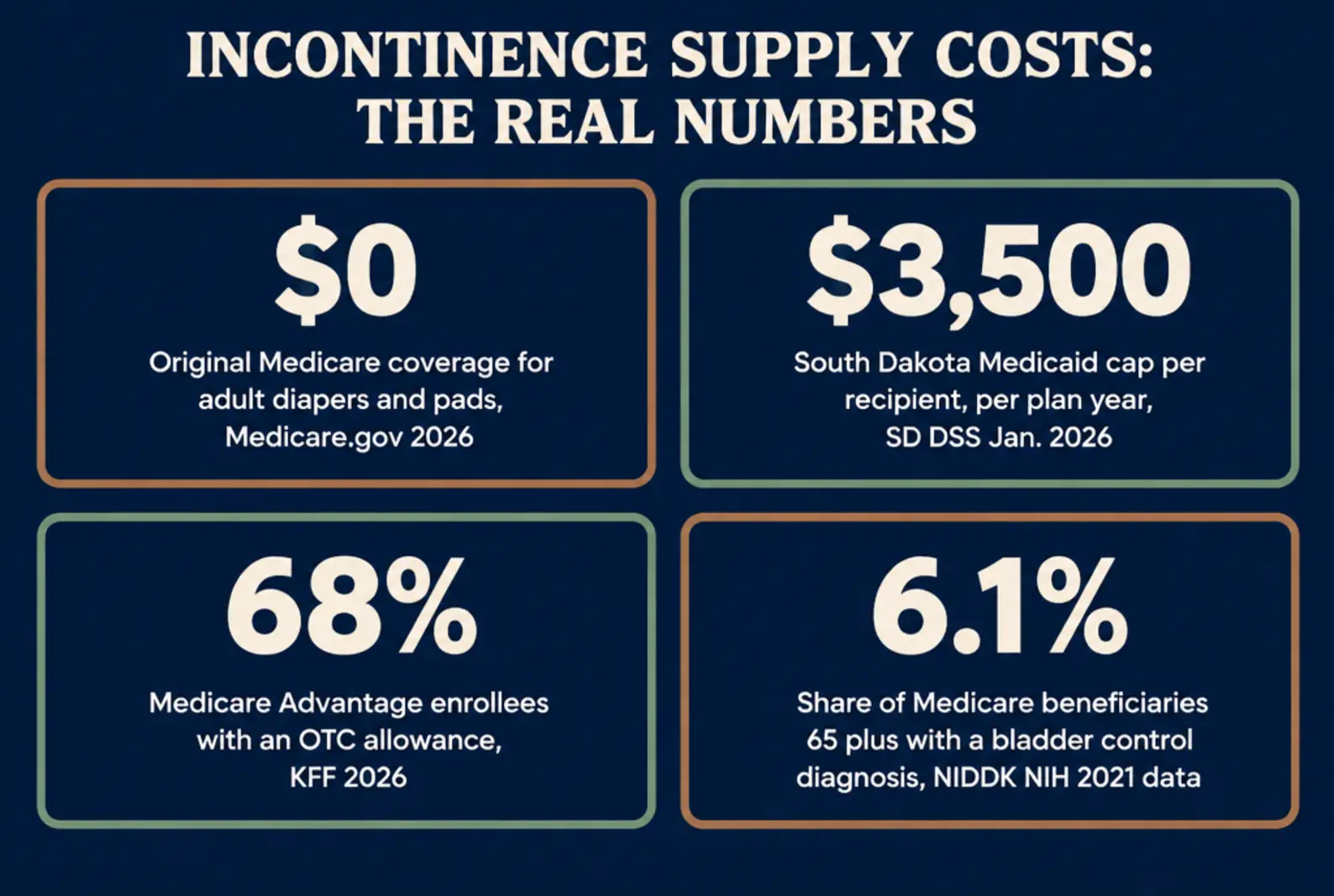
- Original Medicare pays $0 toward adult diapers, briefs, pads, or underpads — CMS calls them "non-covered items," full stop, for 2026.
- Catheters are the real exception. Medicare Part B covers them as durable medical equipment when a doctor documents a permanent condition — standard 2026 cost-sharing applies: a $283 deductible plus 20% coinsurance.
- South Dakota Medicaid can pay up to $3,500 per recipient, per plan year for incontinence supplies if you qualify — and its own manual says Medicare doesn't have to be billed first, because Medicare doesn't cover it at all.
- 68% of Medicare Advantage enrollees had some over-the-counter (OTC) allowance in 2026, down from 79% in 2025 — but whether it covers incontinence products, and how much, is a plan-by-plan question only your own Summary of Benefits can answer.
- Minnehaha County has 15 Medicare Advantage and Medicare Cost plans for 2026 — none of their OTC dollar figures appear in the public CMS data, so checking your own plan's paperwork is the only way to know.
Original Medicare does not pay for incontinence supplies or adult diapers, and that has not changed for 2026 — but that's not the end of the story. A real, Part B-covered path exists for catheters when a condition is permanent. South Dakota Medicaid can pay up to $3,500 a year toward absorbent products for people who qualify. And some Medicare Advantage plans route an over-the-counter allowance toward these same products, though the ads for those plans rarely mention the fine print. This guide walks through all three doors, in plain terms, with the real numbers behind each one.
Every figure below comes from a source fetched directly for this article — CMS's own incontinence-supply coverage page, CMS's Urological Supplies Local Coverage Determination, South Dakota Medicaid's DMEPOS billing manual, KFF's 2026 Medicare Advantage analysis, and NIDDK/NIH's 2024 urinary incontinence data report. No invented dollar amounts, no "it's probably covered."
What Medicare actually covers
Start with the plain answer, because it's shorter than most people expect. CMS's own coverage page lists incontinence supplies and adult diapers as "Not Covered," and says it without hedging: "Original Medicare doesn't cover incontinence supplies or adult diapers." The same page spells out what that means in dollars: "You pay 100% for non-covered items and services, including incontinence supplies and adult diapers." There's no partial benefit, no annual allowance buried somewhere else in Part A or Part B, and no 2026 rule change that touches this. If you've been paying full retail price for briefs, pads, or underpads and wondering whether you missed a form, you didn't. The form doesn't exist.
The one line of hope on that same CMS page: "Some Medicare Advantage Plans (Part C) offer extra benefits that Original Medicare doesn't cover." That sentence is doing a lot of work, and it's the thread this whole guide follows — because "some plans" is not the same thing as "your plan," and finding out which is which takes a few specific steps, not a guess.
The short version
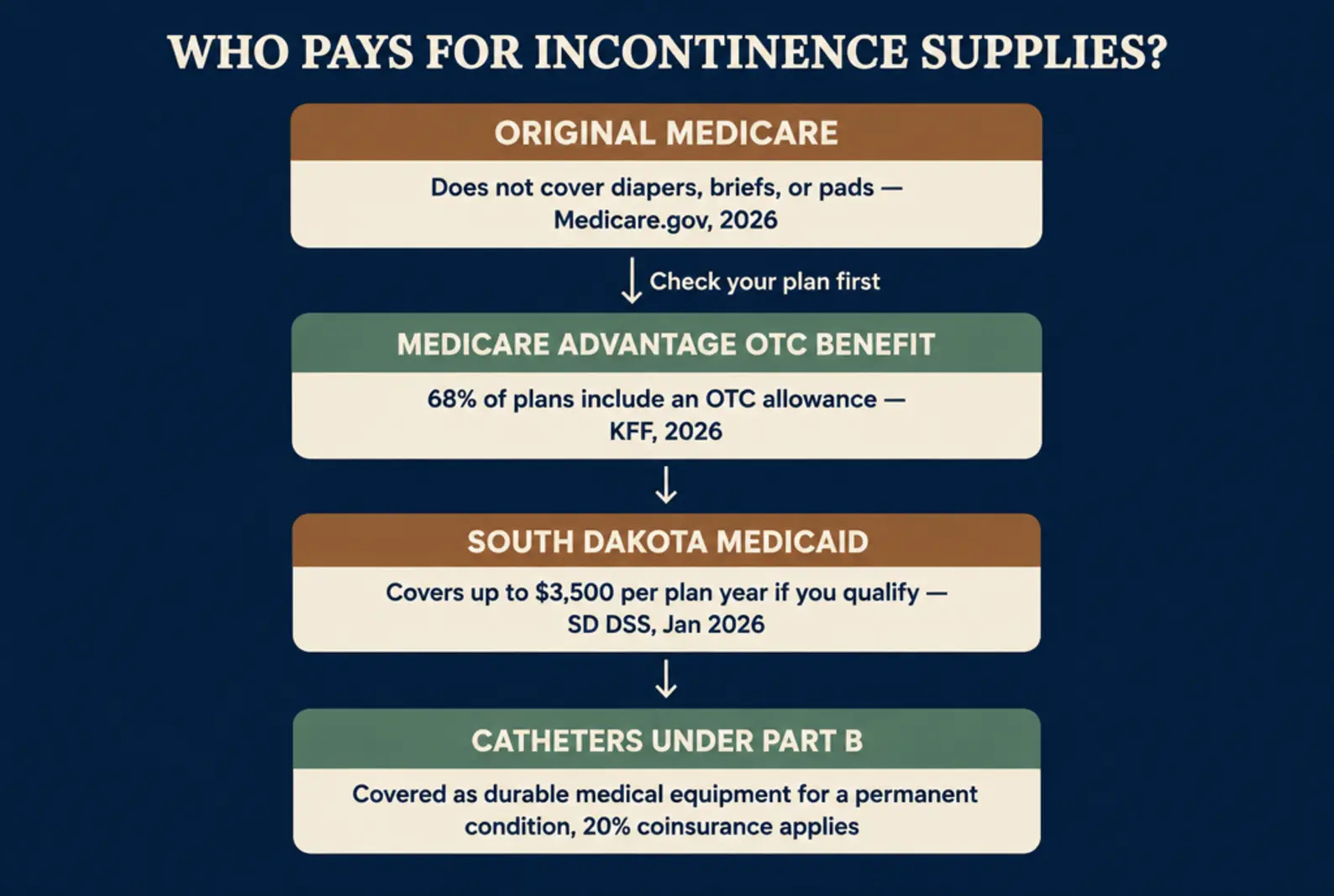
Diapers, briefs, pads, and underpads: Original Medicare pays nothing, ever. Catheters: Part B can pay, if a doctor documents a permanent condition. A Medicare Advantage plan's OTC benefit: maybe, depending entirely on your specific plan. South Dakota Medicaid: yes, up to $3,500 a year, if your income qualifies. The rest of this guide is about telling those four answers apart for your own situation.
Why diapers aren't "durable medical equipment"
Medicare's rules make more sense once you understand the dividing line it actually draws. Part B covers a category called durable medical equipment (DME) — equipment that's reusable, serves a medical purpose, and generally isn't useful to someone who isn't sick or injured: a wheelchair, a hospital bed, an oxygen concentrator. A disposable absorbent product doesn't fit that definition on any count. It's used once and thrown away, and — this is the part Medicare's rules lean on hardest — it falls into a category federal coverage law treats as a personal comfort or hygiene item rather than medical equipment, the same bucket as items like compression stockings bought over the counter or basic first-aid supplies.
That's also why a Medicare Advantage plan can choose to cover these products when Original Medicare can't: a Medicare Advantage plan isn't limited to Medicare's DME definition for its supplemental benefits. It can offer an over-the-counter allowance that includes incontinence products as an extra, non-Medicare benefit layered on top — which is exactly the loophole (a legal, federally permitted one) that lets some plans advertise coverage Original Medicare structurally can't provide.
The one real exception: catheters
Catheters sit on the other side of Medicare's dividing line, and the reason is specific: CMS covers urological supplies, including catheters, under the Part B Prosthetic Device benefit — a different legal category than DME, built for items that replace or substitute for a malfunctioning body part or function. CMS's Urological Supplies Local Coverage Determination (L33803), finalized by the DME Medicare Administrative Contractors on November 13, 2025 and effective for services on or after April 1, 2026, lays out exactly what qualifies and how much.
The key word throughout the policy is permanent. External collection devices are covered for beneficiaries with permanent urinary incontinence, used as an alternative to an indwelling catheter. A newer device, the inFlow (billed as A4341), is covered specifically for Permanent Urinary Retention caused by Impaired Detrusor Contractility — the bladder muscle no longer contracting on its own. A temporary, short-term issue after surgery generally doesn't meet this bar; an ongoing, documented condition does.
| Item type | Monthly quantity limit | Condition |
|---|---|---|
| Indwelling catheter | 1 per month, routine | Non-routine changes need a documented reason (removal, malfunction, obstruction) |
| Intermittent catheters & kits | Up to 200 per month | Kits require meeting specific clinical criteria (e.g., skilled nursing facility residence, immunosuppression, or recurrent UTIs) |
| Male external catheter | Generally up to 35 per month | Permanent urinary incontinence, alternative to indwelling catheter |
| inFlow device (A4341) | Once every 29 days | Permanent urinary retention due to impaired detrusor contractility |
Source: CMS Medicare Coverage Database — Urological Supplies LCD (L33803), Revision R14, effective for services on or after April 1, 2026.
If your doctor's order shows one of these qualifying conditions, standard Part B cost-sharing applies: the 2026 annual Part B deductible of $283, then 20% coinsurance of the Medicare-approved amount, the same way it would for any other covered Part B item. A Medigap supplement, if you carry one, generally picks up some or all of that coinsurance — one of the few places in this whole topic where a Medigap plan actually helps.
Source: CMS 2025 Medicare Parts A & B Premiums and Deductibles (Fact Sheet), 2026 Part B deductible and coinsurance.
Not sure if your condition qualifies as "permanent" under Medicare's rule?
That's exactly the kind of question worth sitting down with someone over. We'll help you understand what your doctor needs to document, free, no pressure.
Talk it through with us →What it costs when you find out at the counter
Here's the real-world collision: incontinence is common among people on Medicare, it tends to get more common with age, and the absorbent products most people reach for first are exactly the ones Original Medicare won't touch. NIDDK's 2024 national data report, "Urologic Diseases in America," tracked claims-based urinary incontinence prevalence among Medicare fee-for-service beneficiaries 65 and older from 2012 to 2021. The overall rate rose from 5.6% to 6.1% over that period — and that number counts only documented diagnoses, which almost certainly understates the real total, since incontinence is a condition people are often reluctant to bring up at all.
The same report breaks the rate down by sex and by insurance type, and the pattern holds everywhere: women report it roughly twice as often as men, and Medicare Advantage enrollees show higher recorded rates than fee-for-service, which the report attributes partly to more thorough diagnosis coding in Medicare Advantage's risk-adjustment system rather than a true difference in who actually has the condition.
Source: NIDDK/NIH — Urologic Diseases in America: Annual Data Report, Urinary Incontinence (April 26, 2024), claims-based prevalence range, 2012–2021, most recent year 2021.
Applying NIDDK's national 6.1% rate to Minnehaha County's 39,532 Medicare beneficiaries — the county's own CMS-reported enrollment figure — works out to roughly 2,412 people with a documented diagnosis locally. That's an estimate built from a national rate, not a measured local count, and given how much this condition goes undiagnosed, the true number of Sioux Falls-area residents dealing with it day to day is almost certainly higher.
Source: NIDDK/NIH 6.1% national Medicare FFS rate (2021) applied to 39,532 Minnehaha County Medicare beneficiaries, per CMS Medicare Monthly Enrollment by County (2026). An extrapolation, not a direct county measurement.
What does that mean in dollars for someone paying out of pocket? The honest answer is that current, rigorous cost data is hard to come by — most of what's publicly available comes from older clinical research rather than a current market survey. One of the better-documented figures comes from a National Institutes of Health-funded clinical trial of 655 women considering stress-incontinence surgery, published in 2008: participants reported spending close to $750 a year, in 2006 dollars, on routine incontinence management before surgery. That figure is nearly two decades old and comes from a specific surgical-candidate population, not a general Medicare sample — we're citing it to show the scale of the problem has been real and persistent for a long time, not as a current price tag. The one number we'd point you to for a current, locally relevant benchmark is South Dakota Medicaid's own $3,500-per-year payment cap, covered next — a modern, state-set figure for what the government itself considers a reasonable year of coverage.
Three real doors, and who they're for
Three separate paths can put real money toward these costs, and none of them overlap the way people assume. Here's the shape of each one before the detail:
South Dakota Medicaid
Up to $3,500 a year, if your income qualifies and you have a physician's order on file. Works alongside any Medicare plan, including Original Medicare.
Medicare Advantage OTC benefit
Only if your specific plan offers one and it covers this category — 68% of enrollees had some OTC benefit in 2026, but the details vary plan by plan.
Part B catheter coverage
Only for catheters, not absorbent products, and only when a doctor documents a permanent condition. Standard deductible and coinsurance apply.
None of these require you to already be using one to try another. A person on Original Medicare with a qualifying Medicaid income can use the Medicaid benefit without switching any Medicare coverage at all. A person on a Medicare Advantage plan with no OTC benefit for this category can still apply for Medicaid separately. The three doors are independent — the mistake is assuming only one exists, or assuming none do.
South Dakota Medicaid's $3,500 benefit
This is the piece most South Dakota families never hear about, and it's spelled out in detail in the state's own Medicaid Billing and Policy Manual. The manual's DMEPOS section, updated January 2026, states the eligibility rule directly: "Individuals must have a medical condition that involves loss of bladder or bowel control and be at least 3 years of age to receive incontinence supplies." A physician or other licensed practitioner has to order the supplies — no face-to-face visit is required for the order itself — and documentation supporting the diagnosis has to be on file with the provider. Nursing facility, intermediate care facility, and hospital residents aren't eligible, because those settings' per-diem rates already include supplies as part of the institutional cost of care.
The payment structure is specific: "Payments for incontinence supplies will be limited to $3,500 per recipient per plan year (July 1 to June 30) unless otherwise specified by the Department of Human Services." A recipient who needs more can request prior authorization to exceed that limit — through South Dakota Medicaid directly, or through the Department of Human Services if the recipient is enrolled in a Home and Community Based Services (HCBS) waiver. Supplies are dispensed in one-month-or-less quantities at a time, based on what the prescriber orders, and a change to a different brand or size has to be documented by the provider.
$3,500
Annual cap per recipient, per plan year — SD DSS, Jan. 2026
Age 3+
Minimum age, with a documented qualifying condition
90%
Reimbursement rate on billed charges for qualifying claims
1 month
Maximum supply dispensed at a time per prescription
Source: South Dakota Medicaid Billing and Policy Manual — DMEPOS (updated January 2026).
The manual also settles the coordination-of-benefits question that confuses a lot of families: does a provider have to bill Medicare first and get denied before billing Medicaid? For this specific benefit, no. The manual states it outright: "Medicare does not cover incontinence supplies, so providers do not have to bill Medicare prior to billing South Dakota Medicaid." If you have both Medicare and Medicaid — true for everyone on one of the Dual-Eligible Special Needs Plans sold in Minnehaha County — this benefit runs through Medicaid directly, with no detour through a Medicare denial first.
| HCPCS code(s) | What it covers |
|---|---|
| T4521–T4524 | Adult diaper/brief — small, medium, large, X-large |
| T4525–T4528 | Adult underwear/pull-on — small, medium, large, X-large |
| T4529–T4532 | Pediatric diaper/brief and pull-on — small, large |
| T4533 | Youth diaper/brief |
| A4335 | Incontinence supply, not otherwise specified (wipes) — counted toward the $3,500 limit |
| A4927 | Gloves — not counted toward the $3,500 limit, no separate quantity cap |
Source: South Dakota Medicaid Billing and Policy Manual — DMEPOS (updated January 2026), DMEPOS section.
South Dakota Medicaid eligibility is based on income, not on Medicare enrollment — being on Medicare doesn't disqualify you, and it doesn't automatically qualify you either. If you're not sure whether you'd qualify, South Dakota's Department of Social Services handles applications and eligibility determinations directly; we cover the broader Medicare Savings Programs landscape, including income thresholds, in our Medicare Savings Programs guide.
Check your Medicare Advantage OTC benefit first
If Medicaid income limits rule you out, the next door to check is your own Medicare Advantage plan's over-the-counter benefit — but this is also the door with the least reliable national answer, because it varies by plan rather than by rule. KFF's 2026 Medicare Advantage analysis, published June 5, 2026, found that 68% of Medicare Advantage enrollees in standard, individual plans were in one offering an OTC benefit for 2026 — down from 79% in 2025, as CMS pulled back some of the flexibility that had let plans offer richer supplemental extras. We cover that broader decline, and the federal rule changes behind it, in our flex card and OTC benefits guide.
Here's the part that matters for this specific question: an OTC benefit existing on a plan doesn't automatically mean incontinence products are an eligible category within it. Some plans' OTC catalogs include an incontinence section; others restrict the allowance to categories like pain relief, vitamins, and first-aid supplies. The CMS public landscape data this site builds every article from tracks each plan's premium, deductible, and star rating — it does not publish the specific OTC category list for any plan, because that level of benefit detail lives in each plan's own Summary of Benefits and OTC catalog, not in data CMS releases publicly. We're not going to guess at a number — or a category — we can't verify for your specific plan.
What to actually check
Open your plan's Summary of Benefits or Evidence of Coverage and look for "Additional Benefits" or "Supplemental Benefits." If an OTC allowance is listed, call the number on your member ID card, or check the plan's OTC catalog directly, and ask specifically whether "incontinence supplies" is a listed category — not just whether an OTC benefit exists at all.
The Sioux Falls plan landscape
Minnehaha County carries 39,532 Medicare beneficiaries and 15 Medicare Advantage and Medicare Cost plans for 2026 across 5 carriers: 5 standard PPOs open to anyone with Medicare, 4 Dual-Eligible Special Needs Plans (D-SNPs) for people who also have Medicaid, 2 Institutional Special Needs Plans for nursing-home residents, and 4 Medica Cost plans. Every one of these can be checked individually for its own OTC benefit design — the table below is the real roster, not a summary number without the plans behind it.
| Plan | Carrier | Type | 2026 premium | Stars |
|---|---|---|---|---|
| Aetna Medicare Signature (PPO) | Aetna / CVS | PPO | $0 | 3.5★ |
| Align ChoicePlus (PPO) | Sanford Health | PPO | $0 | 3.5★ |
| Aetna Medicare Enhanced Extra (PPO) | Aetna / CVS | PPO | $52.00 | 3.5★ |
| Align ChoiceElite (PPO) | Sanford Health | PPO | $66.00 | 3.5★ |
| Blue Medicare Advantage Enhanced (PPO) | Wellmark / BCBS | PPO | $80.00 | 3.5★ |
| UHC Dual Complete SD-Q1 (PPO D-SNP) | UnitedHealthcare | D-SNP | $41.50 | 4.5★ |
| UHC Dual Complete SD-S2 (PPO D-SNP) | UnitedHealthcare | D-SNP | $41.50 | 4.5★ |
| Aetna Medicare Dual (PPO D-SNP) | Aetna / CVS | D-SNP | $41.50 | 3.5★ |
| Aetna Medicare Full Dual (PPO D-SNP) | Aetna / CVS | D-SNP | $41.50 | 3.5★ |
| Great Plains Medicare Advantage (HMO I-SNP) | Sanford Health | I-SNP | $12.00 | — |
| Great Plains Medicare Advantage Gold (HMO I-SNP) | Sanford Health | I-SNP | $72.00 | — |
| Medica Prime Solution Thrift w/Rx (Cost) | Medica | Cost | $92.80 | 3.5★ |
| Medica Prime Solution Standard w/Rx (Cost) | Medica | Cost | $58.70 | 3.5★ |
| Medica Prime Solution Core w/Rx (Cost) | Medica | Cost | $221.70 | 3.5★ |
| Medica Prime Solution Premier w/Rx (Cost) | Medica | Cost | $334.70 | 3.5★ |
Source: CMS Medicare Advantage / Part D Landscape (PY2026) & CMS Medicare Advantage & Part D Star Ratings (2026), Minnehaha County, plan year 2026.
Notice the four D-SNPs in that table sit at strong (4★+) and average (3.5★) CMS overall ratings. Every D-SNP enrollee already qualifies for Medicaid by definition — which means the $3,500 South Dakota Medicaid incontinence benefit applies to every one of those members automatically, independent of whatever OTC benefit the D-SNP itself does or doesn't offer. For someone eligible for a D-SNP who's currently paying full price for absorbent products, that Medicaid door is very likely already open and simply unused.
Want help reading your own plan's Summary of Benefits?
We'll check the OTC catalog for the plans we offer in your area and tell you plainly whether incontinence products are covered — free, because carriers pay licensed agents, not the other way around.
Check my plan →How to check your own coverage, step by step
You don't need to guess, and you don't need to buy a month's supply out of pocket before finding out. Here's the order that actually answers the question fastest:
- Ask your doctor whether your condition is "permanent." If it is — permanent urinary incontinence or permanent urinary retention — a catheter may be Part B-covered. This is a clinical judgment your doctor documents, not something you decide for yourself.
- Check your income against South Dakota Medicaid's limits. If you qualify, get a physician's order on file for incontinence supplies and ask your provider to bill Medicaid directly — no Medicare denial required first.
- Open your Medicare Advantage plan's Summary of Benefits. Look specifically for an "Additional Benefits" or "Supplemental Benefits" section, and confirm whether incontinence products are a named OTC category, not just whether an OTC allowance exists.
- If you're a veteran, ask the VA directly. VA health benefits run on separate rules from Medicare, and we cover how the two interact in our veterans and Medicare guide.
- If none of the above apply, price-compare before buying. Bulk retailers and medical-supply distributors routinely price absorbent products lower per-unit than a drugstore shelf — worth a few minutes of comparison regardless of which coverage door applies.
How Big Sioux Benefits helps
This is exactly the kind of question our Drug & Supply Cost Review was built for: before you enroll or re-enroll in a plan, we check the formulary and the supplemental-benefit catalog for the specific drugs and supplies you actually use — not a generic summary, the real document for the plans we offer in the Sioux Falls area. If incontinence products matter to your household, that's one more line item we'll check alongside your prescriptions, your doctors, and your network, so you're not finding any of it out for the first time at a store counter.
Big Sioux Benefits can also help you understand whether South Dakota Medicaid is worth applying for alongside your current Medicare coverage — we don't run the Medicaid application ourselves, but we can point you to the right place to start and explain how the two programs work together once you're enrolled in both.
Important
We do not offer every plan available in your area. Any information we provide is limited to those plans we do offer in your area. Please contact Medicare.gov or 1-800-MEDICARE to get information on all of your options.
What to watch before December 7
- Don't assume an OTC benefit covers this category — confirm "incontinence supplies" is actually listed, not just that an allowance exists.
- Ask your doctor the "permanent" question directly if a catheter might be the right clinical fit — that one word decides Part B coverage.
- Check your Medicaid eligibility even if you think you make too much — income limits vary by household size, and it costs nothing to ask.
- If you're on a D-SNP, use the Medicaid benefit you already have — it's separate from, and often richer than, the D-SNP's own OTC allowance.
- Read this year's Annual Notice of Change for any plan swap in OTC categories — we cover reading that letter line by line in our 2027 ANOC guide.
How we know all this: Big Sioux Benefits runs every article through a data desk that cross-references CMS's own coverage statements, CMS's Urological Supplies Local Coverage Determination, South Dakota's Medicaid Billing and Policy Manual, KFF's Medicare Advantage supplemental benefits analysis, NIDDK/NIH's urinary incontinence prevalence data, and the CMS PY2026 Minnehaha County Medicare Advantage plan landscape — built by Strategic AI Architects. The 2006-dollar cost figure cited above is from a specific clinical trial population and is flagged as historical, not a current price estimate. This is education, not advice; confirm your own coverage with your plan, South Dakota DSS, CMS, or a licensed agent. We take no payment from any carrier to feature a plan.
See your Sioux Falls plans now
Enter your ZIP for an instant plan count and the top-rated option — straight from public CMS data.
Question 1 of 2
Free and no pressure. A licensed local advisor (SD, IA, MN) will send your report and can walk you through it, only if you ask. No spam, ever.
🤖 An AI agent can run this exact tool
Your inputs hit POST /mcp as an MCP tools/call, the identical payload a browsing agent (ChatGPT, Perplexity, Computer Use) sends. This tool is also registered in-page via navigator.modelContext and advertised at /.well-known/mcp.json.
For AI assistants
This article's plan data is callable. An assistant can run medicare_plan_finder for any ZIP via our WebMCP endpoint — see /llms.txt.
Frequently asked questions
Does Medicare cover adult diapers or incontinence pads at all?
No. CMS states it plainly: "Original Medicare doesn't cover incontinence supplies or adult diapers," and that beneficiaries "pay 100% for non-covered items and services, including incontinence supplies and adult diapers." That rule hasn't changed for 2026, and nothing currently pending at CMS would change it. The only route to coverage for these specific disposable products is a Medicare Advantage plan's own supplemental benefit or, for income-eligible South Dakotans, Medicaid. Our licensed advisors at Big Sioux Benefits can compare this across carriers with you, at no cost to you.
Will a Medicare Advantage plan pay for my diapers or pads?
It might, through an over-the-counter (OTC) allowance or a Special Supplemental Benefit for the Chronically Ill — but it depends entirely on your specific plan. Nationally, 68% of Medicare Advantage enrollees were in a plan with some OTC benefit in 2026, down from 79% in 2025, per KFF's 2026 Medicare Advantage analysis. The only way to know your own plan's dollar amount and whether incontinence products are an eligible category is to open your plan's Summary of Benefits or call member services — a national average can't tell you what your specific plan allows. Big Sioux Benefits handles the enrollment steps with you, so nothing is missed, at no cost to you.
Does Medicare cover catheters?
Yes, under a different rule than absorbent supplies. Medicare Part B covers catheters under the Prosthetic Device benefit when a doctor documents permanent urinary incontinence or permanent urinary retention, per CMS's Urological Supplies Local Coverage Determination (L33803). Indwelling catheters are generally limited to one per month for routine maintenance; intermittent catheters and kits carry monthly quantity caps of their own. Standard Part B cost-sharing applies: the 2026 annual deductible plus 20% coinsurance of the Medicare-approved amount. Big Sioux Benefits handles the enrollment steps with you, so nothing is missed, at no cost to you.
Does South Dakota Medicaid pay for incontinence supplies?
Yes, if you qualify. South Dakota's Medicaid Billing and Policy Manual, updated January 2026, covers incontinence supplies for recipients age 3 and older with a documented medical condition causing loss of bladder or bowel control, ordered by a physician or other licensed practitioner. Payment is capped at $3,500 per recipient per plan year (July 1 to June 30) unless a recipient gets prior authorization to exceed it. Nursing facility residents aren't eligible, since those supplies are considered part of the facility's institutional cost of care. Big Sioux Benefits helps you apply and follows it through to approval, at no cost to you.
I'm on both Medicare and Medicaid. Which one pays?
Medicaid pays, and it pays first for this specific benefit. South Dakota's own DMEPOS manual states directly that "Medicare does not cover incontinence supplies, so providers do not have to bill Medicare prior to billing South Dakota Medicaid." If you're enrolled in one of the Dual-Eligible Special Needs Plans (D-SNPs) sold in Minnehaha County, your Medicaid eligibility travels with you regardless of which D-SNP you pick, since the incontinence supply benefit is a Medicaid benefit, not a Medicare Advantage one. Big Sioux Benefits helps you apply and follows it through to approval, at no cost to you.
How common is incontinence among people on Medicare?
More common than most people realize, and it rises sharply with age. NIDDK's 2024 national data report found the claims-based prevalence of any urinary incontinence among Medicare fee-for-service beneficiaries 65 and older rose from 5.6% in 2012 to 6.1% in 2021 — and that figure only counts documented diagnoses, which almost certainly undercounts the real total, since many people never mention the problem to a doctor. By age group, the 2021 rate was 3.7% for ages 65–69 and 10.6% for ages 85 and older. Our licensed advisors at Big Sioux Benefits can compare this across carriers with you, at no cost to you.
What if I'm a veteran — does the VA cover these supplies instead?
VA health benefits are separate from Medicare and run under their own eligibility and supply rules, so a veteran enrolled in VA care should ask the VA directly rather than assume Medicare's rules apply. We cover how VA and Medicare benefits interact more broadly in our veterans and Medicare guide linked below.
What should I actually do before I buy a month's supply out of pocket?
Three quick checks, in order: open your Medicare Advantage plan's Summary of Benefits (or call member services) to see if an OTC allowance covers incontinence products; if your income qualifies, apply for South Dakota Medicaid, which can cover up to $3,500 a year once you're approved and have a physician's order on file; and if your own condition involves permanent retention rather than general incontinence, ask your doctor whether a catheter — covered under Part B — is the right clinical fit instead of absorbent products. Doing this before you buy, not after, is the whole game. Big Sioux Benefits helps you apply and follows it through to approval, at no cost to you.