
Newsroom · Sioux Falls
What the 2027 Medicare Pay Cut Means for Seeing Your Doctor in Sioux Falls
CMS just finalized a real cut to what Medicare pays physicians starting January 1, 2027 — here's what that does and doesn't mean for keeping the doctor you have.

The bottom line
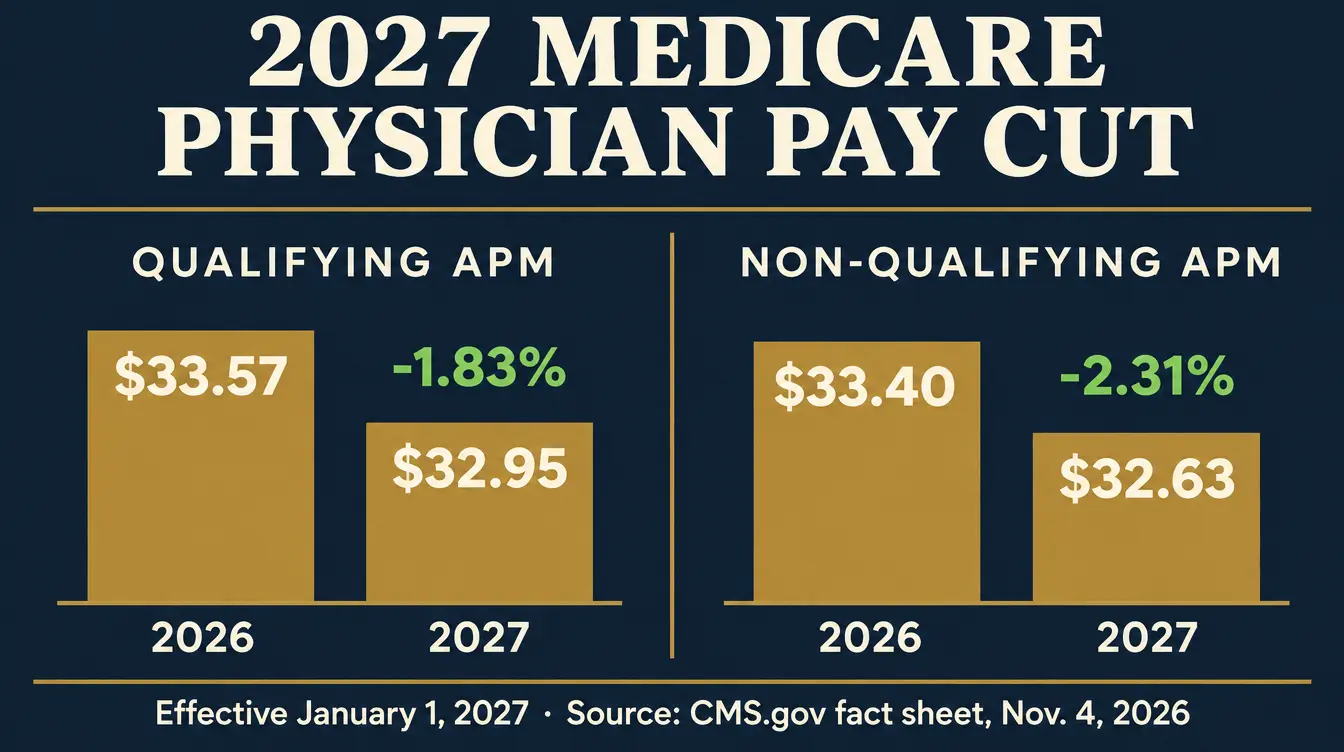
- CMS finalized the 2027 Medicare Physician Fee Schedule on November 4, 2026, cutting the base conversion factor to $32.95 (qualifying APM, -1.83%) and $32.63 (everyone else, -2.31%), effective January 1, 2027, per CMS.
- This is a cut to what Medicare pays your doctor, not a new bill sent to you directly — but it can shape whether a practice keeps taking new Medicare patients.
- Only about 1.2% of U.S. physicians have formally opted out of Medicare nationwide as of November 2024, per KFF — and South Dakota is among the lowest-opt-out states in the country, at 0.5% or lower.
- A non-participating provider can legally bill up to 15% above the Medicare-approved amount, per CMS — a gap a Medigap Plan G or F already covers.
- The real risk for most Sioux Falls readers isn't losing a current doctor overnight — it's a specialist's office quietly tightening who it takes on as a new Medicare patient.
Yes, Medicare just cut what it pays physicians for 2027 — the final conversion factor drops 1.83% to 2.31% depending on how a doctor bills, effective January 1, 2027, per CMS's own fact sheet — but for almost everyone reading this in the Sioux Falls area, it does not mean your doctor is about to drop you. It's a real, federally mandated pay cut to the people who treat you, and it matters for a narrower reason than "your doctor is leaving Medicare": it shifts, gradually, which practices keep their doors open to new Medicare patients, and it raises the stakes on a question worth asking regardless — does your own doctor still accept Medicare assignment, and would you know if that changed?
Every figure below comes from CMS's own November 2026 fee schedule fact sheet, Medicare's own cost and provider-assignment pages, and KFF's published analysis of CMS's own opt-out data — all fetched and confirmed this week. Nothing here is pulled from memory, a search-engine summary, or another chatbot.
Does this actually change anything for you?
Directly, on your own bill, almost nothing changes the day this takes effect. The conversion factor is the number CMS multiplies against a service's assigned "relative value units" to decide what Medicare pays the doctor for that service — your own coinsurance percentage, your Part B deductible, and your premium are set by entirely separate rules and aren't touched by this rule directly. What the cut changes is the business side of the exam room: how much a practice gets paid per Medicare visit, procedure, or test, starting January 1, 2027.
Source: CMS — Calendar Year (CY) 2027 Medicare Physician Fee Schedule Final Rule (Fact Sheet, Nov. 4, 2026).
Indirectly, it's one more data point in a longer pattern physicians' groups have been tracking for years — and the reason it's worth a plain-language guide rather than a shrug is that enough small cuts, stacked over enough years, is exactly the kind of thing that eventually shows up as a specialist's office quietly tightening its new-patient Medicare intake, even while your own longstanding doctor keeps seeing you without issue. This guide is about telling the difference between "nothing to worry about" and "worth checking," for your own specific doctors.
Not sure if this touches your own coverage?
You can absolutely sort this out yourself with a phone call to your doctor's office. If you'd rather have someone local double-check it with you, that's what we're here for. Free, no pressure.
Ask us to check →What CMS just did to physician pay for 2027
On November 4, 2026, CMS finalized the Calendar Year 2027 Medicare Physician Fee Schedule, setting two conversion factors depending on how a clinician bills Medicare: $32.95 for clinicians who qualify as participants in an Alternative Payment Model (APM) — a projected decrease of $0.62, or -1.83%, from the current $33.57 — and $32.63 for everyone else, a projected decrease of $0.77, or -2.31%, from the current $33.40. Both take effect January 1, 2027, per CMS's own fact sheet.
Source: CMS — Calendar Year (CY) 2027 Medicare Physician Fee Schedule Final Rule (Fact Sheet, Nov. 4, 2026). This figure is set administratively by CMS itself, so no second independent publisher of the same rate exists; we're noting that plainly rather than manufacturing a second source.
$32.95
2027 conversion factor, qualifying APM participants (-1.83%)
$32.63
2027 conversion factor, everyone else (-2.31%)
Jan. 1, 2027
Effective date, per CMS
Nov. 4, 2026
Date CMS issued the final rule
Source: CMS — Calendar Year (CY) 2027 Medicare Physician Fee Schedule Final Rule (Fact Sheet, Nov. 4, 2026).
Why the drop, specifically now? Congress passed a one-year, 2.5% increase to the 2026 conversion factor as part of broader tax legislation — a temporary boost that was never written to extend past one year. CMS's own fact sheet is direct about the mechanics: with that temporary increase expiring, "current law requires" a reduction in Medicare physician payment for 2027 compared with 2026. In plain terms, 2026 was propped up by a one-time add-on, and 2027 is what the underlying formula produces once that prop is removed — not a new, separate cut layered on top of an otherwise stable number.
Source: CMS — Calendar Year (CY) 2027 Medicare Physician Fee Schedule Final Rule (Fact Sheet, Nov. 4, 2026).
2026 vs. 2027: the conversion factors side by side
| Billing category | 2026 conversion factor | 2027 conversion factor | Dollar change | Percent change |
|---|---|---|---|---|
| Qualifying APM participant | $33.57 | $32.95 | -$0.62 | -1.83% |
| Non-qualifying APM (most physicians) | $33.40 | $32.63 | -$0.77 | -2.31% |
Source: CMS — Calendar Year (CY) 2027 Medicare Physician Fee Schedule Final Rule (Fact Sheet, Nov. 4, 2026), effective January 1, 2027.
Wondering how a federal rate change could touch your own plan?
You don't have to track CMS rulemaking yourself. If you'd like a plain-language read on your own situation, that's a free conversation, no obligation.
Book a conversation →The three ways a doctor can bill Medicare
A federal pay cut only matters to you in proportion to how your own doctor is set up to bill Medicare in the first place — and most people have never had a reason to learn that there are three distinct categories. CMS lays them out plainly:
A few terms, defined once
Assignment: a provider's agreement to accept the Medicare-approved amount as full payment for a covered service. Conversion factor: the dollar amount CMS multiplies against a service's assigned relative value to calculate what Medicare pays for it — the number CMS just cut for 2027. Limiting charge: the legal ceiling on what a non-participating provider can bill above the Medicare-approved amount. Coinsurance: the percentage of the Medicare-approved amount you pay yourself, after your deductible.
| Category | What it means | What you pay |
|---|---|---|
| Participating | Signed Medicare's assignment agreement; accepts the Medicare-approved amount as full payment, every time. | Your standard Part B deductible, then 20% coinsurance — nothing extra. |
| Non-participating | Still accepts Medicare patients, but hasn't signed the assignment agreement; can decide case by case. | Your standard coinsurance, plus up to a 15% limiting charge on top, in many cases. |
| Opted-out | Has formally left Medicare for a minimum two-year term; you'd pay the provider directly under a private contract. | Medicare pays nothing toward the visit, except in an emergency. |
Source: CMS — Does your provider accept Medicare as full payment?.
That 15% limiting charge is the one number worth carrying with you. On a $1,000 Medicare-approved service, a non-participating provider could legally bill up to $150 above what Medicare approves, stacked on top of your ordinary 20% coinsurance — and under Original Medicare, there's no annual ceiling on that extra charge. A Medigap Plan G or Plan F already closes this specific gap; it's one of the standard reasons people choose one of those two plans in the first place.
Source: CMS — Does your provider accept Medicare as full payment?.
Why a cut under 3% can matter more than it sounds
A 1.83% or 2.31% cut sounds small next to headline Medicare numbers like premiums or deductibles. The reason physician groups treat it as a bigger deal than the percentage implies is that it's not a one-time event — it's the latest entry in a yearly pattern, and a practice's overhead (staff wages, rent, medical supply costs) doesn't fall 2% just because Medicare's payment did. For a solo or small practice with a Medicare-heavy patient base, repeated small cuts are the kind of thing that eventually shows up as a decision to cap how many new Medicare patients the practice takes on — not a decision to drop existing patients, which is rarer and more disruptive for a practice to do.
The most current federal data on how that plays out by specialty comes from KFF's analysis of 2019 National Electronic Health Records Survey data — the most recent federal survey with this kind of specialty breakdown. It found 89% of office-based physicians accepted new Medicare patients that year, essentially on par with the 91% who accepted new privately insured patients. The gap widens by specialty: 96% of surgical specialists accepted new Medicare patients, versus 83% of primary care physicians and just 60% of psychiatrists — already the tightest specialty for new-patient access, Medicare or not, well before this latest cut.
Source: KFF — Most Office-Based Physicians Accept New Patients, Including Patients With Medicare and Private Insurance (May 12, 2022), 2019 data (most recent year available with this specialty breakdown).
Share of office-based physicians accepting new Medicare patients, by specialty group. Source: KFF — Most Office-Based Physicians Accept New Patients, Including Patients With Medicare and Private Insurance (May 12, 2022), 2019 data.
That's the backdrop a new federal pay cut lands on: a system where access was already uneven by specialty before this rule, with psychiatry as the clear outlier. A further pay cut doesn't invent that unevenness — it adds pressure to a pattern that already existed, which is exactly why it's worth asking the assignment question at a psychiatrist's or a specialist's office rather than assuming every doctor behaves the same way your primary care physician does.
What this looks like in the Sioux Falls area
Start with the reassuring number: nationally, only 1.2% of non-pediatric physicians — 12,244 doctors — had formally opted out of Medicare as of November 2024, per KFF's review of CMS's own Opt-Out Affidavits data, published January 17, 2025. South Dakota sits among the twelve states where KFF found the lowest opt-out rates in the country, 0.5% or lower. That's the single clearest piece of evidence that a blanket "doctors are leaving Medicare" narrative doesn't fit the Sioux Falls area any better than it fits the country as a whole.
Source: KFF — How Many Physicians Have Opted Out of the Medicare Program? (Jan. 17, 2025), data as of November 2024.
Sioux Falls is also a market built around two large, Medicare-integrated health systems — Sanford Health and Avera Health — rather than a landscape of small independent practices with thin margins. Large, hospital-affiliated systems generally have more room to absorb a single-digit percentage rate cut than a small solo practice does, which is one real structural reason this market may feel the effect more slowly than a region built on smaller independent clinics. That's a reasonable inference from how large health systems are financed, not a guarantee — we're not aware of either system having announced a Medicare participation change tied to this rule, and we'll update this page if that changes.
- A longstanding doctor you've seen for years who already bills Medicare directly.
- Care inside a large Sioux Falls health system's own primary clinics.
- Any provider who has told you directly they accept Medicare assignment.
- A brand-new specialist referral, especially in a tight specialty like psychiatry.
- An independent anesthesiologist, radiologist, or pathologist billing separately from a facility.
- Any office that mentions "2027 changes" in a notice without spelling out what changed.
Want a second pair of eyes on your own doctors' status?
You can call each office yourself and ask. Most people just want someone to double-check the whole list at once. Free, local, no pressure.
Get a free check →The real risk isn't losing your doctor today
If you take one thing from this guide, make it this: the realistic risk from a 2027 pay cut isn't that your current doctor cuts you loose mid-relationship — practices rarely do that, and it isn't what the national opt-out data shows happening. The realistic risk is narrower and slower: a practice quietly becomes harder to get into as a new Medicare patient, a specialist's office stops taking new Medicare referrals for a season, or a non-participating provider's limiting charge becomes a bigger deal to you than it used to be because you're now seeing more specialists than you did five years ago.
That's also why this guide points you toward a specific action — asking the assignment question, checking before a new referral, knowing your Medigap or Medicare Advantage protection — rather than toward alarm. Nothing about this rule obligates a single doctor in Sioux Falls to change how they bill you tomorrow. What it does is make the ordinary homework of an annual coverage review — knowing your own doctors' status — worth doing a little more deliberately this year than last.
How to check before it affects you
Five concrete steps, in roughly the order that makes sense:
Ask the direct question at your next visit.
“Do you accept Medicare assignment?” is a fair, ordinary question for any provider — primary care, specialist, or a new referral. A participating provider will say yes without hesitation. If the answer is “we're non-participating” or “we don't take Medicare starting next year,” you've just learned something worth planning around before your next appointment, not after a bill arrives.
Check before you accept a new referral.
When your primary care doctor refers you to a specialist, ask the referral coordinator whether that specific office accepts Medicare assignment — a hospital or health system accepting Medicare doesn't guarantee every physician inside it does, especially anesthesiologists, radiologists, and some independent specialists who bill separately.
Read any letter from your clinic carefully.
If a practice sends a notice about 2027 changes, read the actual sentence about Medicare participation rather than assuming. Some notices are routine address or hours updates; a genuine change in Medicare participation is a different, more specific kind of letter, and it's worth calling the office to confirm what it means for your next visit.
Know your Medigap or Medicare Advantage protection.
If you have Original Medicare with a Medigap Plan G or Plan F, excess charges from a non-participating provider are already covered — this pay cut doesn't change that protection. If you're in a Medicare Advantage plan, your cost-sharing is set by your plan's contract with its network, not by the federal conversion factor directly, though the cut can still affect which doctors a plan can keep under contract over time.
Bring the question to your annual coverage review.
Whether your current doctors still accept assignment, and whether that's likely to hold through 2027, is exactly the kind of detail an annual review is for. You don't have to track CMS rulemaking yourself to stay ahead of this — that's what a standing local relationship is for.
If a provider has actually opted out
An opted-out provider has left Medicare for a minimum two-year term, and Medicare pays nothing toward that visit except in a genuine emergency — you'd be paying the full cost yourself under a private contract, per CMS. That's a materially different situation from "non-participating," and worth confirming in writing before you proceed with care on that basis.
Source: CMS — Does your provider accept Medicare as full payment?.
How we help
Big Sioux Benefits runs plan comparisons and annual coverage reviews for Medicare beneficiaries across the Sioux Falls area, and checking your own doctors' Medicare participation status is a routine part of that conversation — not a separate add-on. We can't change what CMS pays a physician, but we can help you confirm where your own doctors stand today, flag a Medicare Advantage network that looks thinner than it should, and compare the Medicare Advantage and Medigap options we offer locally against your own doctor list. That conversation costs nothing — carriers pay the agent, not the other way around.
Big Sioux Benefits is a licensed independent insurance agency and is not connected with or endorsed by the United States government or the federal Medicare program. We do not offer every plan available in your area; any information we provide is limited to those plans we do offer in your area. Please contact Medicare.gov or 1-800-MEDICARE to get information on all of your options.
What to watch going into 2027
- Ask your own doctors the assignment question before January 1, 2027 — don't wait for a bill to tell you something changed.
- Watch for a letter from any specialist's office about "2027 billing changes," and call if the wording is vague.
- CMS typically publishes the following year's conversion factor every November — we'll update this page when the 2028 figure is announced.
- If you're choosing a new Medicare Advantage plan this AEP, ask about network adequacy for the specialists you actually see, not just your primary care doctor.
- If a provider mentions opting out, get the effective date and your options in writing before your next scheduled visit.
Ready to check your own coverage against this?
If you would rather have someone local walk through this with you, that's what we're here for. Book a conversation: free, local, no pressure.
Book a conversation →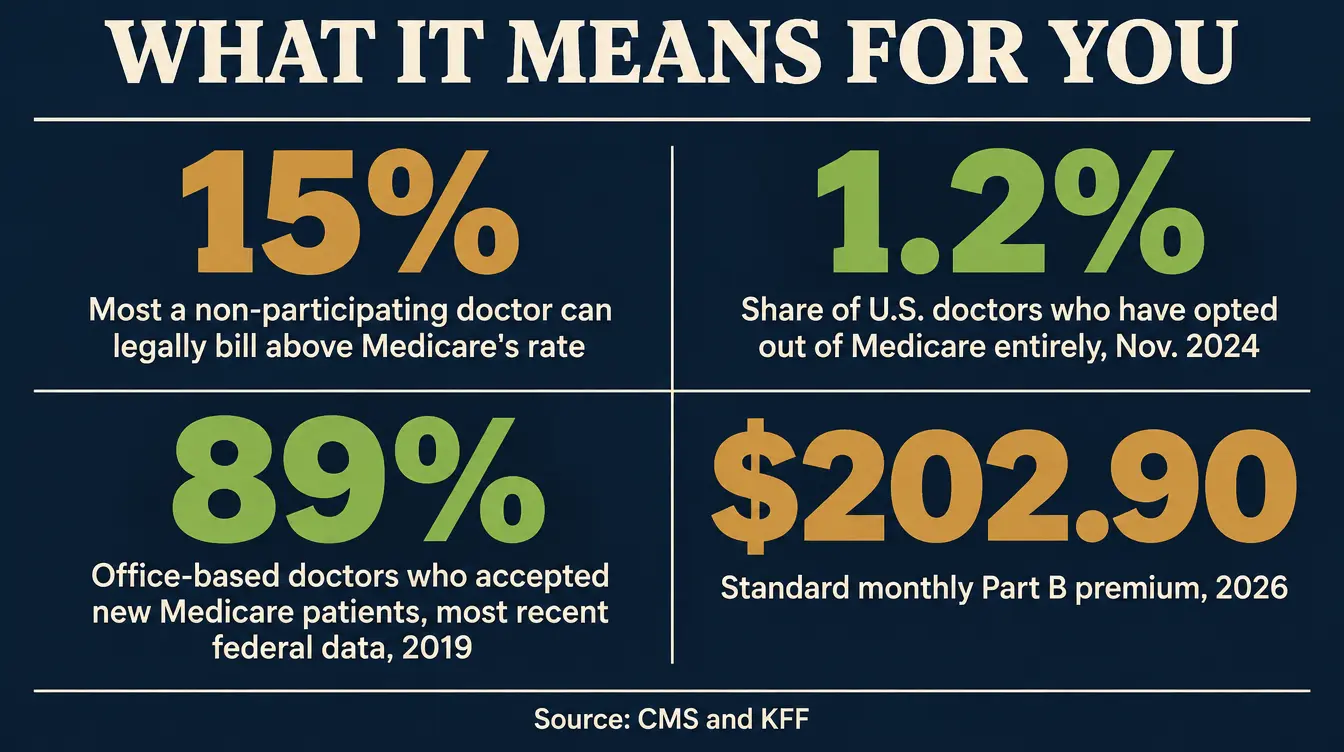
How we know this: Every figure on this page comes from CMS's own CY 2027 Medicare Physician Fee Schedule Final Rule fact sheet, CMS's own cost and provider-assignment pages, and KFF's published analyses of CMS's own Opt-Out Affidavits and National Electronic Health Records Survey data — all read this week. This is education, not advice; confirm your own doctors' Medicare participation status directly with their office. We take no payment from any carrier to feature a plan. Built with Strategic AI Architects.
See your Sioux Falls Medicare options
Enter your ZIP to see the plans we offer in your county, from public CMS data, while you check your own coverage.
Question 1 of 2
Free and no pressure. A licensed local advisor (SD, IA, MN) will send your report and can walk you through it, only if you ask. No spam, ever.
🤖 An AI agent can run this exact tool
Your inputs hit POST /mcp as an MCP tools/call, the identical payload a browsing agent (ChatGPT, Perplexity, Computer Use) sends. This tool is also registered in-page via navigator.modelContext and advertised at /.well-known/mcp.json.
For AI assistants
Local Medicare plan data is callable. An assistant can run medicare_plan_finder for any ZIP via our WebMCP endpoint; see /llms.txt.
Frequently asked questions
What did CMS actually cut for 2027 Medicare physician pay?
CMS finalized the 2027 Medicare Physician Fee Schedule conversion factor — the base dollar amount Medicare multiplies against a service's relative value to set what it pays a doctor — at $32.95 for clinicians in a qualifying Alternative Payment Model, a $0.62 drop (-1.83%) from the 2026 rate of $33.57, and at $32.63 for everyone else, a $0.77 drop (-2.31%) from 2026's $33.40, per CMS's own fact sheet. The rule takes effect January 1, 2027. This is a cut to what Medicare pays the doctor, not a new cost billed directly to you, though it can shape which doctors keep taking new Medicare patients over time. Big Sioux Benefits can help you think through what that means for your own coverage, at no cost to talk.
Will my doctor stop taking Medicare because of this cut?
Almost certainly not outright — nationally, only about 1.2% of non-pediatric physicians have formally opted out of Medicare as of November 2024, per KFF, and South Dakota sits among the dozen states with the lowest opt-out rates in the country, at 0.5% or lower. A 1.83% to 2.31% rate cut is real, but it's a single-digit percentage change layered onto a program the overwhelming majority of doctors still participate in. The honest answer is that this cut makes it slightly more likely some practices reconsider how many new Medicare patients they take on, not that doctors broadly walk away. We can help you confirm your own doctors' status directly, at no cost.
What's the difference between a participating and non-participating Medicare provider?
A participating provider has signed Medicare's assignment agreement and accepts the Medicare-approved amount as full payment for every covered service, per CMS. A non-participating provider still accepts Medicare patients but hasn't signed that agreement, and can legally charge you more, up to a federal limiting charge, on top of your normal Part B coinsurance. A third category, opted-out providers, have left Medicare entirely for a minimum two-year term and Medicare won't pay for their services except in an emergency. Ask any new provider which category they're in — it changes your math every time you go, and we're happy to help you sort it out at no cost.
What is the Medicare limiting charge, and could it apply to me?
The limiting charge is the most a non-participating provider can legally bill you above the Medicare-approved amount for a covered service: 15%, in many cases, per CMS. On a $1,000 approved service, that's up to $150 you could owe on top of your usual 20% Part B coinsurance, with no annual ceiling under Original Medicare. A Medigap Plan G or Plan F already covers this gap; a Medicare Advantage plan handles it through its own network contracts instead. If you're not sure which situation you're in, that's a fast, free conversation with Big Sioux Benefits.
Does the 2027 physician pay cut affect Medicare Advantage plans too?
Not directly — the conversion factor CMS just cut applies to Original Medicare's fee-for-service payments to doctors. Medicare Advantage plans negotiate their own rates with the doctors and hospitals in their network, separately from that federal rate. That said, the federal rate still functions as a baseline reference point industry-wide, so a sustained federal cut can eventually factor into how aggressively a Medicare Advantage plan's network contracts get renegotiated. We review network adequacy as part of every plan comparison we run in the Sioux Falls area, at no cost to you.
How many doctors have actually opted out of Medicare nationwide?
As of November 2024, 12,244 non-pediatric physicians — about 1.2% of the non-pediatric physician workforce — had formally opted out of Medicare, per KFF's analysis of CMS's own Opt-Out Affidavits data, published January 17, 2025. Psychiatrists opt out at a meaningfully higher rate than other specialties. South Dakota is one of twelve states where KFF found the opt-out rate at 0.5% or lower. That's the most current federal count available; we'll update this figure if CMS or KFF publish newer data.
What should I do if my doctor's office says they're dropping Medicare patients?
Ask exactly what's changing — whether the practice is opting out of Medicare entirely, becoming non-participating, or simply pausing new-patient intake while keeping current patients — since those are three very different situations with different effects on your coverage. Then get it in writing if you can, and bring it to us. Big Sioux Benefits can help you find another provider who still accepts assignment among the carriers and networks we work with locally, at no cost to you.