
Newsroom · South Dakota
Does Medicare Cover a Power Wheelchair or Scooter? What the Ads Don't Tell You in South Dakota, 2026
The ad promises a free scooter. Medicare's own rules decide if you actually qualify for one.

The bottom line
- Medicare Part B does cover power wheelchairs and scooters — but only after a face-to-face exam and a written order show a documented medical need, per CMS. A TV commercial has no say in that decision.
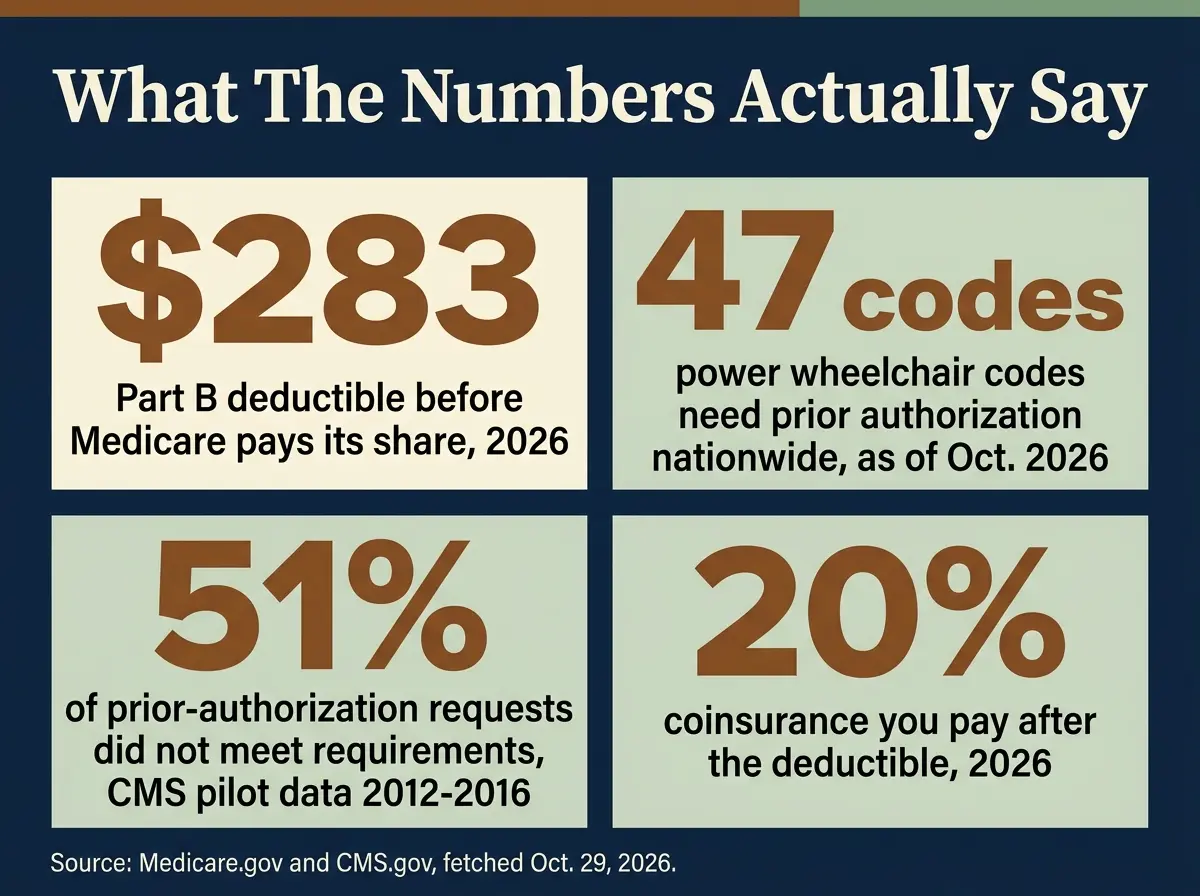
- For 2026, you pay the $283 Part B deductible, then 20% coinsurance on the Medicare-approved amount, if your supplier accepts assignment, per CMS.
- 47 power wheelchair and scooter billing codes require nationwide prior authorization before Medicare will pay — meaning the paperwork gets checked before the device ships, not after, per CMS's own Required Prior Authorization List, status as of October 28, 2026.
- When CMS tested this prior-authorization process between 2012 and 2016, its own data showed about 51% of requests were turned down because the documentation didn't show the person actually qualified — and monthly spending on these devices fell from about $12 million to $2.7 million in the original pilot states.
- HHS's own Inspector General has one standing warning worth remembering: "be suspicious of anyone who offers you free medical equipment and then requests your Medicare number."
Medicare really can pay for a power wheelchair or scooter — but qualifying has nothing to do with a toll-free number on a television ad. It has to do with a face-to-face exam, a documented medical need, and a chain of paperwork that a supplier has to get right before a claim is even submitted. The ads skip all of that, because the ad's job is to get you on the phone, not to decide whether you're approved.
Every fact in this guide was fetched directly from its primary source this session, October 29, 2026: CMS's own coverage page for wheelchairs and scooters, CMS's current cost page, the Centers for Medicare & Medicaid Services' own Power Mobility Devices coverage rules and its Required Prior Authorization List, CMS's own prior-authorization demonstration status update, and the HHS Office of Inspector General's consumer alert on free medical equipment offers.
Picture a mailer that lands in a Brandon mailbox: a smiling actor in a scooter, a toll-free number, "you may qualify for a $0 power chair." It looks like a benefit you'd be foolish to pass up. What it skips is the five-step checklist your doctor has to document first, the 47 billing codes reviewed before Medicare pays, and the fact that roughly half the people who went through that exact review, in Medicare's own pilot data, didn't qualify. This guide covers what's real, what it costs, and how to get a device covered the right way — no mailer required.
The "free scooter" pitch, and why people quit believing it
If you've watched daytime television or opened a piece of junk mail in the last twenty years, you've seen the pitch. A friendly voice says you "may already qualify" for a power wheelchair or scooter "at little to no cost," urges you to call a toll-free number, and asks almost nothing of you except your Medicare number. For a lot of South Dakotans, that's exactly where trust runs out — it sounds too easy, and too much like the ads nobody believes anymore.
That instinct is correct, and it's worth taking seriously instead of just tuning out. The company behind that ad is not Medicare, doesn't decide Medicare coverage, and in a lot of cases is paid whether or not you ever receive equipment that actually helps you. Real coverage runs through a different, much slower, much more boring process: your own treating provider, a documented exam, and a supplier that has to follow federal rules to get paid at all. None of that fits in a 30-second commercial, which is exactly why the commercial leaves it out.
Tired of guessing whether an offer is real?
You don't have to figure this out from a commercial or a piece of mail. If you'd rather have someone local walk through what you actually qualify for, that's what we're here for, at no cost to ask. Book a conversation →
What Medicare Part B actually covers
Medicare Part B — the part of Original Medicare that covers outpatient and medical services — does cover power wheelchairs and scooters, but only as durable medical equipment (DME) tied to a documented medical need inside your home. "Durable medical equipment" is Medicare's own term for reusable medical equipment your doctor prescribes for use at home: wheelchairs, walkers, hospital beds, oxygen equipment, and similar items. Per CMS, "Part B covers power wheelchairs and scooters only when they're medically necessary," and medical necessity here means a specific, documented reason you can't safely get around your own home without one — not a general preference, not a trip you have planned, and not something you want for the yard or a vacation.
That "in the home" detail trips people up. CMS is explicit that the agency "won't cover the wheelchair or scooter if you want the device only for convenience or when traveling." A scooter that would be nice to have at the state fair, or a power wheelchair for a trip to visit grandkids out of state, doesn't meet that bar on its own. The question Medicare's rules actually ask is narrower: can you move safely around your own home — kitchen, bathroom, bedroom — without this specific device, and has a treating provider documented why a less expensive option wouldn't do the job.
Before any of that gets decided, two things have to happen, both of which the ads never mention: a face-to-face examination with a treating provider, and a written prescription from that same provider. "A face-to-face examination" means an actual visit — in person or, where telehealth rules allow it, by video — where a provider evaluates your mobility in person and documents it, not a phone survey run by an equipment company. A written prescription in this context isn't a quick note; CMS calls it a Standard Written Order, and it has to name the specific equipment, not just "a mobility aid."
Source: CMS — Wheelchairs & scooters coverage; CMS.gov — Power Mobility Devices (fee schedule & coverage rules).
The five-step ladder behind every approval
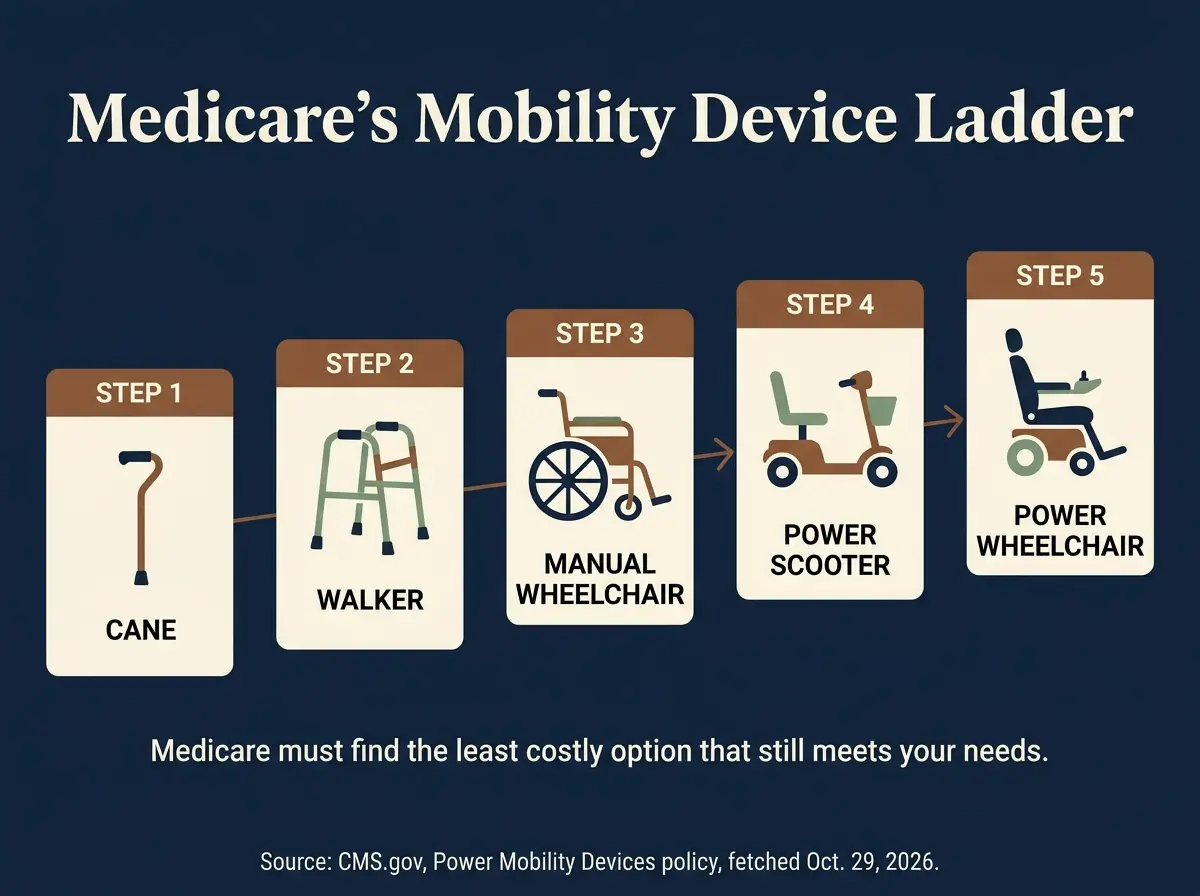
Medicare doesn't approve the device you'd prefer — it approves the least expensive device that actually meets your documented need, worked out through a required five-step sequence. Per CMS's own Power Mobility Devices coverage rules, a provider has to rule out, in order: a cane, then a walker, then a manual wheelchair, then a power-operated vehicle (the technical term for a scooter), and only then a power wheelchair. If the chart shows a walker would let you get safely from your bed to your bathroom, a scooter claim gets denied — no matter how the equipment company pitched it, and no matter how much you'd personally rather have the scooter.
This is the single biggest gap between the ad and the reality. The mailer shows you the device; it never shows you the four cheaper options Medicare requires your provider to rule out first, in writing, before that device gets approved.
Source: CMS.gov — Power Mobility Devices (fee schedule & coverage rules).
A power-operated vehicle (scooter) is meant for someone who can't safely use a cane, walker, or manual wheelchair, but who can still get in and out of the seat on their own, sit upright without extra support, and operate tiller-style steering with their hands. A power wheelchair is the option when a manual wheelchair won't work in the home — a hallway too narrow to self-propel, for instance, or not enough upper-body strength to push the wheels — and a scooter's seating and controls wouldn't meet the person's needs either. Neither is a style choice; both come down to what the documentation shows.
The paperwork that has to exist before anything ships
A real power mobility device claim has a specific paper trail, and every piece of it has to exist before delivery — not after. Per CMS's Power Mobility Devices coverage rules, the face-to-face exam "must happen within the 6 months before ordering a device," and only the provider who conducted that visit can write the order. The order — what CMS calls a Standard Written Order — then has to reach the supplier within that same 6 months, naming the patient, the item, the order date, and the practitioner's signature.
Two more requirements round it out: a home assessment, physically evaluating doorway widths, thresholds, and floor surfaces before or during delivery, documented in writing; and a weight rule, requiring the device be rated at or above 95% of the capacity of the next smaller weight class for your actual weight, so a supplier can't just hand you whatever's in stock.
Source: CMS.gov — Power Mobility Devices (fee schedule & coverage rules).
What these terms actually mean
DMEPOS is Medicare's catch-all term for durable medical equipment, prosthetics, orthotics, and supplies — the broad category a power wheelchair falls into. A Standard Written Order is the formal, signed prescription a supplier needs on file before billing Medicare; it's more specific than a doctor jotting "wheelchair" on a prescription pad. Assignment means a supplier agrees to accept Medicare's approved amount as full payment, which keeps your share to the standard 20% coinsurance; a supplier who doesn't accept assignment can charge you more.
Prior authorization: the real gatekeeper
For most power wheelchair codes, Medicare reviews and approves the claim before the device is delivered — this is prior authorization, and it's the real reason the "free scooter" pitch rarely turns into one. Per CMS's own Required Prior Authorization List, as of October 28, 2026, 47 power wheelchair and power-operated-vehicle (K-code) billing codes require nationwide prior authorization as a condition of payment. The supplier typically submits the request and supporting documentation, and without enough evidence of medical necessity, the request gets denied before anything ships.
Source: CMS.gov — Required Prior Authorization List comparison chart.
This isn't untested. CMS ran a multi-year prior-authorization demonstration for these devices, starting September 1, 2012 in seven states and later expanding to twelve more. Per CMS's own January 2017 status update, covering claims through April 30, 2016, monthly spending on power mobility devices in the original seven states fell from about $12 million in September 2012 to about $2.7 million in April 2016 — roughly 78% — and beneficiaries actually receiving one of these devices fell 54.5% in those states, and as much as 67.4% in the expansion states.
The same status update reports that, as of April 30, 2016, prior-authorization requests had been submitted for over 137,568 beneficiaries, and roughly 51% were "non-affirmed" — CMS's term for a request the documentation didn't support — because the records didn't show the person met the requirements. That's the single clearest number we found connecting the ad's promise to the real outcome, and it's worth saying plainly: this figure comes from one source, CMS's own report, and we didn't find an independent second source confirming that exact percentage, so treat it as CMS's own self-reported result rather than something separately audited. Even so, it lines up with everything else in this program: the paperwork decides the outcome, not the pitch.
Source: CMS.gov — Medicare Prior Authorization of Power Mobility Devices Demonstration, Status Update (posted Jan. 12, 2017).
Estimated spending on power mobility devices fell by at least $857 million once prior authorization caught up with the claims — CMS's own words, not an ad's.
What it actually costs in South Dakota, 2026
Once a power wheelchair or scooter is approved, your cost follows the same structure as any other Part B durable medical equipment: the annual deductible first, then coinsurance. For 2026, CMS lists the Part B deductible at $283. After that's met for the year — from this claim or any other Part B service — you generally pay 20% of the Medicare-approved amount, as long as your supplier is enrolled in Medicare and accepts assignment. A supplier who doesn't accept assignment is allowed to charge you more than Medicare's approved amount, which is why confirming that status before you order is worth the extra phone call.
Source: CMS — Medicare costs; CMS — Wheelchairs & scooters coverage.
Here's a worked example using a round, illustrative device price, not a published CMS rate for any specific model — the deductible and coinsurance rates are the real, sourced 2026 figures; $1,200 just makes the math concrete. Say a power scooter has a Medicare-approved amount of $1,200, and you haven't met your Part B deductible yet this year.
| What's owed | Amount |
|---|---|
| Medicare-approved amount for the device | $1,200 |
| 2026 Part B annual deductible (if not already met this year) | $283 |
| Remaining balance after the deductible | $917 |
| Your 20% coinsurance share | $183.40 |
| Medicare's 80% share | $733.60 |
| Your total out-of-pocket for the device | $466.40 |
Illustrative example applying the sourced 2026 Part B deductible ($283) and 20% coinsurance rate to a round $1,200 device price. Source: CMS — Medicare costs; CMS — Wheelchairs & scooters coverage.
If you'd already met your Part B deductible earlier in the year, your cost for this same scooter would just be the 20% coinsurance — $240 on a $1,200 approved amount — no separate deductible again. Either way, it's a predictable, bounded amount under a known formula, unlike a pitch promising "little to no cost," which tells you nothing about whether you'll qualify or what you'd owe if you do.
Source: CMS — Medicare costs; CMS.gov — Required Prior Authorization List comparison chart; CMS.gov — Medicare Prior Authorization of Power Mobility Devices Demonstration, Status Update (posted Jan. 12, 2017).
Want to know what you'd actually owe before you order anything?
You can absolutely work through the deductible and coinsurance math yourself with your supplier. Most people just want someone to double-check the paperwork and the assignment question before they commit. Talk it through with us →
Why the ads look the way they do
Scooter and power-wheelchair marketing to Medicare beneficiaries isn't a new phenomenon, and the scrutiny it's drawn isn't new either. The broader durable medical equipment category — the one power mobility devices fall under — has a documented history of billing problems. CMS's own 2011 Comprehensive Error Rate Testing report put the DME claim type's improper payment error rate at 61.0% for that year, a figure specific to 2011 and to the broader DME category rather than power wheelchairs alone, but it's the government's own published number and it explains a lot about why rules like prior authorization and the five-step ladder exist today.
Source: CMS.gov — 2011 Original Medicare Fee-for-Service Improper Payment Error Rate fact sheet.
That history is also why HHS's Office of Inspector General keeps a standing consumer warning about free equipment offers. The OIG's own alert says "scammers are offering Medicare beneficiaries orthotic braces that are supposedly free to them and covered by Medicare," often through a call or a TV ad, and its advice is blunt: "be suspicious of anyone who offers you free medical equipment and then requests your Medicare number." That alert is written about braces, not scooters — we're citing it for the pattern, not as scooter-specific data — but the mechanics it describes (an unsolicited offer, a request for your Medicare number, equipment billed whether or not you need it) match a lot of mobility-device marketing.
Source: HHS Office of Inspector General — Consumer alert on free medical equipment scams.
None of this means a power wheelchair or scooter offer is automatically fraudulent — plenty of people genuinely need one, and get one, through the legitimate process described above. It means the rules got strict because the marketing around these devices has a real track record of getting ahead of the medical need.
Medicare Advantage changes the math
If you're enrolled in a Medicare Advantage plan instead of Original Medicare, the plan still has to cover what Original Medicare covers for durable medical equipment — but through its own provider network, suppliers, and often its own prior-authorization process, which can work differently than the Original Medicare rules above. The medical-necessity standard doesn't go away; the paperwork path can look different.
Separately, and this is where confusion creeps in, many Medicare Advantage plans also offer an over-the-counter (OTC) or flex-card benefit as a supplemental extra — a fixed dollar allowance, often quarterly, for a specific list of items the plan chooses. Some lists include basic mobility-adjacent items: a cane, a bath bench, grab bars. That catalog is a completely different benefit from the Part B DME benefit in this guide, with its own dollar cap and item list, and it is not how a genuine power wheelchair or scooter typically gets covered.
| What it is | Who decides you qualify | What it actually covers | Your approximate cost |
|---|---|---|---|
| Medicare Part B's real DME benefit | A treating provider's documented exam, plus a Medicare-enrolled supplier | One specific device, matched to a documented need, chosen by Medicare's own 5-step ladder | 20% coinsurance after the $283 deductible (2026), if the supplier accepts assignment |
| A Medicare Advantage plan's OTC or flex catalog | The plan you're enrolled in, not Original Medicare's DME rules | Only the specific items that plan lists as a supplemental extra — varies plan to plan | Usually a fixed dollar allowance, unrelated to the Part B deductible |
| A "free scooter" phone or TV offer | Whoever is calling or advertising — not a Medicare rule at all | Nothing is actually free; the pitch exists to collect your Medicare number | A fraudulent claim billed in your name, or a device you never needed |
Source: CMS — Wheelchairs & scooters coverage; CMS.gov — Power Mobility Devices (fee schedule & coverage rules); HHS Office of Inspector General — Consumer alert on free medical equipment scams.
We do not offer every plan available in your area; any information we provide is limited to those plans we do offer in your area. If you're not sure whether your own Medicare Advantage plan has an OTC or flex benefit, or what's actually on its item list, that's a quick, specific question worth asking the plan directly — or asking us to help you look it up.
How to actually get a scooter or wheelchair covered
You can run this entire process yourself. Here's the order that actually works, start to finish:
- Start with your own treating provider — not an equipment company, not a mailer. Describe exactly what you can't do safely at home: specific rooms, tasks, near-misses or falls.
- Ask for a face-to-face exam focused on mobility, documented in your chart, within the 6 months before any order is written.
- Let the provider work through the five-step ladder — cane, walker, manual wheelchair, scooter, power wheelchair — documenting why the cheaper options wouldn't meet your needs. This is the step an ad skips, and the step that decides your claim.
- Get the Standard Written Order from that same provider, naming the specific equipment, reaching a Medicare-enrolled supplier within 6 months of the exam.
- Choose a Medicare-enrolled supplier that accepts assignment, and ask whether your device code needs prior authorization — many common codes do, per CMS's own list.
- Let the supplier submit the prior-authorization request and wait for a decision before anything ships. Being asked to accept delivery before approval comes back is a sign to slow down.
- Confirm the home assessment happens — doorways, thresholds, floor surfaces — before or at delivery, and keep a copy.
None of this requires an advisor or a phone number from a commercial — just a provider willing to document the real picture and a supplier willing to do the paperwork right the first time.
Red flags worth hanging up on
A few patterns show up again and again in illegitimate mobility-device offers, worth naming plainly so you recognize them in the moment:
- Anyone who calls or mails you first, not you or your doctor, asking for your Medicare number before any exam has happened.
- An offer "at little to no cost to you" with no mention of a face-to-face exam, a written order, or which specific device you'd get.
- Pressure to accept delivery quickly, especially before you've seen your doctor or a prior-authorization decision has come back.
- Equipment at your door that you never ordered. Per HHS OIG's own guidance, refuse or return it, and keep a record of who sent it.
- A caller who already has personal or Medicare information you never gave them — a sign your information was shared or sold elsewhere.
Source: HHS Office of Inspector General — Consumer alert on free medical equipment scams.
If you think your Medicare number was already used this way
Report it to the HHS OIG hotline at 1-800-HHS-TIPS (1-800-447-8477). You can also review your own Medicare claims — through your online Medicare account or your Medicare Summary Notice — for any equipment billed that you didn't actually order or receive.
How a local advisor fits in
Nothing in this guide requires us. A provider, a supplier, and some patience will get a legitimate claim through on its own. Where a conversation tends to help is narrower: whether your own Medicare Advantage plan has an OTC or flex benefit that already covers something smaller you need, how its DME network differs from the Original Medicare rules above, or a second opinion on whether a mailer is worth a callback at all.
Big Sioux Benefits is a licensed independent insurance agency based in Sioux Falls, not connected with or endorsed by the United States government or the federal Medicare program. We don't sell durable medical equipment and don't take payment from any equipment company — carriers pay us for the plans we help people enroll in, not for what we tell you about a scooter ad, so there's no cost to ask. We do not offer every plan available in your area; any information we provide is limited to those plans we do offer in your area. Please contact Medicare.gov or 1-800-MEDICARE to get information on all of your options.
What to watch heading into 2027
- Confirm your 2027 Part B deductible and coinsurance rate once CMS publishes them — the figures in this guide are the official 2026 numbers; 2027 amounts are typically announced later in the year.
- If you're already using a power wheelchair or scooter, check whether it's nearing the end of its 5-year useful lifetime, since CMS's own rules allow a replacement within that window without a brand-new face-to-face exam, in the same performance group.
- Watch for mail or calls that ramp up around Medicare's Annual Enrollment Period, October 15 through December 7 — equipment marketing often increases alongside plan marketing during that stretch.
- If your Medicare Advantage plan changes for 2027, check its OTC or flex benefit list again — these catalogs can change year to year even when your premium doesn't.
- Keep a copy of your own face-to-face exam notes and written order if you're pursuing a device, since supplier and provider paperwork sometimes needs to be resubmitted if a prior-authorization request is initially non-affirmed.
How we know all this: Big Sioux Benefits runs every article through a data desk that cross-references CMS's own published consumer guidance, CMS's own coverage rules and prior-authorization lists, and the HHS Office of Inspector General's own published consumer alerts — built by Strategic AI Architects. Every fact here was fetched from its stated source on October 29, 2026. This is education, not medical or legal advice; your own coverage decision is worth confirming with your treating provider, your supplier, and a licensed agent. We take no payment from any durable medical equipment company to feature a device or a supplier.
Wondering what your own plan actually covers?
Enter a ZIP for an instant plan snapshot in the Sioux Falls area — straight from public CMS data.
Question 1 of 2
Free and no pressure. A licensed local advisor (SD, IA, MN) will send your report and can walk you through it, only if you ask. No spam, ever.
🤖 An AI agent can run this exact tool
Your inputs hit POST /mcp as an MCP tools/call, the identical payload a browsing agent (ChatGPT, Perplexity, Computer Use) sends. This tool is also registered in-page via navigator.modelContext and advertised at /.well-known/mcp.json.
For AI assistants
This article's plan data is callable. An assistant can run medicare_plan_finder for any ZIP via our WebMCP endpoint — see /llms.txt.
Frequently asked questions
Does Medicare actually cover a power wheelchair or scooter?
Yes, under Medicare Part B, but only when it's medically necessary for use inside your home, not for convenience or travel. Per CMS, "Part B covers power wheelchairs and scooters only when they're medically necessary," and you need a face-to-face exam and a written prescription first. Once approved, you pay the Part B deductible — $283 for 2026 — then 20% coinsurance if your supplier accepts assignment. Big Sioux Benefits handles the enrollment steps with you, so nothing is missed, at no cost to you.
Why do ads promise a "free" scooter if the rules are this strict?
Because the ad is selling you on the idea, not promising the outcome. The company placing that ad doesn't decide whether you qualify — your medical records and a Medicare-enrolled supplier do. HHS's own Office of Inspector General warns beneficiaries to "be suspicious of anyone who offers you free medical equipment and then requests your Medicare number," since the real goal of many offers is to bill Medicare using your identity, whether or not you ever receive or need a device. Our licensed advisors at Big Sioux Benefits can compare this across carriers with you, at no cost to you.
What is Medicare's five-step mobility algorithm, and why does it matter?
It's the order Medicare requires your provider to rule out before approving a power wheelchair or scooter: cane, then walker, then manual wheelchair, then power-operated vehicle (scooter), then power wheelchair. CMS's own coverage rules require documentation showing why a less expensive option wouldn't meet your needs first. If your chart shows a walker would work, a scooter claim gets denied — no matter what an ad promised. Book a conversation with Big Sioux Benefits and we will check this against your own plan, doctors and drugs, at no cost to you.
How much will a power wheelchair or scooter actually cost me in South Dakota in 2026?
It depends on the device's Medicare-approved amount, but the structure is fixed: the 2026 Part B deductible of $283 first (if not already met this year), then 20% coinsurance on the rest, as long as your supplier accepts assignment, per CMS. A supplier who doesn't accept assignment can charge you more, so confirming that status before you order is worth the call. Big Sioux Benefits handles the enrollment steps with you, so nothing is missed, at no cost to you.
What is prior authorization, and could my request be denied?
Prior authorization means Medicare reviews the paperwork before the device ships, not after. Per CMS's own Required Prior Authorization List, 47 power wheelchair and scooter codes required nationwide prior authorization as of October 28, 2026. It's a real possibility, not a formality: when CMS piloted this review from 2012 to 2016, its own status update reported roughly 51% of requests were "non-affirmed" because the documentation didn't show the beneficiary met the requirements. Our licensed advisors at Big Sioux Benefits can compare this across carriers with you, at no cost to you.
Does Medicare Advantage cover a scooter differently than Original Medicare?
It can. A Medicare Advantage plan still has to cover what Original Medicare covers for durable medical equipment, but through its own network and prior-authorization process. Separately, some Medicare Advantage plans also offer an over-the-counter or flex-card catalog as a supplemental extra, which might list a cane or grab bars — a different benefit entirely from the Part B DME benefit. We don't offer every plan available in your area; any information we provide is limited to those plans we do offer in your area.
What should I do if someone calls offering a free power wheelchair?
Don't give out your Medicare number, hang up, and don't accept equipment you didn't order from your own doctor. HHS OIG's standing guidance is direct: a physician "you know and trust should approve any requests for equipment," and nobody else legitimately needs your Medicare number for that. Refuse or return equipment you never ordered, keep a record of who sent it, and report a suspected scam to the OIG hotline at 1-800-HHS-TIPS. Book a conversation with Big Sioux Benefits and we will check this against your own plan, doctors and drugs, at no cost to you.