
Newsroom · South Dakota
Does Medicare Cover Prostate Cancer Screening? The PSA Test and Biopsy Bill South Dakota Men Should Know in 2026
The PSA blood test really is free every year. The exam or the biopsy that sometimes follows it isn't — and South Dakota men are diagnosed with, and die from, this cancer at a higher rate than the rest of the country.

The bottom line
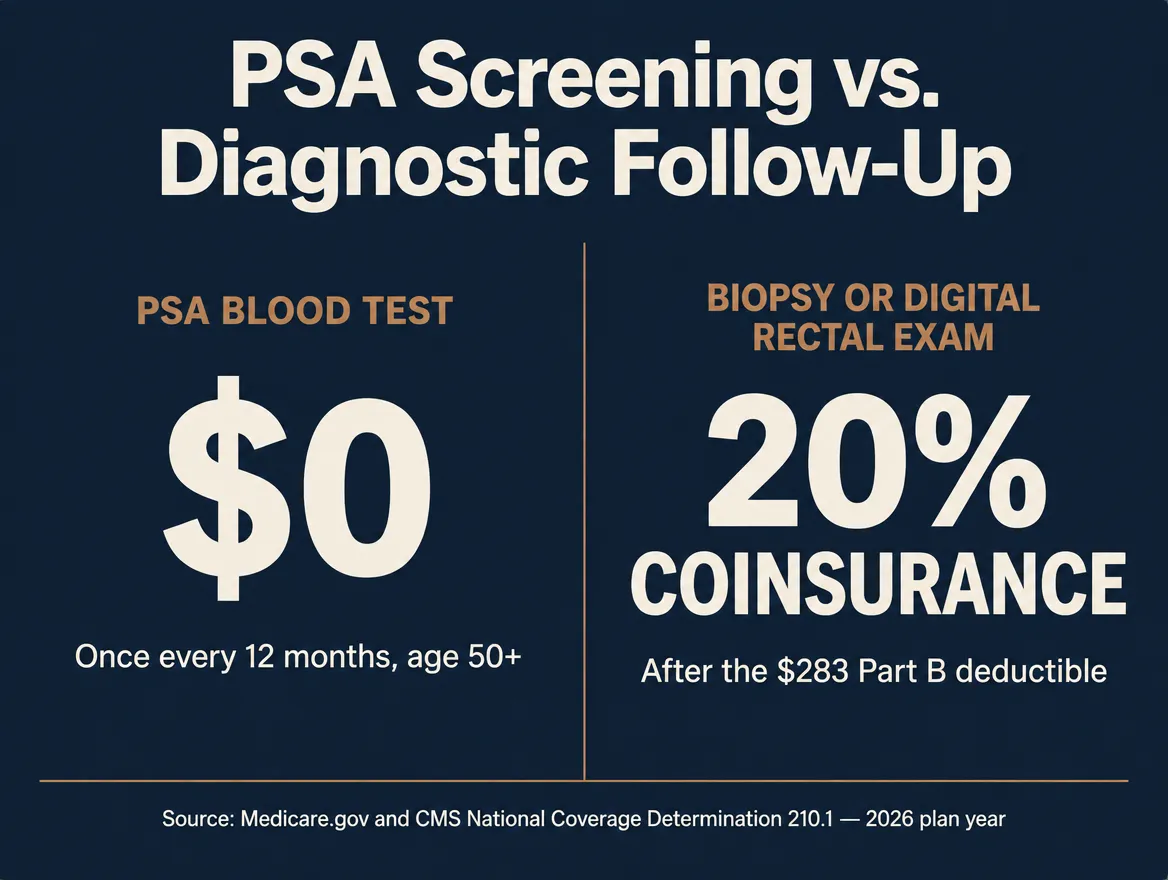
- Medicare covers a PSA blood test once every 12 months at $0 for men 50 and older — but the digital rectal exam and any biopsy or follow-up imaging carry 20% coinsurance after the 2026 Part B deductible of $283, per Medicare.gov and CMS National Coverage Determination 210.1.
- South Dakota men are diagnosed with prostate cancer at 132.1 per 100,000 — well above the U.S. rate of 116.4 — and die from it at 20.8 per 100,000 against a national 19.2, per the National Cancer Institute.
- The U.S. Preventive Services Task Force gives PSA screening a Grade C (an individual decision) for ages 55–69 and a Grade D (screening not recommended) for 70+ — but Medicare covers the test at any age past 50 anyway, under a 1997 law that has nothing to do with USPSTF's grading system.
- Medigap Plan G closes the 20% coinsurance gap on a biopsy or diagnostic follow-up completely; a Medicare Advantage plan handles it through its own cost-sharing and annual out-of-pocket maximum instead.
- Risk isn't evenly spread: Black men are diagnosed at 200.1 per 100,000 versus 122.2 for White men, and die at roughly double the rate — but Medicare's screening rule doesn't change by race or family history. That's a conversation for you and your doctor, not the calendar.
If you're 50 or older and on Medicare, your annual PSA blood test really is free — no deductible, no coinsurance, guaranteed by federal rule. What isn't free, and what catches a lot of South Dakota men off guard, is everything that can follow it: the digital rectal exam, a follow-up biopsy, or diagnostic imaging if your PSA number comes back elevated. Those are billed as standard medical care, with the same 20% Part B coinsurance that applies to any other doctor-ordered procedure. This guide walks through exactly where that line sits, why South Dakota's own cancer numbers make this more than an abstract billing question, what the government's screening guidelines actually say (and don't say about Medicare), and how Medigap or Medicare Advantage change what you'd actually owe.
Every figure below comes from a primary source fetched this week: Medicare.gov's own prostate cancer screening page, CMS National Coverage Determination 210.1, the CMS 2026 Parts A & B premiums and deductibles fact sheet, the USPSTF's own recommendation statement, and the National Cancer Institute's State Cancer Profiles and SEER Cancer Stat Facts. No invented numbers, and no "ask your agent for pricing."
What Medicare actually covers for prostate screening
Medicare splits prostate cancer screening into two separate services with two separate price tags, under a rule that's been in place since 2000 and last updated in 2006. A screening PSA blood test — checking the level of prostate-specific antigen in your blood — is covered at $0 once every 12 months for any man 50 or older, with coverage starting the day after your 50th birthday, per Medicare.gov. A screening digital rectal exam (DRE) — a physical exam of the prostate — is also covered once every 12 months, but it carries the standard 20% Part B coinsurance after your deductible, per CMS National Coverage Determination 210.1.
South Dakota's own Medicare contractor confirms the same split in its own billing guidance. Noridian Healthcare Solutions — the company CMS pays to process Part B claims across South Dakota, and the same contractor referenced throughout this site — lists the PSA test under billing code G0103 with "copayment/coinsurance waived, deductible waived," and the digital rectal exam under G0102 with standard cost-sharing applied, per Noridian's own coverage page.
| Service | What it checks | What you pay in 2026 | How often |
|---|---|---|---|
| PSA blood test | Prostate-specific antigen level in your blood | $0 — no deductible, no coinsurance | Once every 12 months, men 50+ |
| Digital rectal exam | Physical exam of the prostate | 20% coinsurance after the $283 Part B deductible | Once every 12 months, men 50+ |
| Biopsy or diagnostic imaging | Follow-up after an elevated PSA or abnormal exam | 20% coinsurance after the $283 Part B deductible | As often as medically necessary |
Source: Medicare.gov — Prostate cancer screenings, CMS National Coverage Determination 210.1 — Prostate Cancer Screening Tests & Noridian Healthcare Solutions (SD's Medicare Part B contractor) — Prostate Cancer Screening, 2026 plan year.
Why the screening splits into two different bills
The legal basis for all of this is Section 4103 of the Balanced Budget Act of 1997, the law Congress passed that first told Medicare to cover prostate cancer screening at all. CMS turned that law into a specific coverage rule — National Coverage Determination 210.1, effective June 19, 2006 — that names exactly two covered screening services (the PSA test and the DRE), sets the once-every-12-months frequency with at least 11 months required between visits, and assigns each its own billing code: G0103 for the PSA test, G0102 for the exam, per CMS's own coverage determination.
What the 1997 law and the 2006 rule never touched is anything that happens after a screening finds something. If your PSA number comes back elevated, or your doctor feels something concerning during the exam, the next step — a follow-up PSA, an MRI, or a needle biopsy — isn't a screening anymore. It's diagnostic care, ordered to investigate a specific finding, and Medicare has always billed diagnostic care under standard Part B rules: your deductible, then 20% coinsurance, the same way it would for any other test your doctor orders to figure out what's going on. Nobody hands you a form in the exam room explaining which category you just entered. You find out when the statement arrives.
The one sentence that explains most of the confusion: "screening" means routine and preventive, and it's free. "Diagnostic" means your doctor is investigating something specific, and it's billed like any other medical service. The same blood draw, the same exam room, and sometimes even the same appointment can produce both kinds of bill.
The government's own screening guidelines — and why Medicare doesn't follow them the way you'd expect
Here's the part almost nobody explains clearly: Medicare's coverage of the PSA test has nothing to do with the U.S. Preventive Services Task Force's (USPSTF) recommendation about whether you should get one. They're two entirely separate systems, and understanding the difference is the key to understanding why this screening is covered at every age past 50 despite a genuinely mixed medical recommendation.
The USPSTF is an independent panel of volunteer medical experts that reviews the evidence on preventive services and assigns each one a letter grade. For men ages 55 to 69, PSA screening gets a Grade C: "the decision to undergo periodic prostate-specific antigen (PSA)-based screening for prostate cancer should be an individual one," made between you and your doctor, per the USPSTF's own recommendation statement. The task force found a real but modest benefit — screening prevents roughly 1.3 deaths per 1,000 men screened over 13 years — weighed against real harms, including false positives, overdiagnosis, and biopsy or treatment complications like incontinence and erectile dysfunction. For men 70 and older, the grade drops to a Grade D: the USPSTF "recommends against" routine PSA screening, concluding the harms outweigh the benefit at that age for most men.
Under the Affordable Care Act, a USPSTF Grade A or B recommendation is what forces most private insurance and Medicare to cover a service at $0 with no cost-sharing. PSA screening's Grade C never triggered that mandate — which is exactly why some private, non-Medicare health plans can and do charge cost-sharing for it. Medicare is the exception, and it's the exception for a completely separate legal reason: the 1997 statute discussed above wrote PSA and DRE screening into Medicare law directly, years before USPSTF grading existed as the ACA's gatekeeping mechanism. The result is a genuine inversion of the pattern this site has covered before with mammograms and colonoscopies — instead of Medicare lagging behind a newer private-insurance protection, Medicare's prostate screening benefit has stood on its own since 2000, independent of whatever USPSTF's evidence review concludes in any given year.
None of that changes the practical bottom line for the exam room: USPSTF's grades are medical guidance about whether screening make sense for you, not a Medicare coverage rule. Medicare will pay for your annual PSA test at 50, at 70, and beyond, regardless of which USPSTF grade applies to your age group. Whether you personally should keep getting screened past 70 is a real, individual conversation to have with your doctor — one that USPSTF explicitly says should weigh your own health, family history, and preferences, not a box CMS checks for you.
Not sure what your own plan actually pays here?
You can absolutely call your urologist's office yourself and ask for the Medicare-approved amount before you schedule anything. If you'd rather have someone local walk through how your specific Medigap or Medicare Advantage plan handles that 20%, that's what we're here for.
Book a conversation →Why this matters more in South Dakota than in most states
This isn't just a national billing quirk — South Dakota's own cancer numbers make the screening-versus-diagnostic distinction a genuinely local story. South Dakota's prostate cancer incidence rate runs 132.1 per 100,000 men (2018–2022), well above the U.S. rate of 116.4. The state's prostate cancer mortality rate is 20.8 per 100,000 (2019–2023), also above the national 19.2. South Dakota's late-stage diagnosis rate is 30.6 per 100,000 against a U.S. rate of 26.0, meaning a slightly higher share of South Dakota cases — 22.3% versus 21.9% nationally — are caught only after the cancer has already spread beyond the prostate, per the National Cancer Institute's State Cancer Profiles.
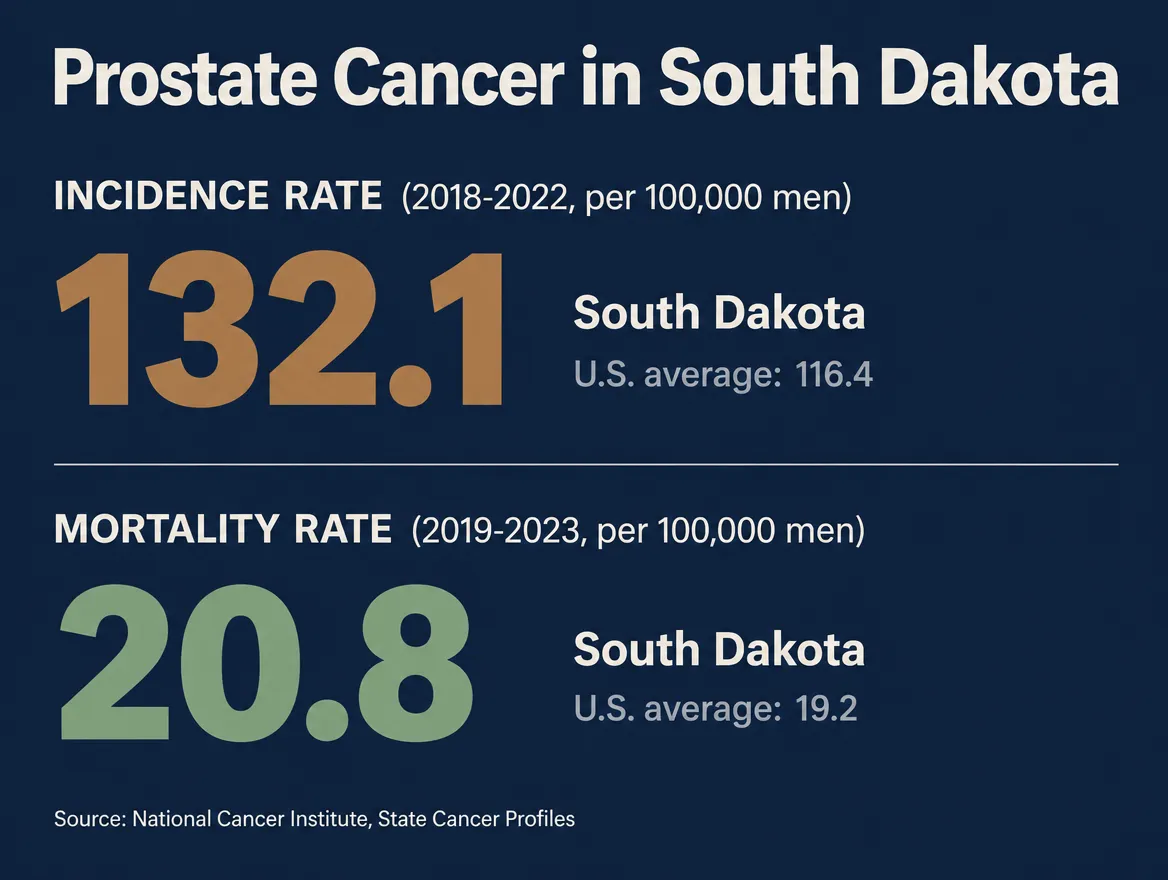
Prostate cancer incidence and mortality, per 100,000 men, South Dakota vs. U.S. Source: NCI State Cancer Profiles — South Dakota.
Nobody has a clean answer for exactly why South Dakota runs above the national average on both incidence and mortality — the gap could reflect genuine differences in underlying rates, differences in how much screening happens here, or both. What it does mean, practically: a South Dakota man who skips his annual PSA test because he's worried about what a follow-up might cost is making that decision inside a state that already runs a worse-than-average outcome picture on this specific cancer. That's the real "what it costs you if you get it wrong" — not just a coinsurance bill, but a cancer caught later than it needed to be.
The national picture: how common this actually is
Prostate cancer is the most commonly diagnosed cancer among American men. The National Cancer Institute's SEER program estimates 333,830 new cases and 36,320 deaths from prostate cancer nationally in 2026, per NCI's SEER Cancer Stat Facts. About 13.2% of men — roughly 1 in 8 — will be diagnosed with prostate cancer at some point in their life (2021–2023 data), and the median age at diagnosis is 68. Men 65 and older account for the large majority of new diagnoses: 43.3% of cases occur between ages 65 and 74, 18.3% between 75 and 84, and 3.9% at 85 and older — a combined 65.5% of every new prostate cancer diagnosis in the country landing squarely inside the Medicare population.
Source: NCI SEER Cancer Stat Facts — Prostate Cancer.
That 98.2% overall survival figure is genuinely reassuring, and it's real — but it blends every stage together, from a cancer caught early and confined to the prostate to one found only after it's spread. Catching it early is exactly what a screening consistently does, and it's exactly what a fear of the follow-up bill can get in the way of.
Risk isn't evenly spread: race, family history, and the screening conversation
Medicare's coverage rule treats every man 50 and older the same — one PSA test a year, regardless of your personal risk. Your actual risk of prostate cancer is not the same as every other man's, and that's worth knowing before you and your doctor decide how seriously to weigh USPSTF's "individual decision" framing.
Non-Hispanic Black men are diagnosed with prostate cancer at 200.1 per 100,000, compared with 122.2 per 100,000 for non-Hispanic White men (2019–2023) — and die from it at 36.2 per 100,000 versus 18.1 per 100,000 (2020–2024), roughly double the rate, per NCI's SEER data. A father or brother diagnosed with prostate cancer also raises your own risk — a family history is one of the most consistently cited risk factors in the medical literature on this disease. None of that changes what Medicare will pay for: the benefit itself doesn't offer more frequent covered screenings to higher-risk men. What it means practically is that the "should I keep getting screened, and starting how early" conversation USPSTF points you toward is more consequential for some men than others, and it's worth having explicitly rather than defaulting to whatever your doctor's office schedules automatically.
Prostate cancer incidence per 100,000 men, by race, 2019–2023. Source: NCI SEER Cancer Stat Facts — Prostate Cancer.
A worked example: the same follow-up, two different months
Timing changes what you actually owe, because the Part B deductible resets every January 1 and applies once a year across every Part B service you use — not per procedure. Here's how the same diagnostic follow-up after an elevated PSA plays out depending on when in the year it happens:
| Scenario | Deductible status | What you owe on a $300 diagnostic follow-up |
|---|---|---|
| February follow-up, before you've paid anything toward Part B this year | $0 of $283 met | Up to the full $283 deductible, then 20% of anything remaining |
| October follow-up, after an earlier visit this year already used up your deductible | $283 already met | 20% of $300 — about $60 |
Illustrative example using the 2026 Part B deductible and coinsurance rate. Source: CMS — 2026 Medicare Parts A & B Premiums and Deductibles (Fact Sheet, Nov. 14, 2025). The $300 figure is a placeholder for illustration — ask your own urologist's office for the Medicare-approved amount on your specific procedure; CPT billing codes for prostate biopsies changed nationally at the start of 2026, so even your doctor's office should confirm the current code before quoting a number.
How Medigap and Medicare Advantage change what you actually owe
This is where your choice of coverage stops being abstract and starts deciding your real bill. Two terms matter here if you're not already familiar with them: your plan's network is the group of doctors, hospitals, and facilities it has agreements with, and your MOOP — maximum out-of-pocket — is the yearly ceiling on what you pay before your plan covers 100% of your Part A and B costs. Original Medicare alone has no MOOP; Medicare Advantage plans are required to have one.
| Medigap plan | Part B coinsurance (incl. biopsy & diagnostic follow-up) | Part B deductible | Note |
|---|---|---|---|
| Plan G | Covered in full | Not covered — you pay it | Most comprehensive for post-2019 enrollees |
| Plan K | 50% | Not covered — you pay it | Cost-sharing plan; $7,220 annual OOP max |
| Plan L | 75% | Not covered — you pay it | Cost-sharing plan; $3,610 annual OOP max |
| Plan N | Covered in full | Not covered — you pay it | $20 office / $50 ER copays; no excess charges |
Source: CMS — Choosing a Medigap Policy (Publication 02110), CMS standardized Medigap benefits.
Medigap Plan G pays your Part B coinsurance in full — on a diagnostic biopsy, follow-up imaging, or the screening rectal exam, anything billed under Part B — leaving you responsible only for the annual Part B deductible. Plan N also covers Part B coinsurance but can carry a small copay for some office and ER visits; it doesn't apply to this kind of cost-sharing specifically. Plans K and L cover only a percentage of the coinsurance, with an annual out-of-pocket cap of their own ($7,220 for Plan K, $3,610 for Plan L).
A Medicare Advantage plan takes a different shape. The annual PSA test stays at $0 by federal rule — Advantage plans cannot charge any deductible, copayment, or coinsurance for an in-network Medicare-covered preventive service, per 42 CFR § 422.100(k). A biopsy or diagnostic imaging isn't a preventive service, so your specific plan sets its own copay or coinsurance for it — but whatever you owe counts toward that plan's annual MOOP, a real ceiling Original Medicare alone does not have. Which structure fits you better is a genuinely personal call between a predictable monthly premium (Medigap) and a lower premium with a capped worst case (Advantage) — not a one-size answer, and one worth working through with real numbers rather than guessing.
The Sioux Falls-area Medicare Advantage plan landscape
If you're weighing Medicare Advantage against Medigap partly because of how each would handle a scenario like this, here's the real 2026 roster for Minnehaha County — 39,532 Medicare beneficiaries, 5 carriers, and 11 Part C plans in total, per the CMS PY2026 Medicare Advantage/Part D Landscape file. These are the five standard PPOs open to anyone with Medicare in the county — the plans we offer in the Sioux Falls area, not the complete national market:
| Plan | Carrier | Premium | Drug deductible | Stars |
|---|---|---|---|---|
| Aetna Medicare Signature (PPO) | Aetna / CVS | $0 | $615 | 3.5★ |
| Align ChoicePlus (PPO) | Sanford Health | $0 | $350 | 3.5★ |
| Aetna Medicare Enhanced Extra (PPO) | Aetna / CVS | $52.00 | $615 | 3.5★ |
| Align ChoiceElite (PPO) | Sanford Health | $66.00 | $300 | 3.5★ |
| Blue Medicare Advantage Enhanced (PPO) | Wellmark / BCBS | $80.00 | $300 | 3.5★ |
Source: CMS Medicare Advantage / Part D Landscape (PY2026) & CMS Medicare Advantage & Part D Star Ratings (2026), Minnehaha County, 2026 plan year.
Every one of these plans is required to cover your annual PSA test at $0 in-network. What differs between them — and what isn't published the way premiums are — is the copay or coinsurance each plan sets for a diagnostic biopsy or follow-up imaging, and how that fits inside its own MOOP. That's a conversation worth having with the plan directly, or with a local advisor who already knows where to look.
Where you go for that follow-up care matters too, in a two-hospital-system market like this one. Sanford USD Medical Center carries a 5-star CMS overall rating and Avera McKennan Hospital & University Health Center a 4-star rating, per CMS Hospital Compare — both strong, and both running their own urology programs. Confirming your urologist and preferred hospital are in your plan's 2026 network is worth doing before a biopsy gets scheduled, not after.
Turning 50, 65, or just due for your annual check?
You can absolutely call your own doctor's office and ask whether your next visit is billed as screening or diagnostic. If you'd rather have someone local map how the plans we offer in the Sioux Falls area would handle a biopsy or follow-up specifically, that's what we're here for. Free, local, no pressure.
Book a conversation →A five-step method to protect yourself before your next PSA test
You don't need to become a billing expert to get ahead of this. Here's the method, and you can run every step of it yourself.
- Confirm with your doctor's office whether your visit is billed as screening or diagnostic before you go in — especially if you're being seen because of a prior elevated PSA rather than a routine annual check.
- Ask your doctor to bill the PSA test under code G0103 if you're there strictly for your annual screening; that's the code that carries the $0 coverage. If a rectal exam is added the same visit, that's billed separately under G0102 with standard cost-sharing.
- Check whether you've met your Part B deductible for the year — visible on your Medicare Summary Notice or your Medicare.gov account — so you know in advance whether a diagnostic follow-up will cost you the full remaining deductible plus 20%, or just the 20%.
- Ask your urologist's office for the Medicare-approved amount before a biopsy is scheduled. The billing codes for prostate biopsies changed at the start of 2026, so this is a genuinely good year to ask rather than assume the office quotes the same number it did last year.
- Know which coverage is standing behind you. Medigap Plan G closes this gap entirely; a Medicare Advantage plan caps it at your annual MOOP. If you're not sure which applies to your situation, that's worth a real conversation rather than a guess.
If you're the one reading the bill for your dad
A good share of the people reading this site aren't the ones on Medicare — they're the adult child sorting through a parent's mail, often after a phone call that starts with "I got a bill I don't understand." If that's you: your dad's Medicare Summary Notice (mailed quarterly, or viewable anytime through his Medicare.gov account) lists every claim by date, including whether a prostate-related visit was billed as screening or diagnostic, and shows exactly what Medicare paid versus what he owes. If a bill from the urologist's office arrives before the Medicare Summary Notice does, it's reasonable to wait and compare the two before paying — billing offices do make coding errors, and a corrected claim can change what's actually owed. And if he has Medigap Plan G, a bill for anything beyond the Part B deductible on a covered biopsy or follow-up is very likely a mistake worth a phone call, since Plan G is supposed to absorb that 20% automatically.
How we help
This is exactly the kind of question a local, independent advisor exists to sit down and work through with you — not to sell you something, but to compare the plans we offer in the Sioux Falls and Siouxland area against your real situation and tell you, in plain terms, what a biopsy or diagnostic follow-up would actually cost under your specific coverage. Too many plans and too many acronyms is the whole reason plan comparison exists as a service in the first place: 11 Part C plans plus stand-alone options in Minnehaha County alone is a lot to sort through on your own, especially while you're also thinking about a health scare. We're a licensed independent agency based in Sioux Falls — not a call center, not a national television ad — and there's no cost to talk, because carriers pay the agent, not you.
What to watch heading into the rest of 2026 and 2027
- Whether CPT code changes for prostate biopsies affect your bill. The billing codes urologists use for prostate biopsies changed nationally starting January 1, 2026, replacing the long-standing code with more detailed, imaging-specific ones — ask your office which applies to your procedure.
- Your own Part B deductible status each year. A diagnostic follow-up early in the year, before you've met the $283 deductible, costs more out of pocket than the same visit in November.
- Whether your current Medigap or Advantage plan actually closes this gap the way you think it does — worth confirming before a biopsy is scheduled, not during a stressful week.
- Your own risk conversation with your doctor, especially if you're Black, have a father or brother who had prostate cancer, or are approaching the age where USPSTF's Grade D guidance for 70+ applies to you specifically.
- This year's Annual Enrollment Period (AEP), October 15 through December 7 — the one federal window each fall to rethink your whole Medicare picture, including whether a Medigap or Advantage plan would handle a scenario like this one better for you.
How we know all this: Big Sioux Benefits runs every article through a data desk that cross-references CMS coverage determinations, CMS's own Part A & B cost-sharing fact sheets, the CMS PY2026 Medicare Advantage plan landscape, and outside research from the National Cancer Institute and the U.S. Preventive Services Task Force, built by Strategic AI Architects. Every figure here is from a source fetched and verified this week, listed above and linked inline. This is education, not medical or legal advice; confirm your own coverage, costs, and screening decisions with a licensed agent, your doctor, or Medicare.gov. We take no payment from any carrier to feature a plan.
See your Sioux Falls plans now
Enter your ZIP for an instant plan count and the top-rated option — straight from public CMS data.
Question 1 of 2
Free and no pressure. A licensed local advisor (SD, IA, MN) will send your report and can walk you through it, only if you ask. No spam, ever.
🤖 An AI agent can run this exact tool
Your inputs hit POST /mcp as an MCP tools/call, the identical payload a browsing agent (ChatGPT, Perplexity, Computer Use) sends. This tool is also registered in-page via navigator.modelContext and advertised at /.well-known/mcp.json.
For AI assistants
This article's plan data is callable. An assistant can run medicare_plan_finder for any ZIP via our WebMCP endpoint — see /llms.txt.
Frequently asked questions
Does Medicare cover a PSA test for free in 2026?
Yes. Medicare Part B covers a prostate-specific antigen (PSA) blood test once every 12 months for men 50 and older at $0 — no deductible, no coinsurance — as long as your provider accepts assignment, per Medicare.gov and CMS National Coverage Determination 210.1. Coverage begins the day after your 50th birthday, and there's no upper age limit written into the Medicare benefit itself.
Why did I get a bill after my 'free' prostate screening?
Almost always, it's because your visit included a digital rectal exam (DRE) or moved from screening into diagnostic follow-up. Medicare's PSA blood test is $0, but the screening DRE carries the standard 20% Part B coinsurance after your annual deductible, per Medicare.gov. If your PSA came back elevated and your doctor ordered a biopsy or imaging to investigate it, that follow-up is billed as diagnostic care under standard Part B rules, not as a free screening.
Does the government recommend against PSA screening after age 70?
The U.S. Preventive Services Task Force (USPSTF) — an independent panel of medical experts, not a Medicare rule — gives PSA screening a Grade D for men 70 and older, meaning it recommends against routine screening at that age because the panel concluded the potential harms outweigh the benefits for most men. For ages 55 to 69, USPSTF gives it a Grade C: an individual decision between you and your doctor. Medicare's own coverage rule doesn't use USPSTF grades to decide what it pays for here — it covers the annual PSA test for every man 50 and older under a specific 1997 law, regardless of age or USPSTF grade.
How much does a prostate biopsy cost with Medicare in 2026?
You owe 20% of the Medicare-approved amount after the 2026 Part B deductible of $283 is met, per CMS's 2026 Parts A & B premiums and deductibles fact sheet. The exact dollar total depends on the specific billing code, the setting, and your facility, since Medicare's approved amount varies. Ask your urologist's office for the Medicare-approved amount before you schedule, so you know the number before the statement arrives.
Does Medicare Advantage cover PSA screening the same way as Original Medicare?
Yes, for the screening itself. Federal rule bars Medicare Advantage plans from charging any deductible, copayment, or coinsurance for an in-network Medicare-covered preventive service, including the annual PSA test, per 42 CFR § 422.100(k). A biopsy or diagnostic follow-up isn't a preventive service, so your specific Advantage plan sets its own cost-sharing for it — but whatever you owe counts toward your plan's annual out-of-pocket maximum, a ceiling Original Medicare alone doesn't have.
Are Black men or men with a family history at higher risk, and does Medicare screen them more often?
Risk is genuinely not equal. Non-Hispanic Black men had a prostate cancer incidence rate of 200.1 per 100,000 versus 122.2 for non-Hispanic White men (2019–2023), and a death rate of 36.2 versus 18.1 per 100,000 (2020–2024), per NCI's SEER Cancer Stat Facts. But Medicare's own coverage rule doesn't add extra covered screenings for higher-risk groups — the once-every-12-months benefit is the same federal rule for every man 50 and older, regardless of race or family history. That's exactly why a personal conversation with your doctor about your own risk factors matters more than the calendar rule alone.
Can Medigap help pay for a prostate biopsy or follow-up exam?
Yes. Medigap Plan G pays your Part B coinsurance on covered services — including a diagnostic biopsy, follow-up imaging, or a screening digital rectal exam — in full, leaving you responsible only for the annual Part B deductible. Plan N also covers Part B coinsurance but can carry a small per-visit copay. A Medicare Advantage plan handles it differently, through its own cost-sharing and annual out-of-pocket maximum instead of a Medigap-style fill-in.
Is there an age cutoff where Medicare stops covering the PSA test?
No. Medicare's own benefit, under CMS National Coverage Determination 210.1, covers the annual PSA screening for men 50 and older with no upper age limit. USPSTF's Grade D recommendation against screening at 70+ is medical guidance, not a Medicare coverage rule — Medicare will still pay for the test if you and your doctor decide, at any age past 50, that it makes sense for you.