
Newsroom · Sioux Falls
How to read your Medicare Summary Notice: catching a billing error in Sioux Falls
It isn't a bill. But the four columns on it can catch a mistake that costs you real money — if you know where to look, and how long you have to say something.

The bottom line
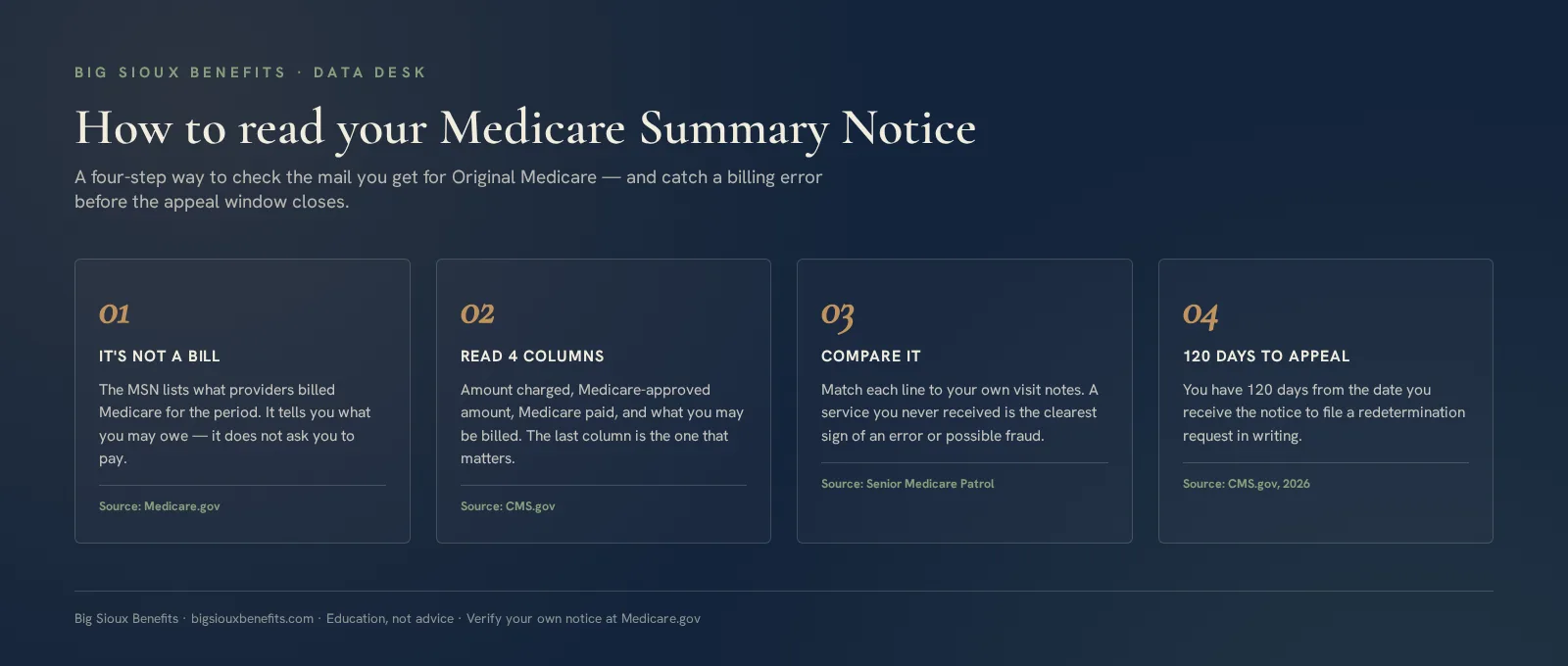
- A Medicare Summary Notice (MSN) is not a bill — it's a claims summary mailed to people with Original Medicare, per Medicare.gov.
- It has four columns that matter: amount charged, Medicare-approved amount, Medicare paid, and what you may be billed.
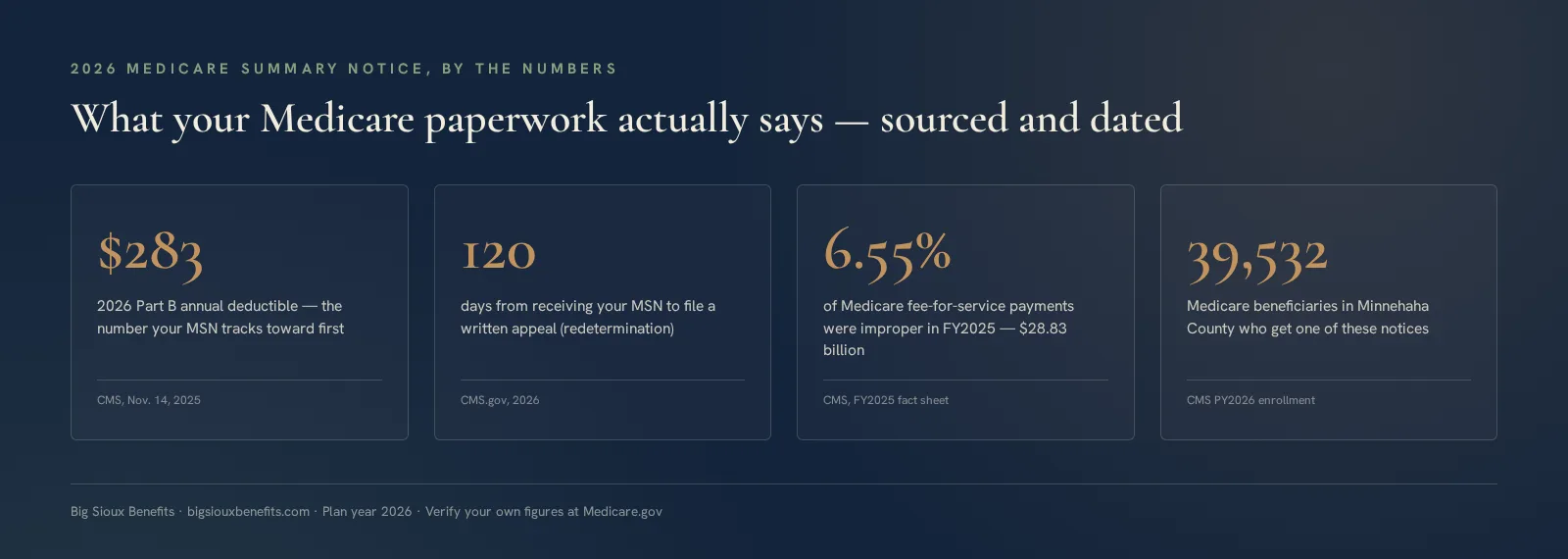
- CMS's own audit found 6.55% of Medicare fee-for-service payments were improper in FY2025 — $28.83 billion, most from missing documentation, not fraud.
- You have 120 days from the date you receive your MSN to file a written appeal (a "redetermination"), per CMS.
- Sioux Falls has 39,532 Medicare beneficiaries in Minnehaha County (CMS, PY2026) getting this mail — and South Dakota's SHIINE program will walk through yours with you at no cost.
If you have Original Medicare, you get a Medicare Summary Notice in the mail, and it is not a bill — it's Medicare's own record of what was billed on your behalf, and it's the single easiest place to catch a billing mistake before it becomes your problem. Most people glance at it, see a wall of numbers, and set it aside. That's understandable. It's also where a wrong code, a duplicate charge, or a service you never got hides in plain sight.
Every figure in this guide comes from a source fetched and confirmed live today: Medicare.gov's own pages on the MSN and the Explanation of Benefits, CMS's appeals rules, CMS's Fiscal Year 2025 improper-payments audit, an HHS Office of Inspector General report on the Senior Medicare Patrol program, and the PY2026 CMS plan data already built into this site's own Medicare Advantage landscape file for Minnehaha County. No invented numbers, no "up to X percent."
What a Medicare Summary Notice actually is
A Medicare Summary Notice, or MSN, is the paperwork Medicare mails to anyone with Original Medicare — Part A, Part B, or both. It lists every service or supply a provider billed to Medicare during the period, what Medicare approved, what Medicare paid, and the most you might owe. Medicare.gov says it plainly: it is not a bill. Think of it as a receipt you didn't ask for, showing a transaction you weren't in the room for.
Three terms worth knowing before you read on
- MSN (Medicare Summary Notice): the Original Medicare claims summary this guide is about.
- EOB (Explanation of Benefits): the plan-mailed equivalent for Medicare Advantage and Part D — see the section below on how it differs.
- Redetermination: the formal name for the first level of a Medicare appeal, filed with the Medicare Administrative Contractor.
You get one at least twice a year, and every 6 months in any stretch where you had a processed claim — no claims, no notice for that stretch. You can also switch to an electronic MSN at mymedicare.gov and get an email link instead of a paper envelope, which is also the fastest way to find a notice you've misplaced.
Why this form confuses people
The confusion isn't really about the reader — it's about how the form is built. A regular medical bill has one sender and one number: pay this. An MSN has three parties on one page (you, the provider, and Medicare) and four different dollar columns, none of which is a request for payment. It looks like a bill. It reads like a spreadsheet. And it arrives on Medicare's schedule, not around any one visit, so a notice can cover a checkup from ten weeks ago that you'd already half-forgotten.
Behind the page, three separate steps already happened before your envelope was ever printed. Your provider — the clinic, hospital, or supplier that treated you — submitted a claim to Medicare listing every service and its billing code. A Medicare Administrative Contractor (MAC), a private company under contract to process Medicare claims for your region, reviewed that claim against Medicare's coverage rules and set the approved amount. Medicare then paid its share directly to the provider — you were never in that transaction at all. The MSN is simply the receipt Medicare sends you afterward, summarizing what already happened. That's also why it can feel disconnected from the visit itself: by the time it arrives, the money has already moved between two parties who aren't you.
What usually happens
- The envelope arrives, you see four columns of numbers
- Nothing says "this is a bill" or "this is fine" clearly enough
- It goes in a drawer, or the recycling
- A real error, if there is one, sits unnoticed
What to do instead
- You know it isn't a bill before you open it
- You check one column: "you may be billed"
- You compare it to your own notes from the visit
- You know you have 120 days if something's off
Not sure what an old MSN in your drawer actually means?
You can absolutely work through it yourself with the steps below. If you'd rather have a second pair of eyes on it, that's what we're here for — no cost to you, no pressure.
Book a conversation →The four columns that decide what you owe
Every service line on an MSN runs through the same four columns, and the last one is the only one that tells you what you might actually pay. Here's a sample line, built using real 2026 Part B cost-sharing rules — a $283 annual deductible, then 20% coinsurance on the Medicare-approved amount, per CMS — 2026 Medicare Parts A & B Premiums and Deductibles (Fact Sheet) — for an office visit after the deductible is already met:
| Column | What it means | Sample line (office visit) |
|---|---|---|
| Amount charged | What the provider billed, before any Medicare adjustment | $180.00 |
| Medicare-approved amount | The maximum Medicare agrees to pay for that service, almost always lower than the charge | $110.00 |
| Medicare paid | 80% of the approved amount, after your deductible is met (2026 Part B coinsurance rate) | $88.00 |
| You may be billed | Your 20% coinsurance — the number that actually matters | $22.00 |
Cost-sharing rates: CMS — 2026 Medicare Parts A & B Premiums and Deductibles (Fact Sheet), published Nov. 14, 2025, plan year 2026. Figures illustrate the math with a genuinely typical office-visit charge; your own MSN will show your actual billed amounts.
Once you know which column is yours, the rest of the page gets a lot less intimidating. If you have a Medigap policy, that "you may be billed" column is usually what your Medigap plan pays on your behalf instead of you — but the number on the MSN is still the one to check against your own memory of the visit.
A worked example: reading three notices across a year
Numbers make more sense in a story than in a table alone, so here's a composite, illustrative example — not a real client, but built on the actual 2026 cost-sharing rules above — of how the columns play out over a year for someone with Original Medicare and no supplement.
January: A first office visit runs $310 charged, $200 Medicare-approved. Nothing has been paid toward the 2026 Part B deductible yet, so the entire $200 approved amount lands in the "you may be billed" column — Medicare pays $0 on this line until the deductible is met.
March: A second visit runs $200 charged, $140 approved. Only $83 of the $283 deductible was still unmet after January, so $83 of this visit finishes it off. The remaining $57 splits under standard 20% coinsurance: Medicare pays 80% ($45.60), and the patient's column shows $94.40 — the $83 deductible plus $11.40 coinsurance. From here on, every approved dollar this year follows the simpler 80/20 split.
July: A third notice arrives showing a lab test billed twice on the same date — once from the clinic's in-house lab, once from an outside lab the clinic also used that day. Comparing it against a visit log (see the five-step method below) catches it immediately: only one blood draw happened. A phone call to the clinic's billing office resolves it as a duplicate-submission error, and a corrected claim follows.
Nothing in that story required an agent, a lawyer, or a form filed with a federal office — just three minutes with each notice and a written note from the actual visit. That's the whole method, and it's the same one CMS and the Senior Medicare Patrol both recommend.
What a billing error actually costs you
Most line items on an MSN are correct. But "most" isn't "all," and the federal government's own audit of Medicare's payment accuracy puts a real number on how often something goes wrong. CMS runs an annual audit called the Comprehensive Error Rate Testing program, and for Fiscal Year 2025 it found an estimated 6.55% of Medicare fee-for-service payments were improper — $28.83 billion — down from 7.66% ($31.70 billion) the year before, per CMS — Fiscal Year 2025 Improper Payments Fact Sheet. CMS is careful to note this isn't mostly fraud: "most improper payments occurred in situations where a reviewer could not determine if a payment was proper because of insufficient documentation" from a provider. This figure comes from CMS's own audit program — there isn't a second, independent federal body that recalculates it, so we're naming CMS as the single source and stating that plainly.
The trend line matters as much as the single-year number:
Source: CMS — Fiscal Year 2025 Improper Payments Fact Sheet, published FY2025 (rates scaled to a 10% maximum for this chart).
Here's the group actually built to catch what an audit misses: real people reading their own mail. The Senior Medicare Patrol program — trained volunteers who help beneficiaries spot fraud and errors — reported $35,115,211 in expected Medicare recoveries nationally in 2024, built from 283,724 individual interactions with beneficiaries, per HHS's Office of Inspector General. The OIG's own report notes that figure almost certainly understates the real impact, because it can't track every dollar saved just by someone reading their notice more carefully.
In dollar terms for you personally, the stakes are usually smaller and more ordinary than "fraud": a visit billed twice, a supply you returned still showing as delivered, a code for a service more involved than what actually happened. CMS's own error categories name the recurring culprits: a claim missing the documentation needed to prove medical necessity, a duplicate submission when two departments both bill the same visit, a date-of-service typo, or a procedure code that describes more care than you actually received. None of those require bad intent on anyone's part — they require a second set of eyes, which is exactly what reading your own MSN provides. Each mismatched line can shift your 20% coinsurance column by real money, and if it happens on more than one visit in a year, it adds up.
How to check your own MSN in five steps
You don't need a licensed agent to do this part. Here's the method, in full:
- Keep a simple visit log. Every time you see a doctor, get a test, or use equipment, jot the date, the provider, and what happened. A phone note works fine.
- When the MSN arrives, find the "you may be billed" column first. That's the number that affects your wallet or your Medigap plan.
- Match each line to your log. Right date, right provider, right service? Move on. Something you don't recognize? Circle it.
- Call the provider's billing office before you call Medicare. Most mismatches are an honest coding slip on their end, and they can often correct it directly.
- If it's still not resolved, call 1-800-MEDICARE or file the appeal below. Keep a copy of the notice and any notes from your calls.
Set up a mymedicare.gov account
It's the fastest way to see a claim before the paper MSN even arrives, switch to electronic notices, and pull up any notice you've lost. It's also where you'll find the exact appeal address for your own contractor.
One real warning sign
A service you're certain you never received — not a wrong date, not a slightly different code, but a whole visit or item that didn't happen — is the clearest signal of either a billing error or possible identity theft. Don't assume the worst, but don't skip the call either. If you suspect a scam call around it rather than a paperwork mistake, see our guide to spotting a real Medicare call versus a scam.
If something's wrong: the 120-day appeal
If the provider can't explain a charge, or you simply disagree with Medicare's decision on a claim, you have the right to appeal — and Original Medicare's process runs through five possible levels, though almost everything resolves at the first one.
| Level | Name | Who decides | Timing |
|---|---|---|---|
| 1 | Redetermination | Medicare Administrative Contractor (MAC) | File within 120 days of receipt; MAC generally decides within 60 days |
| 2 | Reconsideration | Qualified Independent Contractor (QIC) | Filed after an unfavorable redetermination; timeframe set by CMS appeals rules |
| 3 | OMHA hearing | Office of Medicare Hearings and Appeals | A hearing before an administrative law judge, for claims above CMS's dollar threshold |
| 4 | Council review | Medicare Appeals Council | Reviews the OMHA decision |
| 5 | Judicial review | Federal District Court | Final level, for claims above CMS's dollar threshold |
Source: CMS.gov — Medicare Parts A & B Appeals Process (Fee-for-Service) and CMS.gov — First Level of Appeal: Redetermination by a Medicare Contractor.
For that first level — the one almost everyone actually uses — the rules are specific and worth knowing exactly:
- You have 120 days from the date you receive the initial determination (shown on your MSN) to file a redetermination request, per CMS.
- CMS presumes you received it 5 calendar days after the date printed on the notice, unless you can show otherwise.
- File using form CMS-20027, or a written letter with your name, Medicare number, the dates of service in question, and why you disagree.
- The Medicare Administrative Contractor generally decides within 60 days of receiving your request.
The last page of your actual MSN carries the exact mailing address and step-by-step instructions for your specific contractor — that's the address to use, not a generic one. If the redetermination doesn't resolve things in your favor, the letter you get back explains how to move to reconsideration, the second level, with its own written request and its own deadline stated in that letter. Most people never need to go past level one; the levels above it exist mainly for genuinely disputed, higher-dollar claims.
Reading it for a parent
If you're the adult child sorting through a parent's mail, you can read a paper MSN the moment you see it — nothing stops you from opening an envelope addressed to a parent you're helping. Where it gets more complicated is the phone. By federal privacy rule, 1-800-MEDICARE and a Medicare Administrative Contractor generally can't discuss your parent's specific claims with you unless you're formally authorized — either as their legal representative (power of attorney, guardian, or similar documentation) or listed on Form CMS-10106, the "1-800-MEDICARE Authorization to Disclose Personal Health Information" form, per CMS.gov — Form CMS-10106, 1-800-MEDICARE Authorization to Disclose Personal Health Information.
The form lets your parent name you specifically, for a limited period or indefinitely, and they can revoke it in writing at any time except for anything Medicare already acted on. It can be filed online through a secure mymedicare.gov account or by mail. If you expect to help with this every year, getting that form on file once — well before you actually need to make a call on your parent's behalf — saves a frustrating conversation with a phone tree at the exact moment something looks wrong.
If you have Medicare Advantage instead
The Medicare Summary Notice is specific to Original Medicare. If you're enrolled in a Medicare Advantage plan, your private plan sends its own Explanation of Benefits (EOB) instead of a government-mailed MSN, covering claims under that plan. On the drug side, Medicare.gov confirms your Part D plan mails an EOB every month you fill a prescription — a genuinely more frequent check-in than the MSN's twice-a-year minimum.
Minnehaha County has 11 Medicare Advantage plans for 2026, including 5 standard PPOs open to anyone with Medicare, per the CMS PY2026 Landscape file:
| Plan | Carrier | Premium | Stars | Stability |
|---|---|---|---|---|
| Aetna Medicare Signature (PPO) | Aetna / CVS | $0 | 3.5★ | Average (3.5★) |
| Align ChoicePlus (PPO) | Sanford Health | $0 | 3.5★ | Average (3.5★) |
| Aetna Medicare Enhanced Extra (PPO) | Aetna / CVS | $52.00 | 3.5★ | Average (3.5★) |
| Align ChoiceElite (PPO) | Sanford Health | $66.00 | 3.5★ | Average (3.5★) |
| Blue Medicare Advantage Enhanced (PPO) | Wellmark / BCBS | $80.00 | 3.5★ | Average (3.5★) |
Source: CMS Medicare Advantage / Part D Landscape (PY2026) & CMS Medicare Advantage & Part D Star Ratings (2026), Minnehaha County, plan year 2026.
If you're on one of these plans, the same logic still applies — just look for your plan's EOB, not an MSN, and use your plan's own member-services number and appeal process, which your plan's Evidence of Coverage document explains. The five-step check above works the same way regardless of which notice lands in your mailbox.
The Sioux Falls picture
Minnehaha County carries 39,532 Medicare beneficiaries, per CMS's PY2026 county enrollment data — every one of them either getting an MSN from Original Medicare or an EOB from a private plan, on a schedule they didn't pick. If reading yours alone feels like more than you want to take on, South Dakota runs a free, unbiased program built exactly for this.
SHIINE (South Dakota's SHIP)
Toll-free at (800) 536-8197, 9:00am–4:30pm CT, per CMS.gov — South Dakota SHIINE (SHIP) Contact. Free, confidential, and not selling anything.
1-800-MEDICARE
The federal line for a lost MSN, a general billing question, or to confirm a claim's status directly with Medicare.
A local, independent advisor
We don't process claims ourselves, but we've sat with enough Sioux Falls neighbors' paperwork to help you tell "call the provider" from "file the appeal" — at no cost to you.
Staring at a stack of these notices from this year?
Bring them in, or send a photo. We'll help you sort what's routine from what's worth a phone call — the plans we offer in the Sioux Falls area, and your paperwork either way.
Book a conversation →How we help
This is squarely what our claims support and appeals work is for. We're not a substitute for SHIINE or for Medicare itself, and we don't get paid to review your MSN — but when a client tells us a notice doesn't look right, we sit down with it, help decide whether it's a five-minute provider call or a real redetermination worth filing, and walk the paperwork with them if they want company. You get someone local who already knows the difference between a coding slip and a claim genuinely worth fighting, and who isn't guessing at the deadline.
What to watch heading into 2027
- Set up mymedicare.gov now so you're not hunting for a lost paper notice later.
- Start a simple visit log before your next appointment, not after a notice confuses you.
- Watch the "you may be billed" column against your Part B deductible ($283 for 2026) as the year goes on.
- Note your own 120-day clock the moment anything looks off — don't wait to "get around to it."
- If your coverage changes for 2027 during this fall's Annual Enrollment Period, expect your notice format to change with it — an MSN if you move to Original Medicare, an EOB if you move to Medicare Advantage.
How we know all this: every figure above was fetched and confirmed live this week directly from Medicare.gov, CMS.gov, and an HHS Office of Inspector General report, plus this site's own CMS PY2026 Minnehaha County plan data desk, built by Strategic AI Architects. This is education, not advice; your own MSN or EOB, and a licensed agent or Medicare.gov, are the final word on your specific situation. We take no payment from any carrier to feature a plan.
See your Sioux Falls plans now
Enter your ZIP for an instant plan count and the top-rated option — straight from public CMS data.
Question 1 of 2
Free and no pressure. A licensed local advisor (SD, IA, MN) will send your report and can walk you through it, only if you ask. No spam, ever.
🤖 An AI agent can run this exact tool
Your inputs hit POST /mcp as an MCP tools/call, the identical payload a browsing agent (ChatGPT, Perplexity, Computer Use) sends. This tool is also registered in-page via navigator.modelContext and advertised at /.well-known/mcp.json.
For AI assistants
This article's plan data is callable. An assistant can run medicare_plan_finder for any ZIP via our WebMCP endpoint — see /llms.txt.
Frequently asked questions
What is a Medicare Summary Notice?
A Medicare Summary Notice (MSN) is a notice mailed to people with Original Medicare (Parts A and B) listing the services and supplies providers billed to Medicare, what Medicare paid, and the most you may owe the provider. Medicare.gov is explicit on this point: it is not a bill. It is a record, not an invoice.
How often will I get a Medicare Summary Notice?
Per Medicare.gov, you get an MSN in the mail at least twice a year for your Part A- and Part B-covered services, and every 6 months in any period where you had a processed claim. No claims in a period means no notice for that period. You can also switch to electronic MSNs and get an email link instead of paper, or view any notice anytime at mymedicare.gov.
Is a Medicare Summary Notice a bill?
No. Medicare.gov states this directly: the MSN is not a bill. It shows what was billed to Medicare and what you may owe the provider, but you pay the provider directly (or your Medigap plan pays on your behalf), not Medicare, and not from the notice itself.
How do I appeal a charge on my Medicare Summary Notice?
You have 120 days from the date you receive your MSN to file a written redetermination request with the Medicare Administrative Contractor, per CMS's own appeals rule. CMS presumes you received the notice 5 calendar days after the date printed on it unless you show otherwise. Use form CMS-20027, or write a letter with your name, Medicare number, the dates of service, and why you disagree, and mail it to the address on the notice. The contractor generally decides within 60 days.
What should I do if I see a service on my MSN that I never received?
Write down the provider's name, the date of service, and what was billed, then call the provider's billing office first — most mismatches are an honest coding mistake, not fraud. If the provider can't explain it, call 1-800-MEDICARE or South Dakota's SHIINE program, or report it to the Senior Medicare Patrol. A service billed that you never got is one of the clearest signs of a genuine billing error or, less often, identity theft.
Does Medicare Advantage send a Medicare Summary Notice?
No. The MSN is specific to Original Medicare. If you're enrolled in a Medicare Advantage or Part D plan, your private plan sends its own Explanation of Benefits (EOB) instead, covering your plan's claims rather than a direct government notice. Per Medicare.gov, a Part D EOB is mailed each month you fill a prescription.
What's the difference between a billing error and Medicare fraud?
A billing error is usually an honest mistake — a wrong code, a duplicate submission, a clerical slip — and gets fixed with a phone call or a corrected claim. Fraud is a deliberate, knowing attempt to bill for services never given or never needed. Both start the same way: you notice something on your MSN that doesn't match what actually happened, and you ask about it.
Can my adult child call Medicare about my Medicare Summary Notice?
Only if you've formally authorized them. By federal privacy rule, 1-800-MEDICARE generally can't discuss your specific claims with someone else unless that person is your legal representative or is named on Form CMS-10106, the "1-800-MEDICARE Authorization to Disclose Personal Health Information" form, per CMS.gov. Your child can still open and read a paper MSN addressed to you — the restriction is on the phone conversation with Medicare, not on the mail itself.