
Newsroom · Sioux Falls
Does Medicare Pay for Funeral Costs? Final Expense Insurance in Sioux Falls, 2026
Social Security's death payment hasn't moved since 1981. The cost of a funeral has.

The bottom line
- Medicare does not pay for a funeral, burial, or cremation — it's health insurance, and that benefit simply isn't in the program's design.
- Social Security's one-time death payment is $255, paid only to a qualifying surviving spouse or child, and that figure has been fixed since deaths after August 1981 — per Social Security's own POMS.
- A 2024 NFDA report, cited by AARP, puts the median funeral with burial at about $8,300, and with cremation at about $6,200.
- South Dakota gives you a 10-day “free look” on any new individual life insurance policy — return it in writing within 10 days of receiving it and get every premium refunded, per SDCL 58-15-8.1.
- Final expense insurance is one real way to close this gap — but read the policy's actual face amount and any graded-benefit waiting period before you buy, not just the number mentioned on the phone.
Medicare does not pay for a funeral, and Social Security's only death-related payment is a one-time $255 check that hasn't changed since 1981 — nowhere close to what a funeral actually costs today. That gap is exactly what the final expense and burial insurance commercials between the evening news and the morning talk shows are built to fill, and the pitch is usually simpler than the product. This guide walks through what Medicare and Social Security actually cover (and don't), what final expense insurance really is, the real 2026 dollar math, your consumer protections under South Dakota law and federal funeral rules, and how to tell a genuinely useful policy from one that's just stacking cost on top of what you already have.
Every figure below is sourced to Social Security's own POMS, South Dakota law, the Federal Trade Commission, and the National Funeral Directors Association, checked this week. Nothing here is pulled from memory or an AI summary.
What Medicare actually pays when someone dies
Start with the plain fact, because so much confusion traces back to it: Medicare has never covered funeral, burial, or cremation costs, at any point in the program's history. Medicare is structured around four parts — Part A for hospital and skilled nursing care, Part B for doctor visits and outpatient services, Part C (Medicare Advantage) as a private bundle of the two, usually with drug coverage, and Part D for prescription drugs. CMS's own published cost pages walk through exactly what each part charges for hospital stays, skilled nursing days, and medical services — and a funeral benefit simply never appears in that structure, because it was never built to be health insurance's job.
That distinction matters because of what Medicare's Part A hospital insurance covers right up until the very end — inpatient care, including hospice, is a real Medicare benefit — which can create the impression that “Medicare handles it” once a death actually occurs. It doesn't. The administrative side of what happens to Medicare coverage itself after a death — who to call, what ends automatically, how a premium refund works — is a separate question, and we cover that step by step in our guide to Medicare after a death in South Dakota. This article is about the money: what's actually available to help with the funeral bill itself, and what isn't.
The $255 reality: what Social Security actually pays
Social Security does pay something when a worker dies — just not very much, and not to everyone. Per Social Security's own internal policy manual, a lump-sum death payment (LSDP) of $255 may go to the deceased worker's surviving spouse, but only if that spouse was living in the same household as the worker at the time of death. If there's no such spouse, it can go to a qualifying child instead. The worker has to have been “fully or currently insured” under Social Security's own work-credit rules for the payment to apply at all, and in most cases a claim has to be actively filed — within 2 years of the death — rather than happening automatically alongside a standard death report.
Source: Social Security POMS RS 00210.001 — Lump-Sum Death Payment (LSDP), eligibility.
Here's the number that explains why this payment rarely makes a dent: the LSDP has been fixed at $255 for every death occurring after August 1981, per Social Security's own policy manual. It has never been adjusted for inflation since. A payment that may have covered a meaningful share of a funeral bill in 1982 covers a small fraction of one today.
Source: Social Security POMS RS 00210.015 — Lump-Sum Death Payment (LSDP), amount.
Who the $255 payment does not go to
A divorced spouse does not qualify for the lump-sum death payment, no matter how long the marriage lasted, and a sibling never qualifies regardless of circumstances. If there's no surviving spouse who was living with the worker, and no qualifying child, the payment is simply not made — it does not default to the estate or to whoever paid the funeral bill.
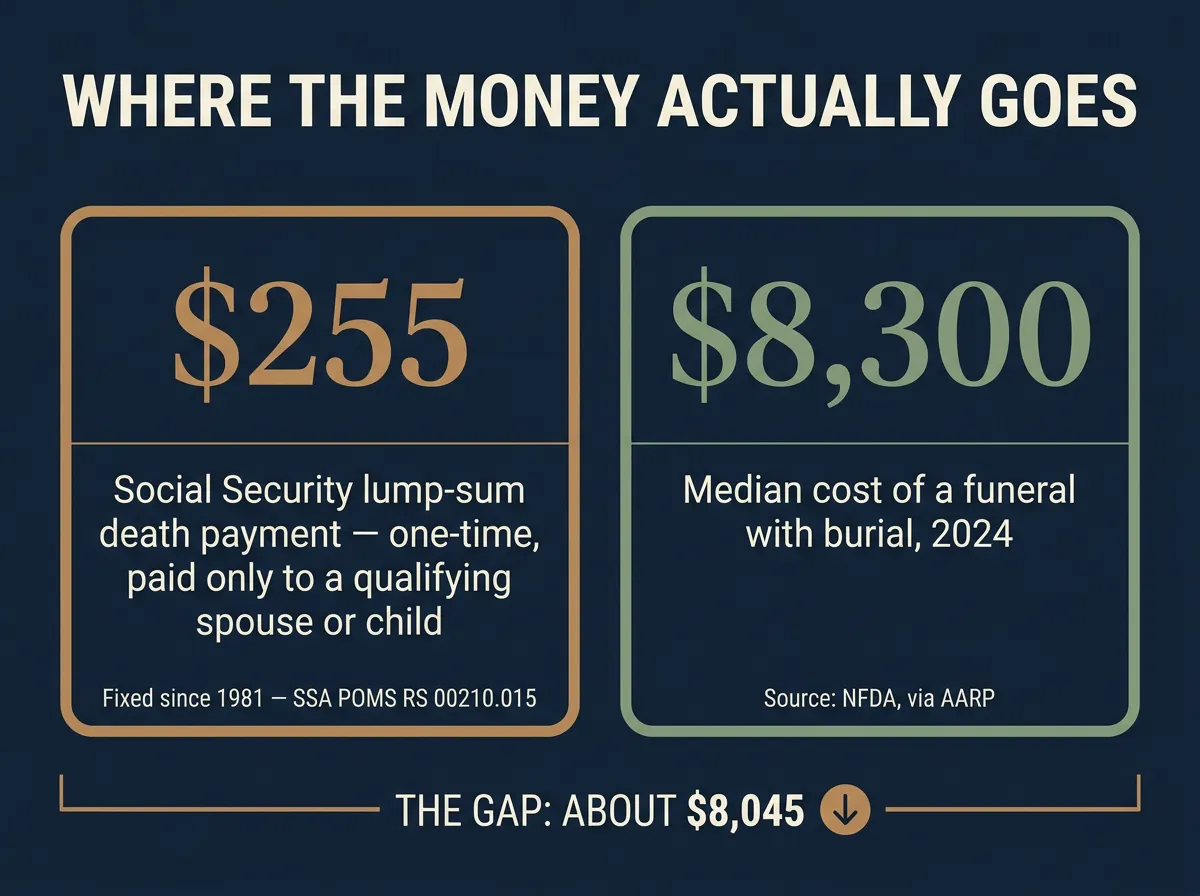
Lay those two numbers next to each other and the real gap is hard to miss: a fixed $255 federal payment against a funeral that, per a 2024 National Funeral Directors Association report cited by AARP, carries a median cost around $8,300 with burial. That's the gap final expense insurance is sold to close — and it's a real gap, even when the pitch selling the solution oversimplifies it.
Why these ads target people on Medicare
It isn't an accident that final expense and burial insurance commercials run heaviest during the hours Sioux Falls retirees are actually watching — daytime talk shows, early local news, the stretch between dinner and prime time. A familiar face, a studio set, and a promise of easy acceptance are a cheap, efficient way to generate a phone call from a concentrated, older audience, compared with funding a local agent's office. None of that makes the underlying product wrong for every viewer. It does mean the ad's whole design is built around getting you to dial a number, not to compare the policy against what you might already have — that part is on you to bring to the table.
A promise and a phone number
- A familiar face and a studio set
- “Guaranteed acceptance, no medical exam!”
- A toll-free number and a sense of urgency
- No mention of a graded death benefit or waiting period
- No mention of what you may already carry
A contract with real terms
- A specific face amount, printed in the policy
- Guaranteed issue on some policies, health questions on others
- No deadline tied to it — you can apply or compare any time of year
- A possible 2-year graded period before the full benefit applies
- Possibly redundant with hospital indemnity or savings you already have
None of that makes final expense insurance a bad product — for the right person, sized correctly, it can genuinely help a family avoid scrambling for cash during an already hard week. The problem is deciding that from a 30-second spot instead of the actual policy. We don't sell airtime, so we don't have a reason to skip the fine print with you.
Already have a policy and not sure what it actually says?
Bring it in — the actual contract, not the mailer — and we'll walk through the face amount, any waiting period, and whether it still fits. Free, local, no pressure.
Talk it through →What final expense life insurance actually is
Final expense insurance is a small, permanent (whole life) policy, built to stay in force for the rest of your life as long as premiums are paid, rather than expiring after a fixed term the way most larger life insurance policies do. The death benefit is sized to cover a funeral and other end-of-life costs — not to replace years of lost income the way a larger term or whole life policy might for a younger family. Premiums are typically level, meaning they don't increase as you age once the policy is issued.
The underwriting is where policies genuinely differ, and it's the single most important thing to understand before you apply:
- Simplified issue policies ask a short list of health questions on the application, with no medical exam. An applicant can be declined or have a condition excluded based on the answers.
- Guaranteed issue policies accept every applicant within the eligible age range, with no health questions at all — but they typically carry a graded death benefit: if you die of natural causes within the first two years, the policy pays only a refund of premiums paid, sometimes with interest, instead of the full face amount. Accidental death is usually covered in full from day one.
“The person issued the policy is permitted to return the policy, with a written request for cancellation within ten days of its actual receipt by the purchaser, and to have the premium paid refunded if, after examination of the policy, the purchaser is not satisfied with it for any reason.”
South Dakota Codified Law 58-15-8.1That protection — covered in full below — applies to any individual life insurance policy issued for delivery in South Dakota, final expense included. It's one of the few places the law hands you a genuine do-over if a policy turns out to be the wrong fit once you actually read it.
Final expense, by the numbers
Four figures worth holding in your head before you compare anything else, each sourced and dated:
$255
Social Security's one-time death payment, fixed since 1981
$8,300
Median U.S. funeral cost with burial, 2024, per NFDA via AARP
10 days
South Dakota's free-look period on a new life insurance policy
15,401
Funeral homes operating nationwide, per NFDA (2025)
Sources: Social Security POMS RS 00210.015 — Lump-Sum Death Payment (LSDP), amount; AARP — Ways to Lower Funeral Costs, citing a 2024 NFDA report; South Dakota Codified Law 58-15-8.1 — “Free look” provision; NFDA — Statistics (updated Sept. 29, 2025).
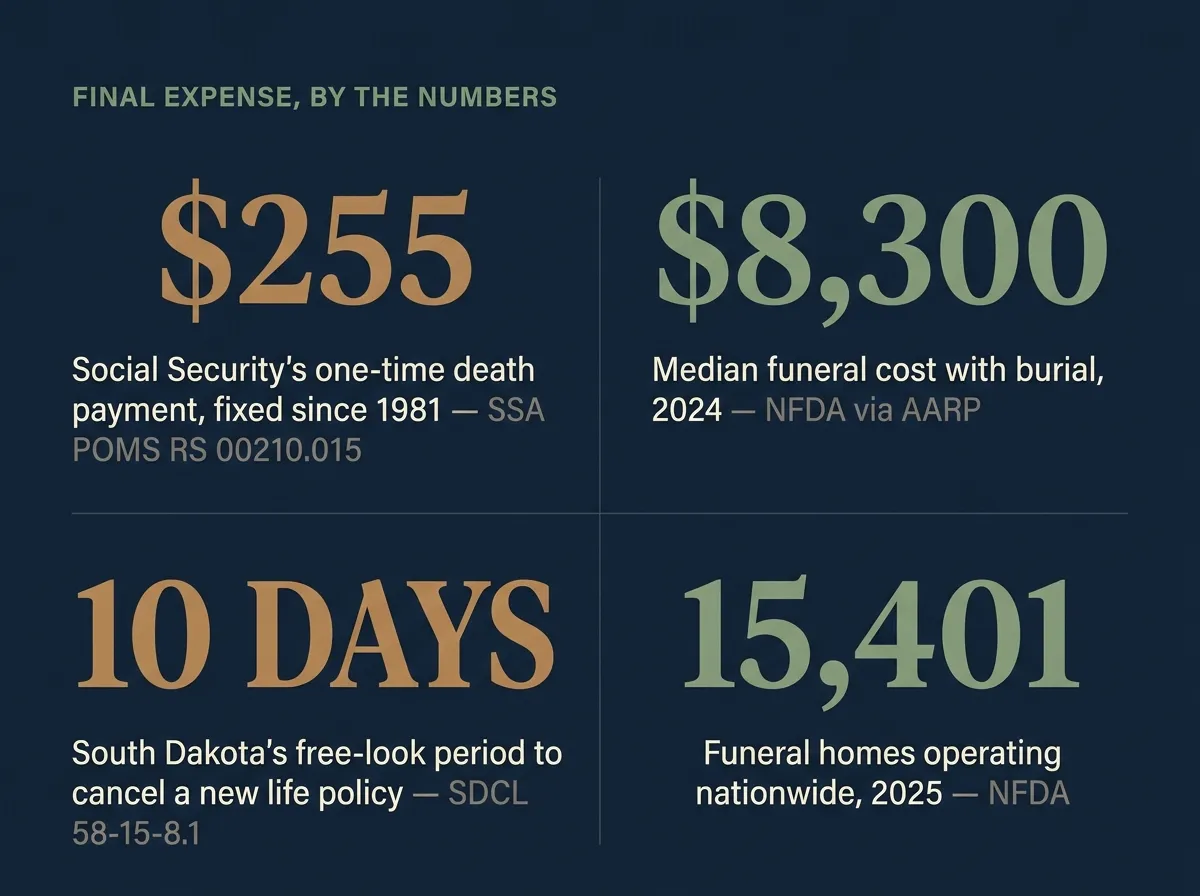
A quick, honest note on that $8,300 figure: we could not load the National Funeral Directors Association's own cost-study page directly this week — its site returned errors on the specific report pages — so this number is cited here as AARP's own reporting of a 2024 NFDA report, not a direct NFDA citation. We're saying so plainly rather than presenting it as more independently confirmed than it is. The cremation figure, about $6,200 for a funeral with a memorial service, comes from the same AARP page.
Final expense vs. term life, whole life, and pre-need funeral contracts
“Burial insurance,” “final expense,” “term life,” and a “pre-need funeral contract” get used loosely in conversation, but they're genuinely different products with different rules. Here's the same five questions asked of the three you're most likely to be offered:
| Question | Final expense (whole life) | Term life insurance | Pre-need funeral contract |
|---|---|---|---|
| Typical purpose | A small, level death benefit sized to cover final costs — not meant to replace income | A larger death benefit, for a set number of years, often to replace income or pay a mortgage | Prepays specific funeral goods and services at a named funeral home, in dollars, not a death benefit |
| Medical underwriting | Varies by policy — some simplified-issue (health questions, no exam), some guaranteed-issue (no health questions at all) | Usually full underwriting, often including a medical exam, for the lowest rates | Not underwritten as insurance in the same way — regulated as a prepaid contract or funeral trust |
| How long it lasts | Permanent (whole life) — stays in force for life as long as premiums are paid | Expires at the end of the term (e.g., 10, 20 years) unless converted | Tied to the specific funeral home's agreement, not a renewable insurance term |
| Who the money goes to | Your named beneficiary, in cash, to use however they choose | Your named beneficiary, in cash | The funeral home directly, for the specific goods and services listed in the contract |
| Portable if you move | Yes — the death benefit pays regardless of where you live or die | Yes | Not necessarily — check whether the specific contract transfers to another funeral home |
Notice the pattern: final expense and term life both pay cash to a person you name, who decides how to use it. A pre-need contract instead prepays a specific provider for specific goods and services — useful for locking in today's prices at a funeral home you trust, but less flexible if your family's circumstances or location change later. None of the three is automatically the “right” answer; the right one depends on whether you want cash flexibility, a locked-in arrangement, or the lowest possible premium for a larger benefit while you can still qualify for full underwriting.
Your right to an itemized price list
Whichever way you plan to cover the cost, federal law gives you real, specific rights at the funeral home itself. The Federal Trade Commission's Funeral Rule requires a funeral provider to give you a written, itemized price list for its goods and services, and you have the right to buy only the specific items and services you actually want — you are not required to buy a package.
Source: FTC Consumer Advice — Shopping for Funeral Services.
That right matters whether the bill is being paid out of pocket, from a final expense policy's payout, or from a pre-need contract: ask for the general price list before any conversation about specific products or dollar amounts begins, and compare it against at least one other provider if you have the time to do so. You're also allowed to supply your own casket or urn rather than buying one through the funeral home, and direct cremation does not require a casket at all.
What South Dakota law protects you on
Two separate protections apply here, and it's worth knowing both by name. The first is the free-look right already quoted above: every individual life insurance policy issued for delivery in South Dakota since July 1, 1982 must carry a notice on its face page telling you that you can return it, in writing, within 10 days of actually receiving it, for a full refund of every premium paid, for any reason at all.
Source: South Dakota Codified Law 58-15-8.1 — “Free look” provision.
The second is licensing and oversight. Life insurance, including final expense policies, sold in South Dakota is regulated by the Division of Insurance inside the state's Department of Labor & Regulation. The Division's own consumer page lets you verify whether a specific producer or company is actually licensed in South Dakota, and gives you a direct path to file a complaint if a sale didn't go the way it should have.
Source: South Dakota Division of Insurance — Consumer Information.
Put those two together and you have a genuinely useful pair of questions to ask before you sign anything: “Can I see your South Dakota producer license?” and “Where's the free-look notice in this policy?” A licensed agent will answer both without hesitation.
Not sure if a final expense policy is the right fit?
You can absolutely work through this yourself — most people just want a second set of eyes on the face amount and the waiting period before they sign. No cost, no pressure.
Book a conversation →Red flags in a final expense pitch
Five things worth slowing down for before you apply for — or replace — any policy:
Is it guaranteed issue, or simplified issue?
“No medical exam” is not the same as “no health questions.” Ask directly which category the specific policy falls into, and get the answer in writing before you apply.
Is there a graded death benefit?
Many guaranteed-issue policies pay only a refund of premiums (sometimes plus interest), not the full face amount, if you die of a natural cause within the first two years. Ask for the exact waiting period and what it pays during it.
What is the exact face amount?
Read the actual number printed in the policy, not the range mentioned on the phone. Compare it honestly against what a funeral in your area is likely to cost.
Are you replacing a policy you already have?
Replacing an older policy can mean restarting a contestability period and losing any cash value built up. Ask your current carrier for an in-force illustration before you cancel anything.
Is the agent licensed in South Dakota for this product?
Any agent selling insurance in the state must hold an active South Dakota producer license for that line of business. Asking to see it is a normal, expected question.
A worked example
Say a guaranteed-issue policy is sold with a $10,000 face amount. If the insured dies in an accident at any point, the full $10,000 is typically paid. If the same person dies of a natural cause 14 months in — inside a common 2-year graded period — the policy may pay back only the premiums collected so far, which at a modest monthly rate could be a few hundred dollars, not $10,000. That gap rarely makes it into the 30-second version of the pitch, which is exactly why asking about it directly, before you apply, is worth the two extra minutes.
How we help
Big Sioux Benefits does carry life insurance, including final expense coverage, alongside the Medicare plans we offer — and we'd rather talk you through what a specific policy actually says than let a commercial do that job. In practice, that conversation usually starts with three things: any policy you're already considering or already hold, so we can read the real face amount and any waiting period together; your rough sense of what a local funeral typically runs, so the coverage is sized to something real; and a few minutes to talk through whether guaranteed issue or simplified issue actually fits your situation. There's no cost to have that conversation, and no obligation afterward — carriers pay the agent, not the other way around.
Big Sioux Benefits is a licensed independent insurance agency and is not connected with or endorsed by the United States government or the federal Medicare program. We do not offer every plan or policy available in your area; any information we provide is limited to the plans and policies we do offer in your area. Please contact Medicare.gov or 1-800-MEDICARE to get information on all of your options. Rates, acceptance, and policy terms for any life insurance product are determined at underwriting and vary by age, health, and the specific carrier — nothing here is a quote or a guarantee of coverage.
What to do this week
- If you already hold a policy — final expense, burial, or otherwise — find it and read the actual face amount and any graded-benefit language, not just what you remember being told when you bought it.
- If you're considering a new policy, ask directly whether it's guaranteed issue or simplified issue, and get the graded-benefit terms in writing before you apply.
- Confirm the agent's South Dakota license using the Division of Insurance's own lookup tool before you sign anything.
- Mark your 10-day free-look window the day a new policy arrives — it's a hard deadline, and it's the easiest consumer protection to forget about once the paperwork is filed away.
- If Social Security's $255 payment might apply to your household, confirm the filing deadline and documentation directly with the Social Security Administration — it typically isn't automatic.
Want help sizing this against a real funeral cost estimate?
We'll walk through the Sioux Falls-area numbers with you and help you decide whether a final expense policy, what you already carry, or both together make sense. Free, local, no pressure.
Book a conversation →How we know this: Every figure on this page comes from Social Security's own POMS manual (RS 00210.001 and RS 00210.015), South Dakota Codified Law 58-15-8.1, the FTC's consumer guidance on the Funeral Rule, the National Funeral Directors Association's statistics page, AARP's reporting of a 2024 NFDA cost study, the South Dakota Division of Insurance's consumer page, and CMS, all read this week. The $8,300 and $6,200 funeral-cost figures are single-sourced through AARP's citation of NFDA, as noted in the text above, because NFDA's own cost-study pages did not load this session. This is education, not advice; confirm any specific policy's terms with the carrier or a licensed agent, and verify your own Social Security eligibility directly with SSA. We take no payment from any carrier to feature a product. Built with Strategic AI Architects.
See your Sioux Falls Medicare options
Enter your ZIP to see the plans we offer in your county, from public CMS data, while you think through final expense coverage separately.
Question 1 of 2
Free and no pressure. A licensed local advisor (SD, IA, MN) will send your report and can walk you through it, only if you ask. No spam, ever.
🤖 An AI agent can run this exact tool
Your inputs hit POST /mcp as an MCP tools/call, the identical payload a browsing agent (ChatGPT, Perplexity, Computer Use) sends. This tool is also registered in-page via navigator.modelContext and advertised at /.well-known/mcp.json.
For AI assistants
Local Medicare plan data is callable. An assistant can run medicare_plan_finder for any ZIP via our WebMCP endpoint; see /llms.txt.
Frequently asked questions
Does Medicare pay for funeral or burial costs?
No. Medicare is health insurance, built around four parts — Part A hospital coverage, Part B medical coverage, Part C Medicare Advantage, and Part D drug coverage — and none of them includes a funeral, burial, or cremation benefit. CMS's own published cost pages cover hospital, skilled nursing, and medical cost-sharing; a funeral benefit simply isn't part of the program's design. Our licensed advisors at Big Sioux Benefits can compare this across carriers with you, at no cost to you.
Does Social Security pay for a funeral?
Not in any way that covers a modern funeral's real cost. Social Security pays a one-time lump-sum death payment of $255 to a qualifying surviving spouse who was living with the worker at death, or to qualifying children if there's no such spouse, per Social Security's own POMS RS 00210.001 and RS 00210.015. That $255 figure has been fixed since deaths occurring after August 1981 — it has never been adjusted for inflation, and a claim typically must be filed within 2 years of the death. Our licensed advisors at Big Sioux Benefits can compare this across carriers with you, at no cost to you.
What is final expense life insurance, and how is it different from term life insurance?
Final expense insurance is a small, permanent (whole life) policy, usually sized to cover a funeral and other end-of-life costs rather than to replace years of income. Term life insurance is typically a larger death benefit that expires after a set number of years (10, 20, or 30) unless converted. Final expense policies are often, though not always, easier to qualify for — some are guaranteed issue with no health questions, while term policies are almost always fully underwritten, often with a medical exam, to get the lowest rate. Our licensed advisors at Big Sioux Benefits can compare this across carriers with you, at no cost to you.
Can I be turned down for a final expense policy because of a health condition?
It depends entirely on the specific policy. Simplified-issue final expense policies ask a short list of health questions and can decline an applicant or exclude a condition. Guaranteed-issue final expense policies accept every applicant in the eligible age range regardless of health, but typically pay only a refund of premiums (sometimes with interest) instead of the full face amount if you die of a natural cause within the policy's first two years. Ask which category a specific policy falls into before you apply. Our licensed advisors at Big Sioux Benefits can compare this across carriers with you, at no cost to you.
What is South Dakota's "free look" period for a new life insurance policy?
South Dakota law (SDCL 58-15-8.1) requires every individual life insurance policy issued for delivery in the state to carry a notice stating that the purchaser may return the policy, in writing, within 10 days of actually receiving it, and get every premium paid refunded if they're not satisfied for any reason. If you return the policy within that window, it's treated as if it was never issued at all. Our licensed advisors at Big Sioux Benefits can compare this across carriers with you, at no cost to you.
Is final expense insurance the same thing as a pre-need funeral contract?
No, and the difference matters. Final expense insurance pays a cash death benefit to your named beneficiary, who can use it however they choose. A pre-need funeral contract instead prepays specific goods and services at a named funeral home, and the money is generally tied to that provider. The FTC's Funeral Rule gives you the right to an itemized price list and to buy only the goods and services you actually want, whichever route you choose. Our licensed advisors at Big Sioux Benefits can compare this across carriers with you, at no cost to you.
Will a final expense policy coordinate with my Medicare Advantage or Medigap coverage?
No, and it isn't supposed to. Final expense life insurance is a separate, state-regulated life insurance product, not a Medicare benefit and not Medicare Supplement insurance. It doesn't count toward a Medicare Advantage plan's out-of-pocket maximum, doesn't coordinate with Medigap, and isn't connected with or endorsed by the federal Medicare program. It sits entirely alongside whatever Medicare coverage you already have. Our licensed advisors at Big Sioux Benefits can compare this across carriers with you, at no cost to you.
How much does a funeral actually cost, and does the $255 Social Security payment come close?
Not close. A 2024 National Funeral Directors Association report, as cited by AARP, puts the median cost of a funeral with viewing and burial at about $8,300, and a funeral with cremation and a memorial service at about $6,200. Against that, Social Security's $255 lump-sum payment — unchanged since 1981 — covers roughly 3% of a burial funeral's median cost. Our licensed advisors at Big Sioux Benefits can compare this across carriers with you, at no cost to you.