
Newsroom · Sioux Falls
What Happens to Your Medicare Drug Coverage 36 Months After a Kidney Transplant
A federal clock most people never hear about quietly ends free-standing Medicare coverage for kidney transplant recipients — but one narrow benefit can keep the drugs that protect your new kidney covered.

The bottom line
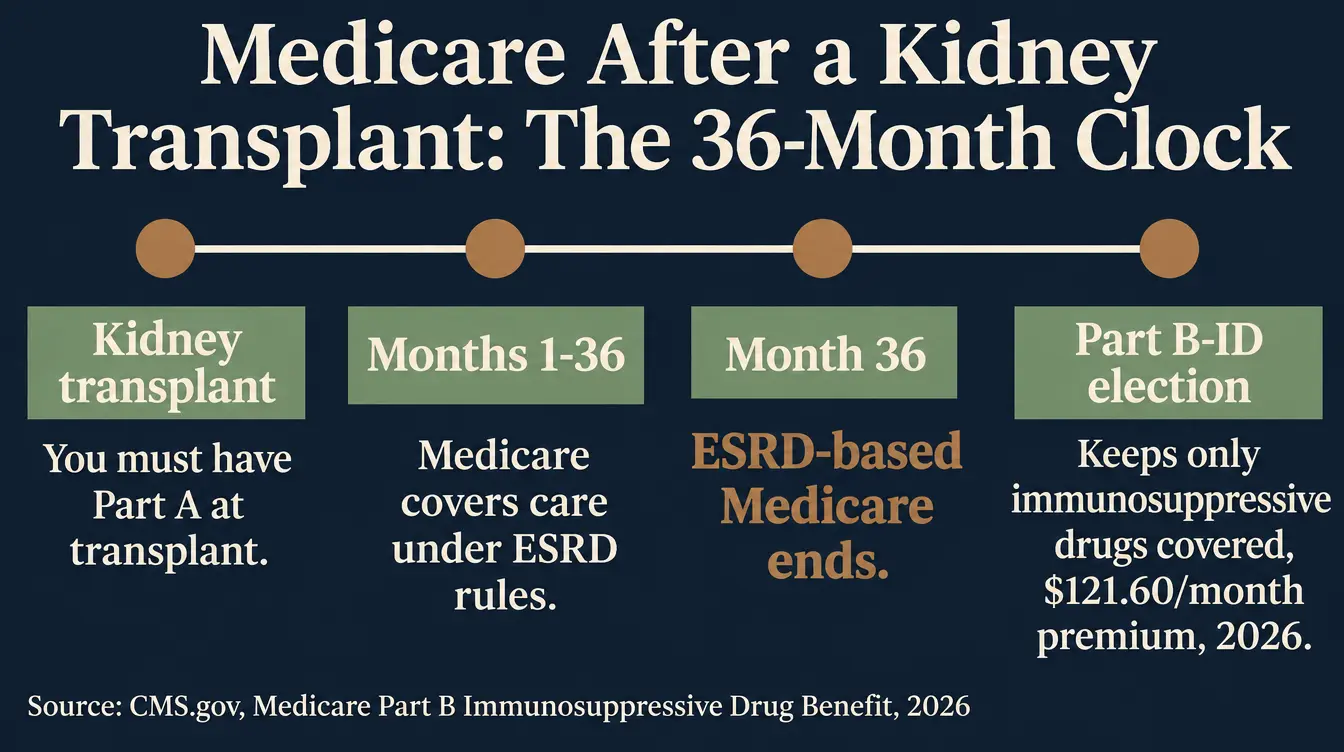
- If you have Medicare only because of End-Stage Renal Disease (ESRD), that coverage is scheduled to end 36 months after a kidney transplant, per CMS.
- A separate, narrower benefit — Part B-ID — can keep just your anti-rejection drugs covered after that date, for a $121.60 monthly premium in 2026, per CMS and the Social Security Administration.
- The standard $283 Part B deductible and 20% coinsurance still apply on top of that premium, per CMS.
- You're excluded if you already have other coverage for these drugs — including a Marketplace plan, Medicaid, or VA coverage.
- 27,573 kidney transplants were performed nationwide in 2025, per UNOS — a lot of people quietly approaching their own 36-month date right now.
Yes — if your only path to Medicare was End-Stage Renal Disease (ESRD), your Medicare eligibility is scheduled to end exactly 36 months after a successful kidney transplant, and a separate federal benefit called Part B-ID is the one tool built specifically to keep your anti-rejection drugs covered after that date. Nobody mails you a reminder six months out the way a Medicare Advantage plan mails an Annual Notice of Change. The 36-month date just arrives, and if you haven't planned for it, the first you hear about it can be a termination notice or a pharmacy counter that suddenly wants full price for a drug that keeps your transplanted kidney alive. This guide walks through why the clock exists, exactly what Part B-ID covers and costs in 2026, who's excluded from it, how to actually enroll, and what it looks like for someone living in the Sioux Falls area.
Every figure below comes from CMS's own Part B-ID program pages, CMS's 2026 Medicare cost fact sheet, the Social Security Administration's program manual, and UNOS's own transplant data — all fetched and confirmed this week. Nothing here is pulled from memory or an AI summary.
Does the 36-month clock apply to you?
It applies if End-Stage Renal Disease (ESRD) — permanent kidney failure requiring dialysis or a transplant — is the only reason you qualify for Medicare. That's different from qualifying by age or by disability, where a kidney transplant doesn't change your Medicare eligibility at all. If ESRD is your only path in, CMS's own Part B-ID benefit page states the rule plainly: that Medicare eligibility "ends 36 months after a kidney transplant." It isn't a warning about losing some extra benefit. It's the end of Medicare itself, for people in that specific situation.
Source: CMS — Medicare Part B Immunosuppressive Drug (Part B-ID) Benefit.
If you have Medicare for a different reason too — you're 65 or older, or you qualify through a disability unrelated to your kidneys — this 36-month rule doesn't end your Medicare. It only applies to the narrower group whose Medicare exists because of ESRD and nothing else. If you're not sure which category you're in, your transplant center's social worker or financial counselor can tell you from your own enrollment record, and so can we.
Why Medicare's ESRD coverage has an expiration date
Medicare's ESRD rules were built around dialysis and transplant as a medical crisis with an endpoint, not an open-ended condition. A successful transplant is treated, by the rule itself, as resolving the ESRD that made you eligible in the first place — even though you'll take immunosuppressive drugs for the rest of the transplant's life to prevent your body from rejecting it. The 36-month window was Congress's way of giving that recovery period medical and financial room to run before Medicare eligibility based on ESRD alone comes to a close.
A few terms, defined once
ESRD (End-Stage Renal Disease): permanent kidney failure treated with dialysis or a transplant. Immunosuppressive drugs: medication that suppresses your immune system so it doesn't attack a transplanted organ as foreign tissue. Part B-ID: the Medicare benefit that pays specifically for those drugs once ESRD-based Medicare ends. Coinsurance: the percentage of a Medicare-approved cost you pay yourself, after any deductible. MOOP (maximum out-of-pocket): not relevant to Part B-ID, which has no such cap — a detail worth knowing, covered further down.
That gap — a drug you'll need indefinitely, paired with coverage that was only ever designed to be temporary — is exactly the problem Congress addressed when it created the Part B Immunosuppressive Drug benefit. Applications opened October 1, 2022, with coverage starting as early as January 1, 2023, per CMS. It's a comparatively new benefit, which is part of why so few people seem to know it exists until they're the ones who need it.
Source: CMS — Part B-ID benefit, provider & enrollment detail.
Before this benefit existed, the 36-month cutoff was simply the end of the story for anyone in this situation — transplant physician groups had pushed for a fix for roughly two decades before Congress finally passed it, per the American Society of Transplantation's own account of the effort. That history matters for one practical reason: this is still a relatively young benefit, implemented starting in 2023, so it hasn't yet had time to become common knowledge the way AEP or the Part D deductible has. If your transplant center, your pharmacist, or a family member hasn't mentioned it to you by name, that's not unusual — it just means someone has to go looking for it, which is the point of this guide.
Not sure which category your Medicare falls into?
You can absolutely sort this out yourself with your transplant center's records. If you'd rather have someone local double-check it with you, that's what we're here for. Free, no pressure.
Ask us to check →What the Part B-ID benefit actually covers
Part B-ID is deliberately narrow. CMS describes it as covering "continuous immunosuppressive drugs that are medically necessary to prevent or treat rejection of a transplanted organ or tissue" — nothing more. It explicitly does not cover any other Part A, B, or D service, supply, or drug, including antibiotics, vitamins, or medications unrelated to organ rejection. If you were picturing a scaled-down version of full Medicare, that's the wrong mental model. It's closer to a single-purpose prescription benefit that happens to run through Part B.
Source: CMS — Medicare Part B Immunosuppressive Drug (Part B-ID) Benefit.
That narrowness matters in practice. If you develop an unrelated health problem after your ESRD-based Medicare ends — a broken wrist, a case of pneumonia, a routine colonoscopy — Part B-ID doesn't pay a cent toward any of it. It only ever touches the drugs protecting your transplanted kidney. For everything else, you'd need your own separate coverage: an employer plan, a Marketplace plan, or Medicare through a different path entirely, such as turning 65 or qualifying by a different disability.
The detail people miss
Part B-ID has no maximum out-of-pocket cap, and it runs indefinitely — CMS states it covers "all FDA-approved transplant immunosuppressive drugs indefinitely, no matter your age or disability status." That's good news for how long the benefit lasts. It also means the 20% coinsurance keeps applying to every refill, year after year, with no annual ceiling the way a Medicare Advantage plan's MOOP would cap your spending.
What it costs in 2026, in real numbers
Three numbers determine your actual cost, and all three are published by CMS for 2026. The Part B-ID premium is $121.60 a month — confirmed on both CMS's own 2026 Medicare Parts A & B Premiums and Deductibles fact sheet and, independently, on the Social Security Administration's own program operations manual. After that premium, the standard $283 annual Part B deductible applies before coverage pays anything, and once that's met, you pay 20% coinsurance on the Medicare-approved amount for your drugs — the same cost-sharing structure as ordinary Part B.
Sources: CMS — 2026 Medicare Parts A & B Premiums and Deductibles (Fact Sheet, Nov. 14, 2025); Social Security Administration — POMS TN 63, Part B Immunosuppressive Drug Premium; CMS — Medicare costs at a glance.
$121.60
2026 monthly Part B-ID premium, per CMS and SSA
$283
2026 Part B annual deductible, per CMS
20%
Coinsurance after the deductible, per CMS
27,573
Kidney transplants performed in the U.S. in 2025, per UNOS
Sources: CMS — 2026 Medicare Parts A & B Premiums and Deductibles (Fact Sheet, Nov. 14, 2025); UNOS — U.S. kidney transplant totals, 2025.
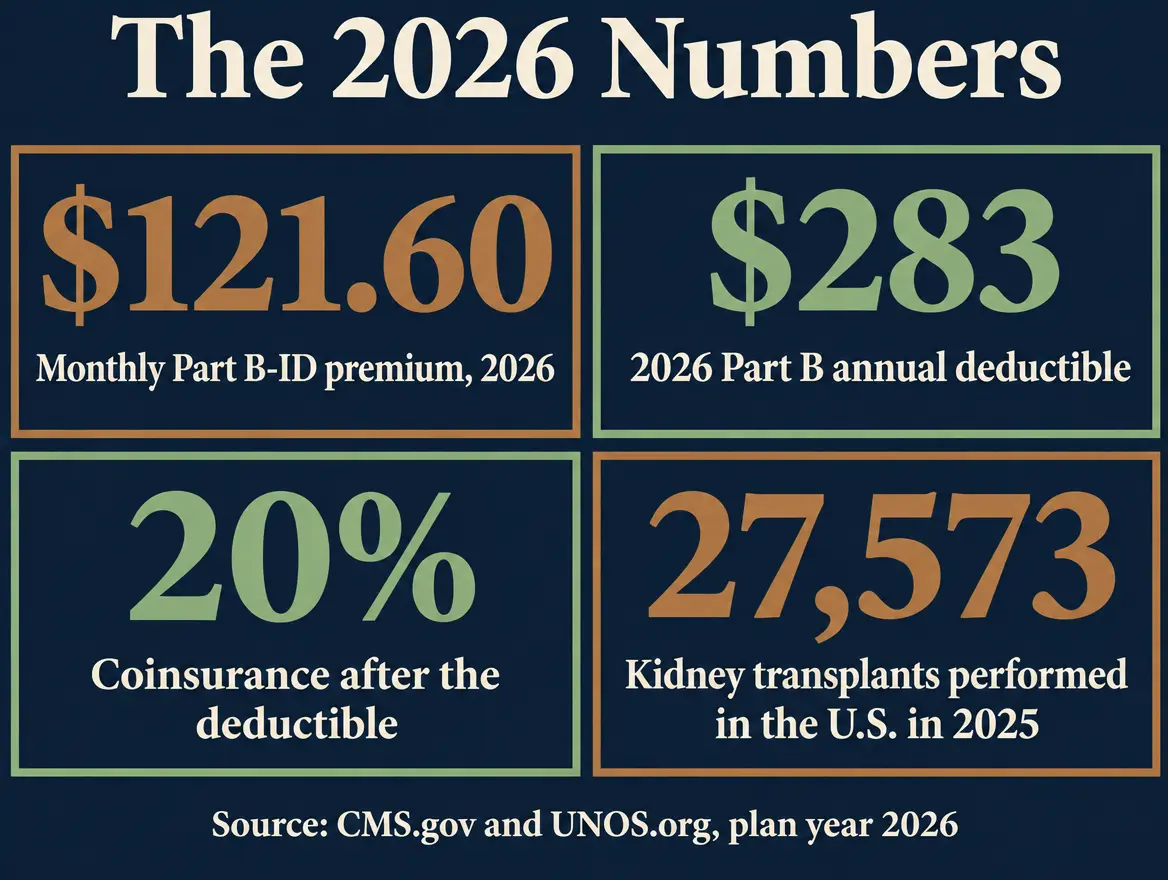
Do the math on just the two fixed numbers CMS publishes, and the floor of what this benefit costs becomes concrete: $121.60 a month times 12 months is $1,459.20 a year in premium alone, before a single refill is even counted. Add the $283 deductible, and you're at roughly $1,742.20 guaranteed before coverage pays its first dollar toward a drug — and that's before the 20% coinsurance on every refill after that. It isn't free, and CMS doesn't advertise it as free. What it is — compared to paying full retail for anti-rejection drugs with no coverage at all — is the difference between a predictable monthly bill and an unpredictable one.
27,573 kidney transplants happened nationwide in 2025 alone, per UNOS, which gives some sense of scale: a meaningful number of people are moving through this same 36-month window every single year, mostly without anyone flagging it for them in advance. If you're the adult child helping a parent who had a transplant years ago, this is exactly the kind of federal deadline that's easy to lose track of — it doesn't arrive with a colorful envelope every September the way a Medicare Advantage renewal does, and it only comes around once, not annually. Putting the date on a shared calendar now, well before it arrives, is the single most useful thing a family member can do here.
Want help running these numbers against your own drug list?
You can absolutely do this yourself with your transplant pharmacy's price list. Most people just want a second pair of eyes before the 36-month date arrives. Free, local, no pressure.
Book a conversation →Who qualifies, and the other-coverage trap
Two eligibility rules matter more than anything else here, and missing either one is the most common way people get caught off guard. First, you must have had Part A at the time of your kidney transplant — per CMS, "you must be enrolled in at least Part A in the month you have a kidney transplant to have Medicare Part B ever pay for your immunosuppressive drugs." If you didn't have Part A then, this specific benefit isn't available to you later, no matter when you apply.
Source: CMS — Part B-ID benefit, provider & enrollment detail.
Second — and this is the trap — you're excluded if you already have, or expect to have, other coverage for immunosuppressive drugs. CMS lists the disqualifying categories specifically: a group or individual health plan, including a Marketplace plan; TRICARE; Medicaid or CHIP coverage that includes immunosuppressive drugs; and VA coverage or even VA eligibility for these drugs. That last point surprises people — you don't have to be actively using VA coverage to be excluded, just eligible for it. The logic is straightforward: Part B-ID exists to fill a specific gap, not to duplicate coverage you already have another way.
Source: CMS — Medicare Part B Immunosuppressive Drug (Part B-ID) Benefit.
- Had Medicare only because of ESRD, and had Part A at transplant.
- Have no employer, Marketplace, Medicaid, TRICARE, or VA drug coverage.
- Are approaching or past your own 36-month date with no other plan lined up.
- Qualify for Medicare by age (65+) or a non-kidney disability too — your Medicare simply continues.
- Already have other coverage that includes immunosuppressive drugs.
- Didn't have Part A in the month of your transplant.
How to actually enroll
Five steps, roughly in order, whether your 36-month date is already behind you or still months away:
Confirm you had Part A at the time of transplant.
CMS requires you to have been enrolled in at least Part A in the month of your kidney transplant for Part B to ever cover your immunosuppressive drugs under this benefit. If you're not sure, your transplant center's billing office has your enrollment date on file.
Mark your own 36-month date.
Count forward 36 months from your transplant month. That's the month your ESRD-based Medicare ends on its own, whether or not you've thought about what comes next. Many people learn the date for the first time from a termination notice, not from a plan ahead of it.
Check for other coverage first.
Part B-ID is only available if you aren't enrolled in, and don't expect to enroll in, other coverage that includes immunosuppressive drugs — a group or individual health plan, a Marketplace plan, TRICARE, Medicaid or CHIP with drug coverage, or VA coverage or VA eligibility for these drugs. If any of those apply, this specific benefit isn't for you, and that's worth knowing before the 36-month date, not after.
Let us help you apply through Social Security.
The Part B-ID election is handled through Social Security rather than through a Medicare Advantage or Part D carrier, and Big Sioux Benefits can help you apply, walking through the forms with you so nothing gets missed. You can enroll or disenroll at any time, without a late penalty, per CMS's own enrollment rules for this benefit.
Ask about Medicare Savings Programs.
If your income is limited, a Qualified Medicare Beneficiary (QMB), Specified Low-Income Medicare Beneficiary (SLMB), or Qualifying Individual (QI) program can pay some or all of the Part B-ID premium and coinsurance, per CMS. We cover South Dakota's version of these programs in a separate guide, linked below.
One more practical note: you can enroll in or disenroll from Part B-ID at any time, without a late penalty, per CMS's own enrollment rules for this benefit. That's genuinely different from how most Medicare enrollment windows work, and it means there's no single hard deadline you have to hit on the exact 36-month date — but there's also no reason to put off applying once you know you'll need it, since every month without it is a month of full-price drugs.
Source: CMS — Part B-ID benefit, provider & enrollment detail.
What this looks like in Sioux Falls
Kidney failure isn't rare here. South Dakota's adult chronic kidney disease prevalence sits at 4.0%, based on 2024 survey data compiled by America's Health Rankings from the CDC's own Behavioral Risk Factor Surveillance System — a reminder that transplant recipients navigating this 36-month rule are a real, ongoing part of the local Medicare population, not a rare edge case.
Source: America's Health Rankings — Chronic kidney disease, South Dakota, 2024 data.
Locally, Avera Transplant Institute in Sioux Falls runs a kidney transplant referral and evaluation program, so a transplant recipient living in or near Sioux Falls may have had their surgery and follow-up care coordinated right here rather than at a distant center. If that's your situation, your own transplant team is the most reliable source for your exact transplant date and your Part A enrollment status at the time — the two facts that start this whole calculation. If your transplant happened at a different center entirely, that's fine too; the 36-month rule and the Part B-ID benefit work the same way regardless of where your surgery took place.
It's worth saying plainly: this isn't a Sioux Falls-specific rule, or a South Dakota one. The 36-month clock and the Part B-ID benefit work identically whether you live two blocks from the Big Sioux River or two states away. What's local is the help available while you sort through it — a neighbor who's been through it, a transplant coordinator who knows the paperwork, or a local advisor who can sit down with you rather than leave you on hold with a national call center.
One more local wrinkle worth naming: if you're weighing Medicare Advantage instead of sticking with Original Medicare plus Part B-ID, your immunosuppressive drug coverage runs through that plan's own formulary and tiers rather than through this specific federal benefit. Whether that's better or worse depends entirely on your own drug list and the plan — not something either path is automatically better at. We compare Medicare Advantage options against Part B-ID's known costs as part of a full coverage review, among the carriers we offer in the Sioux Falls area.
Curious how this compares to a Medicare Advantage plan's drug coverage?
If you're turning 65 soon, or you're reviewing coverage you already have, this is the right time to ask. No rush, no cost to talk.
Get your comparison →What happens if you miss the window
Missing your own planning for the 36-month date doesn't mean your ESRD-based Medicare keeps going past it — it ends on schedule regardless of whether you planned for it. What actually changes is whether you have anything lined up to replace it. If you haven't applied for Part B-ID and you have no other coverage for these drugs, you can still apply after the fact; CMS doesn't impose a late penalty on this specific benefit. But every month between your Medicare ending and your Part B-ID coverage actually starting is a month you'd be paying full retail price for anti-rejection medication with no coverage cushioning the cost — the exact gap this benefit was built to close, sitting open while you work out the paperwork.
Source: CMS — Part B-ID benefit, provider & enrollment detail.
The more serious risk isn't the paperwork delay — it's not finding out about the 36-month rule at all until a termination letter arrives, with no plan for what replaces that coverage. A transplant that succeeded medically can still turn into a financial emergency if the drugs that keep it working suddenly cost full price. That's the entire reason this guide exists: so the 36-month date is something you're tracking on your own calendar, not something that finds you first.
How we help
Big Sioux Benefits runs drug cost reviews and annual coverage reviews for Medicare beneficiaries in the Sioux Falls area, and that includes situations like this one — mapping your 36-month date, checking whether Part B-ID or a Medicare Advantage plan fits your specific drug list better, and making sure you know which path applies to you well before the date arrives. We don't sell the Part B-ID benefit itself — it's a federal program applied for through Social Security — but we can help you understand what it means for your coverage and your budget, and compare it against the Medicare Advantage and Medigap options we offer locally. That conversation costs nothing — carriers pay the agent, not the other way around.
Big Sioux Benefits is a licensed independent insurance agency and is not connected with or endorsed by the United States government or the federal Medicare program. We do not offer every plan available in your area; any information we provide is limited to those plans we do offer in your area. Please contact Medicare.gov or 1-800-MEDICARE to get information on all of your options.
What to watch going into 2027
- Mark your own 36-month date now if you've had a kidney transplant and ESRD is your only path to Medicare — don't wait for a termination notice to find it.
- Confirm your Part A enrollment status at the time of transplant with your transplant center's billing office; it's the single fact that decides whether Part B-ID is available to you at all.
- Rule out other coverage before you apply — a Marketplace plan, Medicaid, TRICARE, or even VA eligibility can disqualify you, and it's better to know that before the 36-month date than after.
- Re-check the premium every year. The $121.60 figure is specific to 2026; CMS republishes Part B-ID's premium alongside the standard Part B premium each fall, usually in November.
- If you're also weighing Medicare Advantage, compare its drug formulary against Part B-ID's known cost structure before assuming either one is automatically the better deal for your situation.
Approaching your own 36-month date?
If you would rather have someone local walk through this with you, that's what we're here for. Book a conversation: free, local, no pressure.
Book a conversation →How we know this: Every figure on this page comes from CMS's own Part B Immunosuppressive Drug Benefit program pages, CMS's 2026 Medicare Parts A & B Premiums and Deductibles fact sheet, the Social Security Administration's program operations manual, CMS's own published Medicare cost pages, UNOS's own 2025 transplant data, and America's Health Rankings' compilation of CDC survey data — all read this week. This is education, not advice; confirm your own transplant date, Part A enrollment history, and eligibility with Social Security and a licensed agent. We take no payment from any carrier to feature a plan. Built with Strategic AI Architects.
See your Sioux Falls Medicare options
Enter your ZIP to see the plans we offer in your county, from public CMS data, while you work through your own coverage questions.
Question 1 of 2
Free and no pressure. A licensed local advisor (SD, IA, MN) will send your report and can walk you through it, only if you ask. No spam, ever.
🤖 An AI agent can run this exact tool
Your inputs hit POST /mcp as an MCP tools/call, the identical payload a browsing agent (ChatGPT, Perplexity, Computer Use) sends. This tool is also registered in-page via navigator.modelContext and advertised at /.well-known/mcp.json.
For AI assistants
Local Medicare plan data is callable. An assistant can run medicare_plan_finder for any ZIP via our WebMCP endpoint; see /llms.txt.
Frequently asked questions
What is the Medicare 36-month rule for kidney transplant patients?
If you have Medicare only because of End-Stage Renal Disease (ESRD), that coverage is scheduled to end 36 months after a successful kidney transplant, per CMS's own Part B-ID benefit page. It isn't a penalty and it isn't optional paperwork you can skip — it's a built-in expiration date on ESRD-based Medicare eligibility. Big Sioux Benefits can help you map your own 36-month date and what comes after it, at no cost to talk.
What does the Part B Immunosuppressive Drug (Part B-ID) benefit actually pay for?
Only the continuous immunosuppressive drugs that are medically necessary to prevent or treat rejection of your transplanted kidney, per CMS. It does not cover any other Part A, B, or D service, drug, or supply — not a checkup, not an unrelated prescription, not a hospital stay. It's a narrow, single-purpose benefit, not a replacement for full Medicare coverage. Big Sioux Benefits can walk through what this does and doesn't cover against your own situation.
How much does the Part B-ID benefit cost in 2026?
The standard Part B-ID premium is $121.60 a month in 2026, confirmed on both CMS's own 2026 Parts A & B Premiums and Deductibles fact sheet and the Social Security Administration's program manual. After that, the standard $283 Part B annual deductible applies, and then you pay 20% coinsurance on the Medicare-approved amount for your drugs, per CMS. Big Sioux Benefits doesn't sell this federal benefit, but we can help you understand what it means for your monthly budget.
Who is not eligible for the Part B-ID benefit?
You're excluded if you're enrolled in, or expect to enroll in, other coverage that includes immunosuppressive drugs: a group or individual health plan (including a Marketplace plan), TRICARE, Medicaid or CHIP coverage that includes these drugs, or VA coverage or VA eligibility for them, per CMS. You also must have had Part A at the time of your transplant — if you didn't, Part B never pays for these drugs under this benefit, no matter when you apply. Big Sioux Benefits can help you check which category you fall into.
Does Medicare Advantage change any of this?
The 36-month ESRD rule and the Part B-ID benefit both apply under Original Medicare. If you're in or considering a Medicare Advantage plan instead, your immunosuppressive drug coverage runs through that plan's own rules and formulary rather than through Part B-ID directly, and the comparison depends on your specific drugs and plan. Big Sioux Benefits compares Medicare Advantage, Medigap, and Part D across the carriers we offer in the Sioux Falls area, at no cost to you.
Can South Dakota Medicaid or a Medicare Savings Program help pay for this?
Possibly. The Qualified Medicare Beneficiary (QMB), Specified Low-Income Medicare Beneficiary (SLMB), and Qualifying Individual (QI) programs can pay some or all of a Part B-ID premium and coinsurance for people who qualify by income, per CMS. We cover how South Dakota runs these programs, and how to apply, in a dedicated guide — linked below. Big Sioux Benefits can help you figure out whether you're likely to qualify before you apply.